
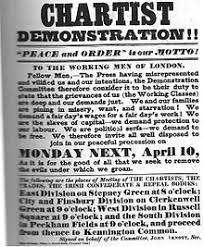
I have been engaged on (and more often distracted from) writing a review of Rob Sewell’s important new book on the history of Chartism- Chartist Revolution. The text below is not part of that review but some notes on the wider project of what a Chartist historiography might look like in 2024. Suffice to say the good news is that there are currently decent numbers working in this field
Defending the real legacy of Chartism
An Exceptionalism when it comes to the influence of Marxism here and in Europe
Practical involvement of Marx and Engels in movement
Bronterre O’Brien in 1848
John Saville on what kind of society Chartism would have built
Left & Chartist histories: Reg Groves, Andrew Rothstein
Ernest Jones, Harney & Marx & Engels
From around 1960 with the formation of the Society for the Study of Labour History, Chartism has been the subject of a considerable amount of historical research and publications.
While the movement lasted only from 1837 to around 1860 its scale and extent meant still means that there is a vast amount to research and a large amount of archival material to facilitate this. In recent times the weekly Chartist newspaper The Northern Star has been digitised and can be viewed and searched free on-line. Its closely packed pages in small print means that there is still a good deal to find out about Chartism. New research questions and issues can be posed and perhaps answered!
Academic studies have ranged across histories of the movement, that by the late Malcolm Chase reflecting the current state of the art, to specific subjects such as women and Chartism where the late Dorothy Thompson looked at the issues of sex and class in the movement.
The scope of studies of Chartism has increased and broadened since the 1960s and rightly questions of gender and ethnicity are central to this. Rob Sewell’s book is particularly good at placing the struggles of Irish democrats and socialists at the centre of the Chartist challenge in 1848. It doesn’t grapple quite so well with, for example, the role of black Chartists. To be fair this is an area which remains far too little researched.
However the trial of black Chartist William Cuffay is not discussed. The fact that Cuffay was the leader of London Chartism in 1848 and on the left of the movement warrants further thought.
The book does focus, and does well to do so, on some of the key moments of the Chartist challenge. The 1839 Newport Rising, the 1842 General Strike and events in the year of revolutions, 1848. In doing so it provides a very different picture of the British working class to the gradualist Labourist model that has appeared to dominate matters since the beginning of the twentieth century. It suggests that other possibilities and other roads could have been taken. A key issue there is why these were eventually not taken.
The problems of being first
Before 1889, the Chartist May Day in 1850
The Socialist Second International proclaimed the first May Day in 1889 and ever since then marches proclaiming socialism and internationalism have taken place around the world on May 1st.
The origins of May Day in Britain go back much further as a traditional festival marking the coming of Spring.
The first workers movement anywhere in the world, the Chartists while marking the traditional coming of Spring also on occasion prefigured the May Days of 1889 and after.
The Chartist Land Company had set up a series of land settlements- in effect small holdings in England- with people allocated to them by ballot. The idea was to opt out of industrial capitalism and return to the land. The Government refused to make the scheme legal and it had to be wound up.
One of the key Chartist Land Settlements was at O’Connorville on the outskirts of Rickmansworth. The Chartist dwellings still stand although these days they are luxury housing.
On 11th May 1850 the Chartist Northern Star paper published an account of the May Day celebrations that had taken place at O’Connorville on May 1st 1850
The O’Connorville band, improved in instrumentation and numbers made the day ‘echo with the sounds of joy’. In the afternoon the school room was filled with allottees, their wives and children ‘all beaming with ruddy health’. ‘Substantial justice’ was done to a tea of ‘old English fare’ after which there were speakers.
The first resolution praised the People’s Charter ‘may its speedy enactment emancipate the wealth producers’. Another resolution sent solidarity to ‘Louis Blanc, Kossuth, Mazzini and the democrats of all nations’
There followed merry dancing, songs and recitations that went on to the early hours.
There was a pub adjacent to the settlement, the Land of Liberty, Peace and Plenty, but alcohol was frowned upon


Leave a Reply