
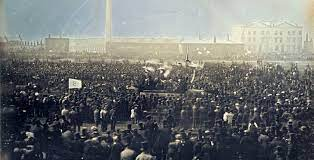
At Peterloo in Manchester on Monday 16th August 1819 60,000 protested peacefully for the vote. The local Magistrates decided the only way to deal with the protest was to send in troops on horseback (the Yeomanry) to disperse the crowd. At least sixteen were killed and hundreds injured.
The State learnt a lesson. While industrial disputes are sometimes violently attacked (see Orgreave 1984) protest marches are policed.
When the Chartists gathered on Kennington Common on Monday 10th April 1848, again to demand the vote, the Government feared revolution. 1848 was after all the year of revolutions in Europe. Police, Special Constables and Soldiers were mobilised on a large scale. The march was banned from crossing the river to Parliament. While there were skirmishes nothing more transpired.
In general the pattern has repeated itself for London protests, except the police now have enough numbers not to need Specials or the Army. Of course sometimes things go wrong. Police tactics on the 1990 Poll Tax march briefly led to rioting in Trafalgar Square. It was the exception.
The title for this post ‘the maintenance of order’ comes from David Goodway’s magisterial London Chartism (CUP) which looks in some detail at the Chartist demonstrations in London in 1848 and the response of the State to them. The book was written well before the weekly Chartist paper the Northern Star was digitised-making research a lot easier-so Goodway does not provide a comprehensive account. In fact that still remains to be written.
However as Goodway underlines on 10th April 1848 the State assumed violent intentions on behalf of the Chartists which did not in the main exist. Hence the forces of authority were massively over mobilised. The Government created its own panic and Queen Victoria was despatched to the Isle of Wight for the duration.
On Bloody Sunday 13th November 1887 30,000 marchers on unemployment and Irish Coercion were forcibly and violently prevented from gathering in Trafalgar Square by the police with the army on stand up
The same pattern, minus the Isle of Wight and the army, repeated itself in the anti-Vietnam War demonstrations in London in March and October 1968. Large numbers of police were mobilised on the pretext that the marchers would be violent. In reality what violence there was in Grosvenor Square at the March protest was caused largely by over zealous policing.
Since October 2023 there have been numerous marches in support of Palestine. Everyone has seen hundreds of thousands march. Despite attempts to ban them by the former Home Secretary Braverman and claims they are hate marches, in reality they have seen fewer arrests than at football matches and music events. Very few actual charges seem to have inspired.
The pattern of often very large and peaceful marches on Palestine, with increasingly restrictive police ‘conditions’, often simply made up, continued until 18th January 2025. The police banned a march planned to start at the BBC to focus on biased reporting of Gaza, and after eventually allowing a gathering in Whitehall then attacked and arrested protesters, include the march’s Chief Steward, who planned to lay flowers to mark the many dead children in Gaza, in Trafalgar Square.
The Government always has a reason (albeit rarely rationally based) for over reactive policing. Perhaps the continued focus on the current Governments (as the last) refusal to actually do much beyond words, to try and stop the genocide in Gaza was playing on the official mind.


Leave a Reply