
Tony Benn b 3rd April 1925. History Man
Tony Benn would have been 101 today. He died twelve years ago in 2014
His published Diaries remain an important historical resource. The eleven
published volumes represent a fraction of his total archive. It is to be hoped
that just as the papers of Mrs Thatcher are being deposited in an academic
archive and made available on-line by the Thatcher Foundation, so Benn’s
equally if not more important- not least for its longevity- documentation can
be made accessible to the public in its entirety.
Tony Benn was a rarity among modern politicians in that he also had a sense
of history and specifically labour and democratic history.
Media commentary after his death suggested that he did not have a grasp of
historical perspective when was a Labour Minister in the 1960s. Rather his
experience of power led him to reflect on lessons that might be learnt from a
study of the past.
Benn however was not an historian, and nor did he claim to be.
He did not spend his time researching matters in archives or wondering if a
study of history might throw up distinctly awkward questions for present
practice.
He did though understand the historical context he which he operated.
I’m grateful to Professor Owen Ashton, the Editor of the invaluable Merlin
Press Chartist Studies series, for reminding me how much Benn focused on the
Chartist movement.
Ashton has argued that Benn was in the tradition of dissenting ‘Gentleman
Leaders; who were radical ‘Friends of the People’. In the nineteenth century
one might look to figures like Henry Hunt who spoke at Peterloo, William
Cobbett and the great Chartist leader Feargus O’Connor who became MP for
Nottingham, as broadly comparable figures.
Benn himself saw the Chartists in the context of a broad democratic heritage
including the Peasants Revolt the English Revolution of the 1640s and the
Suffragettes of the early years of the twentieth century. It was an historical
list he often spoke about and recounted in a 1999 article for History Today
He became he a regular attender at the TUC’s Tolpuddle Festivals in July and
that was very much part of his awareness of labour history. He was also often to be
found at the Durham miner’s gala for the same reason.
He also spoke at a London Socialist Historians conference on the history of
the vote that we organised at the Institute of Historical Research
His Diaries contain several references to the Chartists. He wrote in 1981
about Paul Foot’s book Red Shelley and argued that Shelley’s influence on
Chartism and the working-class movement had been all but hidden.
More poignantly in his General Election defeat in Bristol in 1983, on
changed constituency boundaries, he nevertheless paid tribute in his after-poll
speech to the Chartists and the suffragettes, who had fought for the democracy
that had allowed him to stand.
Historians can argue that Benn’s understanding was too uncritical perhaps
even to a degree hagiographic. Yet that itself misses the times in which Benn
was active as a leader of the labour movement.
Relatively few other Labour MPs or Union leaders knew much if anything about
labour history and even fewer made any reference to it when they spoke in
public.
The importance of Tony Benn as an educator of the labour movement should not
be overlooked. When he spoke at large public meetings and rallies about the
Chartists or the Levellers he inspired numbers to go away and find out more
about who those people were, why and how they fought and what they did and did
not achieve.
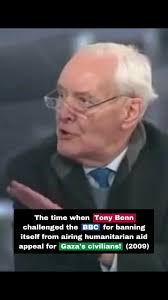
In terms of 2026 Benn who was originally a supporter of the foundation of Israel
came to grasp the impact this had on Palestinians and in later life became an
advocate for Gaza and for aid for those suffering at the hands of Israeli
forces
The inspiration of the life of Tony Benn remains with us in the present


Leave a comment