
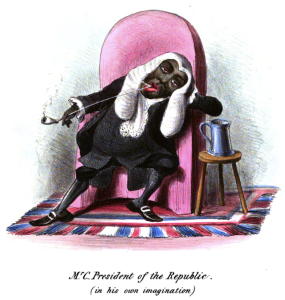
How the press saw William Cuffay, black organiser of the Chartist demonstration at Kennington on Monday 10th April 1848
This week marks the anniversary of the Chartist rally for the vote in 10th April 1848.
The organiser of that rally and indeed of London Chartism in the Year of Revolutions was William Cuffay, a black tailor.
Cuffay was not a political leader of Chartism nationally, although he may have played a key role in London, but he was certainly the person who was responsible for making things happen.
Ahead of 10th April the Chartist Assembly of 49 delegates meeting in London, concerned that the Government would try to prevent the Kennington rally, agreed to send a deputation to the Home Office to reassure the Home Secretary that nothing beyond peaceful protest was planned.
Cuffay alone voted against on the grounds that as the organiser he was determined that the rally went ahead whatever the Government’s view was
Then, as it would now, racism likely played a key part in how the media depicted Cuffay. The Times referred to the Chartists as ‘the black man and his party’
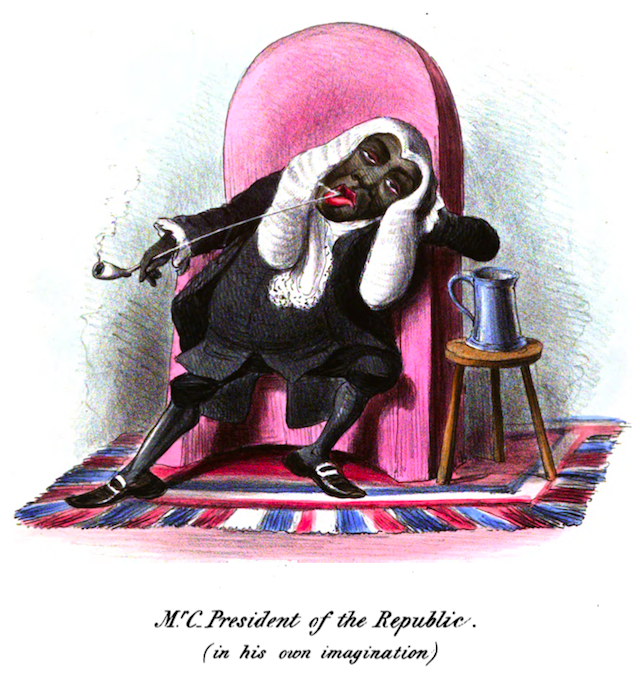
The caricature above is from Punch. The context is explained below:
In 1848 particularly Cuffay was lampooned in print, in newspapers like the Times, and the Observer, in magazines like Punch and the London Illustrated News. While he was in Newgate Gaol awaiting transportation Punch carried The Three Christmas Waits a lampooning poem by William Makepeace Thackeray. A book titled The Political Life of Cornelius Cuffey, Esq., Patriot, &c, &c., was on sale for half a guinea. It consisted of a poem that was lavishly illustrated with hand-coloured lithographed plates protected by tissue guards, and claimed to have been “Printed for Sale at the Bazaar in Aid of the Governesses’ Benevolent Institution”. This organisation was an invention of Punch in 1846.
While Cuffay was noticed by official society in 1848 he was after that promptly written out of history. It took Peter Fryer’s Staying Power (1984) on the history of black radicalism in Britain to bring his name back on to the historical record.


[…] How the press saw William Cuffay, black organiser of the Chartist demonstration at Kennington on Mon… […]
The Punch caricature seems to me to be no different from others it printed at the time, aside from the colour of the skin (which is explained by the colour of the skin of its target). That he was lampooned is also something he shared with a huge number of white political activists. Is the comment that race played a part based on evidence, or is it an assumption?
I’m reminded of the mural used to attack Jeremy Corbyn, in which bankers are shown at a table resting on the backs of the poor. This was claimed to be anti-Semitic – though the idea that the bankers were Jewish was purely in the minds of those complaining (so that the claim that the mural was anti-Semitic was the direct result of an anti-Semitic attitude: “here are ugly, grasping, fat, greedy bankers – they must be Jewish”).
(On B.B.C. radio yesterday I heard someone refer to “the racist language of the time”, and it turned out that what was meant was simply the use of “Negroes” to refer to black people – something that wasn’t in the least racist at the time (and, frankly, isn’t now).)
There’s so much real racism in the world (and in the past) that we don’t need to create it where it doesn’t exist.
The media referred to the Chartists as the ‘black man and his party’. Its not known pending further research how many London Chartists were black but given the number of sailors and ex-sailors in the Capital possibly numbers.
Again, though, there’s nothing (implicitly or explicitly) racist in simply referring to a person’s colour, especially in a milieu in which it’s unusual. It may be that they expected his colour to arouse prejudice in their readers, though that’s of course mere conjecture as it stands. At the very worst, it would be an extremely mild expression of racism – far outdone by the like of the Sun and the Mail in much more recent times.