
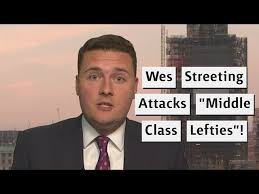
Wes Streeting has criticised ‘middle class lefties’ who he thinks are standing in the way of his efforts to privatise bits of the NHS should he get to be Health Secretary in the next Government. He might well find that the mostly not middle class UNISON and RCN are even more formidable opponents.
Streeting will only fit the definition of a ‘leftie’ if it’s one drawn up by Lee Anderson. However his £90K desk job as an MP marks him out as definitively middle class. Social being defines consciousness as any middle class lefty could tell him.
I’m not sure what Streeting studied at Cambridge, even after checking but it probably wasn’t history.
I did however consult Raymond Williams Keywords on the history of the term middle class. As might be expected it’s quite complicated. The modern usage dates from the earlier decades of the nineteenth century and developed in the decades after.
Before the 1832 Reform Act there are instances of references to the middling and lower orders as forming a broadly distinct grouping. That Act enfranchised some middle class male voters but left the working class without the vote.
The distinction began to arise between the lower or working classes and the upper classes. In between were the middle classes- quite small in numbers at this point.
By the 1880s there was a difference widely understood between workers who did manual work and got paid a wage and the middle class- also workers- who however attracted a salary and did desk jobs ranging from clerks to managers and professionals.
Williams did not touch on more modern developments (reasonably given the book was published in 1975. However certainly from the late 1960s there developed a trend for middle class workers to become unionised. The Robbins Report, by the 1964 Labour Government saw a significant extension of University education. It drew thousands more into higher education and created graduates who were able to use their degrees to advance in society. In short the kind of social mobility that Keir Starmer is promoting and which allowed Wes Streeting to go to University and become a student leader
The political hold that the Tory Party held over the middle class also began to crack, perhaps in some cases because the salaries the new graduates were paid did not lend themselves to a supposed middle class lifestyle.
From the formation of the Labour Party in 1900 middle class also had a specific political meaning. Two key figures were Sidney and Beatrice Webb. They founded the London School of Economics and were responsible for the first Labour Party Constitution in 1918. Sidney Webb was a member of the first 1924 Labour Government.
In political outlook they were Fabians. In a Communist Party Training Manual published in 1926 Tom Bell described the Fabian Society as a ‘middle class body with a petty bourgeois outlook’. So in fact not ‘lefty’ at all and something a right-wing Labour figure like Streeting could quite happily align themselves with.
As E P Thompson noted class is not a static category but determined in practice in relations between people and struggles coming out of that. This will certainly be the fact if Streeting does in fact between Health Minister in the next Government.
There is a wider point
Given that Labour is an electoral party seeking a broad base of support Streeting’s comments reflect a narrow factionalism which suggests a lack of genuine experience of life as it is actually lived on the shop floor and in the office.
This post originally appeared in the Morning Star

Press TAB five times to redirect to the Accessibility page.


Leave a Reply