
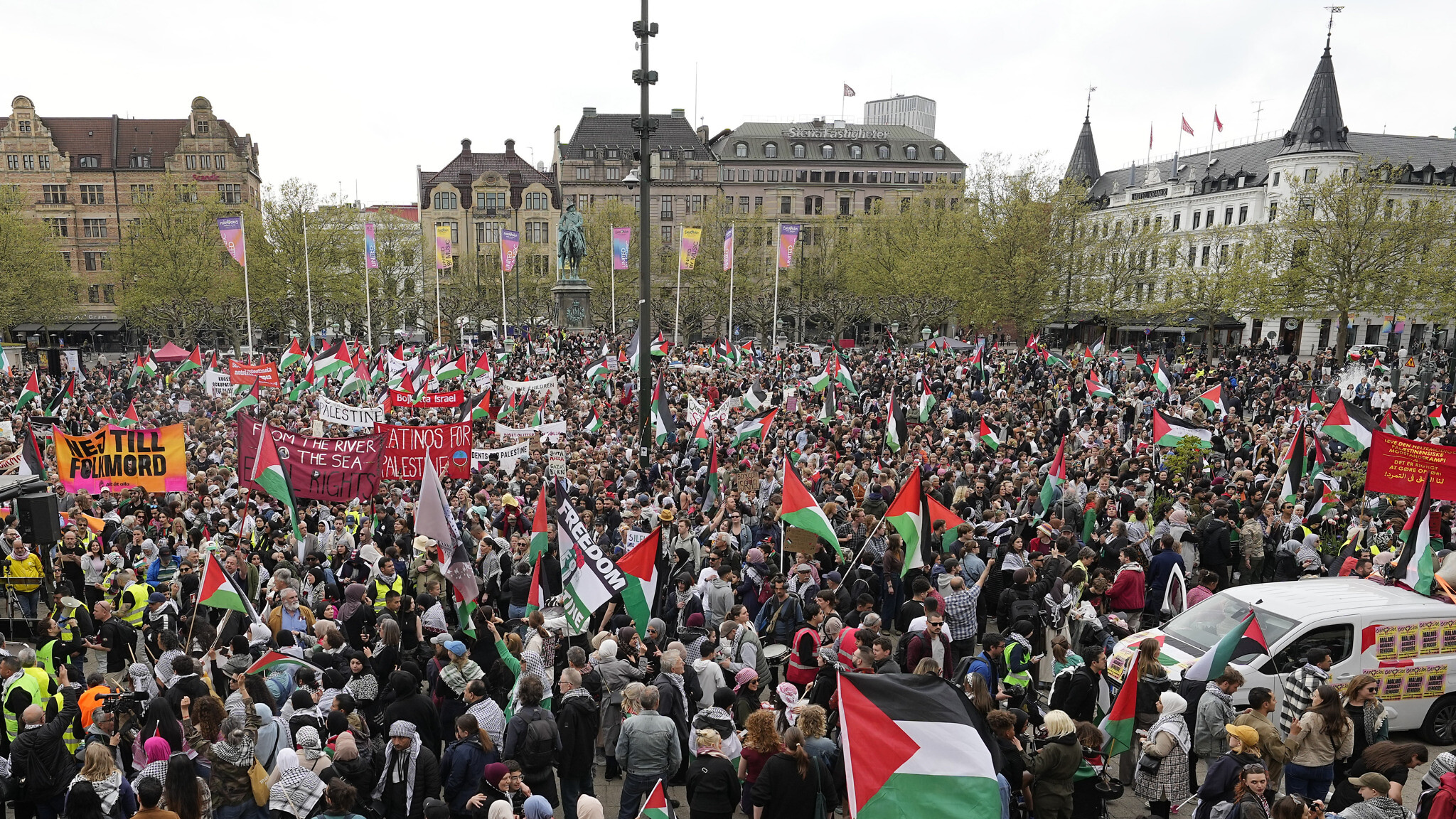
According to an Editorial in the Times (11th May) large peaceful protests about the participation of Israel in Eurovision held in Malmo this year were ‘mob intimidation’. The Times has form. It supports the right to protest but never actual protests and remains firmly on the side of Edmund Burke when it comes to describing protesters.
In reality the Malmo protests were peaceful if no doubt noisy. If we look nearer to home there was no London Gaza march this week (the next is on 18th May). But protests continued throughout the UK. I joined the regular Saturday march in Cardiff and noted large protests in Bristol and in Scotland. What was to be seen was not a mob but a crowd raising a protest about genocide.
The same is true for the growing number of student protest camps at Universities (and one outside Hackney Town Hall) supporting Gaza, and calling for divestment. Sunak’s attempt to get the protests stopped, which he could probably actually do by stopping arms sales to Israel, got nowhere like everything else he tries
Nesrine Malik has made the point in the Guardian. Protesters have one thing: their voices. Making them heard peacefully but forcefully is essential
There is also something about the projection of lurid intentions on to Palestinian solidarity and calls for self-determination that misreads the very nature of protest as something that needs to be measured and rational (in ways that are never quite specified) for it to be credible. But protest becomes necessary precisely because authorities have not been responsive. And it is defined by asymmetry of power and access to political tools. Politicians have executive power, and protesters have one thing: their voices. Protest movements are by their very nature performances of opposition and they often have this miraculously consistent quality – quickly expanding from political spaces to community ones, incorporating song, dance, poetry and protective fraternity among strangers.


Leave a Reply