
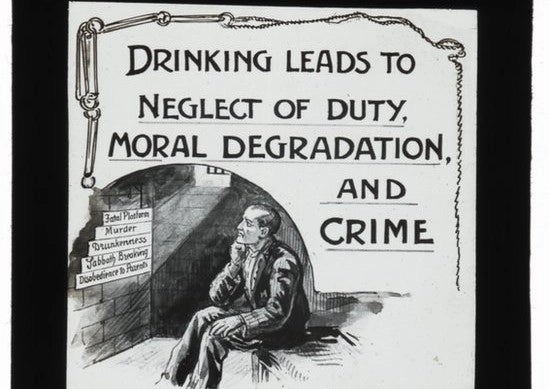
Temperance & the left. An historical discussion that should be revisited
The Guardian, which when it was the Manchester Guardian, was supporter of temperance as a progressive working-class demand, has a report on alcohol abuse leading its print edition (18th May) https://www.theguardian.com/society/article/2024/may/17/27bn-a-year-spent-in-england-on-harm-done-by-alcohol-study-finds
Alcohol abuse is a serious issue and should be taken seriously
Unfortunately the Guardian article is largely an exercise in temperance prejudices which is reflected in the Institute of Alcohol Studies connection. The IAS is the successor to the UK Temperance Alliance.
Very similar articles based on the at best highly doubtful statistics summarised by the IAS have now appeared in the Times and the Telegraph as well
My issue with this is not temperance as such but the dishonesty in which such views are cloaked these days. There are those who think drink is a bad thing and society would be better off if people didn’t drink. It was once a respectable and quite widely held view, including on the left and in the labour movement. It’s a pity that its modern supporters can’t be upfront on the matter.
I’ve always been clear that while fairly obviously I like a drink I have quite robust views on where and when it’s appropriate to drink. When I organise meetings I’m very strict about no drinking before or during the meeting. It causes disruptive behaviour. Unlike the pub which has rules and laws and a landlady or landlord, meetings don’t have such a helpful framework. Your only course of action is to throw a non-sober person out.
Some history on the relationship between temperance and the left is below. I do wish modern day temperance campaigners, many of whom do sit on the liberal-left, would own this and be upfront on matters. Then maybe we could have a genuine discussion on the role of drink in society the downsides and the upsides, instead of publishing rather odd pieces of ‘research’.
The relationship between radical and labour movements and drink was complex from the start.
Pubs were radical meeting places. One need only look at how protesters gathered at Peterloo on 16th August 1819 from all over the north-west, some stopping at ale houses on the way for refreshment (water not generally being safe to drink).
The 1830 Beer Houses Act allowed for the opening of a new layer of pubs that sold beer only (no spirits)and had a mainly working-class clientele.
The Chartist Movement certainly met in pubs but also contained those who regarded, rightly, drunkenness as the enemy of radical organisation. The Chartists had a principle of ‘exclusive dealing’ buying things only from those who backed the Six Points of the Charter for the vote. The August 1839 Grand National Holiday called for abstention from all excisable goods underlining the development of a temperance trend.
Temperance remained an important part of working-class and labour politics in the first decades of the twentieth century. Keir Hardie was a temperance supporter from the early days of the Independent Labour Party in the 1890s. He argued ‘that a man who can take a glass or let it alone is under moral obligation for the sake of the weaker brother who cannot do so, to let it alone.
By 1905 a Trade Union & Labour Official Temperance Fellowship had been formed and a majority of the Labour MPs elected in 1906 were abstainers. Philip Snowden, a leading figure in the first Labour Government in 1924 published Socialism and the Drink Question in 1908. There was a problem though. The Tories were the party of brewing, beer and pubs and working mens and socialist clubs sold drink not only because it was what their customers wanted but also because it provided the profit to allow them to continue.
Temperance has remained, in part, an honourable tradition rooted in dislike of giving money to (Tory) drinks manufacturers and a realisation that unsober people rarely get to change the world for the better.
We might also be reminded what the Labour MP Victor Grayson had to say about efforts to promote temperance in law in the House of Commons over a hundred years ago:
In October 1908 Grayson tried to adjourn a Licensing Debate in the Commons so the question of unemployment could be considered. The next day he underlined the point: ‘there are thousands of people dying in the streets while you are trifling with this Bill’.
Many of those who survive on Universal Credit may well think Grayson had a point. Whether they like a drink or not their focus is on keeping a roof over their heads and making sure they have enough money to eat.


I once heard that Yates’ Wine Lodges were set up by temperance folk in an attempt to wean the working classes off gin etc. Beer and wine were served. So temperance didn’t always mean abstinence.