
Class, History & Geography in the General Election
A footnote that the socialist historian E P Thompson made to his A Psessay in Ephology about the 1959 General Election, though over 60 years old, does seem to capture quite well the relation between the media, leaders debate and opinion polls currently:
A psephologist is a man employed by the mass media to research into what people think the mass media has told them to think. An ephologist is a man employed by the ‘Observer’ or BBC to interpret the results of psephology and who makes an ephing good thing out of it
As it turned out all the polls with the marginal exception of YouGov overestimated Labour support but not the scale of victory. This may reflect issues with Voter ID, a turnout of 60% (one of the lowest since 1885) and antipathy among sections of Labour voters over changed Labour and Gaza. Four indy candidates focused on Palestine won seats. Did the polls reflect that?
The headlines generated by such polls often come with brief if unexplained historical references.
For example the Tories won fewer seats than at any Election for over a hundred years. References to the 1832 Election have a certain historical niche (see below) but that was fought on a very restricted franchise
The Labour majority was one of the largest the Party has ever achieved. That was not matched by the 9.7m votes received well below what Jeremy Corbyn got in 2017 and 2019. Of course Labour targeted seats they needed to win as opposed to safe seats. There was little sign of Labour in my constituency of Tottenham, and Labour activists posted on X mostly about being anywhere else, as did the candidate. As a result David Lammy’s majority was cut by 20%
Starmer goes on constantly about his changed Labour Party but it is not a new approach. Very similar wording was used by Blair in 1997. By change of course he means that he has purged much of the left from Labour. Purging voters is more difficult.
Jeremy Corbyn with a genuine campaign got a deserved victory in Islington North, itself a rare achievement for an independent. But canvassing showed that on the doorstep people supported Corbyn but of course have always voted Labour. Explaining that this time he is an independent candidate was crucial.
That underlines that despite Starmer, voting Labour for many people and in many areas remains a class vote. At least since Labour lost the 1959 Election pundits have been trying to argue that such a thing no longer exists.
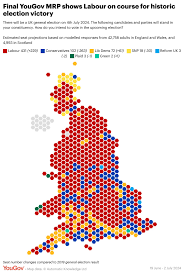
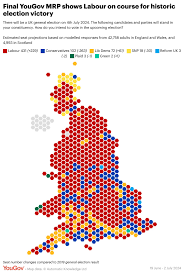
However if you look at the map closely associated with a pre-election YouGov poll it closely mirrors one that might have been found 60 years ago. Whatever Starmer’s changed Labour is about, the strongly working class areas of London, South Wales, the North-West and Tyneside are a sea of red just as they were in 1964.
The Tories ended up with 34 less than the 155 seats they won at the 1906 Election where they split over the issue of Free Trade. Perhaps more relevant but in a different way was that Election held after the 1832 Reform Act extended the franchise. The Tories lost and a complete rethink began. William Hulton the Magistrate who sent the Yeomanry in at Peterloo in 1819 was amongst those who began to organise grassroots Tory organisation.
Something similar might be expected for the Tories after July 4th combined perhaps with a further lurch to the right.
All this though represents a one-dimensional politics. The differences between Starmer and Sunak exist but are very much at a secondary level. Both back a capitalist market economy and a drive to war.
On that basis turn-out was low and the total share of the poll taken by Labour and the Tories was amongst lowest of recent times. There were many independent candidates standing some on socialist and Palestinian platforms. They could not rely on any media coverage but on organising locally and going door to door.
In the interests of wider democracy and socialist politics there were some decent votes and some victories . A landslide however does tend to sweep aside all. In this election matters were rather more complicated.
Not only were four independent MPs elected on broadly pro-Palestinian platforms but the Greens got 4 MPs. There is clearly interest from some sections of the left in the Greens. Having worked with them for many years in North London I’d suggest that like Labour they are party which has some socialists in it. Hopefully part of the solution…
An earlier version of this post appeared originally in the Morning Star


Leave a Reply