
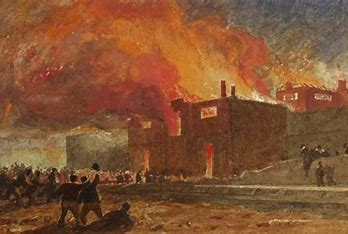
The Bristol Riots of 29-31 October 1831 are a well known event in British History, coming as they did in the run-up to the passage of the 1832 Reform Act. The Act began the extension of the Suffrage that so far has concluded in 1928 when both women and men got the vote.
The nature of the riot is disputed and in particular by E P Thompson in the Making of the Working Class(1963). Thompson agreed that the slogan of the rioters ‘King and Reform’ was not an obviously reactionary one. The King was believed to favour reform so it was not a reactionary ‘Church and King’ mob (also the traditional principles of the Tory Party).
Thompson argued that while the protesters had democratic sentiments the Bristol riots were not a ‘politically conscious revolutionary action’. Rather they exemplified the ‘persistence of older backward looking traditions of behaviour’. By contrast Peterloo in 1819 had exemplified the ’emergence of the self-disciplined patterns of the new working class movement’. He went on to argue that ‘Ignorance and Superstition had been jerked from loyalist into Radical courses; but we get a whiff of the Gordon and Priestley riots in the words of the Bristol rioter who threw an armful of manuscripts and books from the Cathedral Chapter Library into the fire declaring ‘there could be no reform without books were burnt’.
The line between the mob and the crowd was finely drawn and the former could on rare occasion transition into the latter as with the Gordon Riots. However the mob’s roots were reactionary, while the crowd’s were progressive and democratic.
One might note that in the riots of early August 2024 a mob in Liverpool partly destroyed a library. Perhaps some had legitimate grievances on housing, low pay and so on. However the progressive and democratic way of expressing that was to oppose the divisions racism causes as did Stand Up To Racism protests across England in the same period
The Thompsonian example of Bristol is illustrative and other views and perspectives exist, see perhaps particularly work by the Bristol Radical History Group
Keith Flett is the Editor of A History of Riots (CSP 2015)


Leave a Reply