
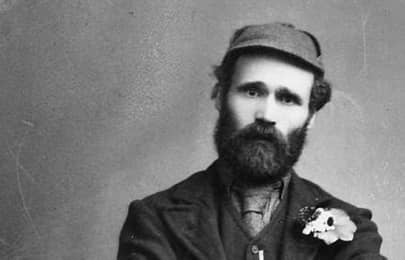
Keir Hardie took his Parliamentary seat for West Ham on August 3rd 1892. He had been elected as a labour candidate where the Liberals did not run but did not back him either.
His dress sense marked him out immediately
Upon taking his seat on 3 August 1892, Hardie refused to wear the “parliamentary uniform” of black frock coat, black silk top hat and starched wing collar that other working-class MPs wore. Instead, Hardie wore a plain tweed suit, a red tie and a deerstalker hat. Although the deerstalker was the correct and matching apparel for his suit, he was nevertheless lambasted in the press, and was accused of wearing a flat cap, headgear associated with the common working man; “cloth cap in Parliament” (Wiki)
While the deerstalker was of course not a proletarian flat cap the point was that it was definitely not a top hat. Hardie had a clear sense of dress by class.
Eric Hobsbawm (Worlds of Labour) argued that the flat cap started to become something that marked someone out as working class (men of course) in the 1880s and Hardie was part of shaping that change. Hobsbawm notes that by 1914 the cap was universally worn and points to the cartoon character of Andy Capp as reflecting this in later decades


Leave a Reply