
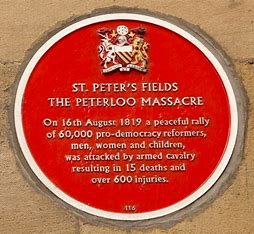
Its 207 years since the Peterloo Massacre, when 60,000 or so gathered in central Manchester to call for the vote and cheaper bread.
The Magistrates sent in the Yeomanry, the local business community on horseback who killed 16 people and injured many others.
Peterloo has a central role in E P Thompson’s Making of the English Working Class that appeared in 1963. However in a new left journal he jointly edited with John Saville, the New Reasoner, in the last years of the 1950s he reviewed a couple of books on Peterloo. He found neither satisfactory but it his assessment of the meaning of that Manchester Monday that is perhaps of most importance:
Strikers or agricultural labourers might be fair game; but never since Peterloo has authority dared to use equal violence on a peaceful British crowd. Even Bloody Sunday saw a violence which was care-fully controlled; the real thing has been reserved for Amritsar or Nicosia. The most dramatic incident of August 16th, in its bearing on the future, took place not on St. Peter’s Fields but some time later on the road leading out of Manchester. Samuel Bamford, after searching for his wife, turned homewards up the road along which hundreds were streaming in disarray to the upland districts. In Harpurhey he caught up with a great number of the Middleton and Rochdale contingent: I rejoined my comrades, and forming about a thousand of them into file, we set off to the sound of fife and drum, with our only banner waving, and in that form we re-entered the town of Middleton
The State violence on display at Peterloo was vicious but its also reflected a new development. A democratic and organised working class politics


Leave a comment