
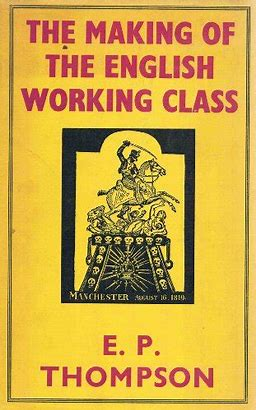
E P Thompson wrote the Making of the English Working Class over some years, while working as a Leeds University Adult Tutor in Yorkshire, researching in archives and helping to build the post-1956 new left.
How all this began to come together can be seen in this extract below. The ULR joined with the New Reasoner and became the New Left Review in 1960
E P Thompson, Universities & Left Review 6, 1959
First, working-class history is not the record of a coherent “way of life”; it has always been a way of struggle, between competing moralities. At any given point a whole complex of objective and active, subjective factors determine which morality is dominant. The objective factors are most obvious: in times of relative prosperity and social flexibility, when it is possible for individuals or groups to “better themselves,” the acquisitive ethic and the status-striving assert themselves. Conversely, in times of hard-ship, when it is most clear that the working class (or groups within it) can only defend themselves or advance by collective action, the communal ethic flowers and active, subjective factors determine which morality is dominant. This way of struggle, against class rule above, and between competing moralities within the working class, has never been a blind, spontaneous reflex to objective economic conditions. It has been a conscious struggle of ideas and values all the way. It has been possible for working-class organisations to hold fast to the vision of collective good, in the face of the acquisitive surge in times of prosperity. It has been possible for treacherous leadership (as at the time of the General Strike) to shatter that vision for a decade. And, the more closely we study it, the more we are forced to a recognition of the role of the politically active minority. In times of brutalisation and degradation, working people have asserted their humanity only by revolt against these conditions; and the most conscious, morally-engaged form of revolt has been in political organisation. For 150 years the political minority has been the carrier of the aspirations of the majority; it has been the point at which the diffuse ideal of community has come to effective expression.


Leave a Reply