
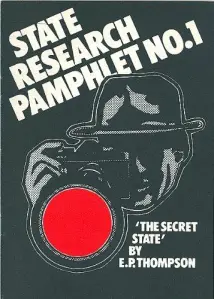
Tony Bunyan 1941-2024. E P Thompson & The Secret State
It is sad to note the passing of Tony Bunyan the author of the Political Police in Britain (1976) who has long been a key figure in State Research and then State Watch.
The extract below from EP Thompson’s essay The Secret State (1978) was the first product of what became of necessity a lengthy and on-going project. The intersection between a concern about the erosion of civil liberties in the present day with the fight to gain the liberties in the first place is a reminder of the need for constant vigilance and campaigning
Thompson notes that the nineteenth century British working-class disliked the intrusion of authority from above and the role of a centralised police force. The twentieth century saw Labour embrace a Statist politics but the libertarian origins of the labour movement live on:
The insurgent British working-class movement took over for its own the old Whiggish bloody-mindedness of the citizen in the face of the pretentions of power. Even when labouring under the manifest class discrimination of the Combination Acts, the secretary of an illegal trade union branch of framework knitters in Mansfield in 1812 was able to protest against a clause in a Bill proposed by the workers’ representatives themselves, which authorized the search for shoddy goods in the houses of manufacturers : ‘if iver that bullwark is broke down of every english mans hous being his Castil then that strong barrer is for iver broke that so many of our ancesters have bled for and in vain.’ The workers had appropriated the democratic precedents and practices of past generations for their own; the ancestors were not ’theirs’ but ’ours’.
And this was how matters continued for at least one hundred years. The Chartist, Radical Liberal, Irish Nationalist and formative Labour movements were distinguished by their sensitivity to libertarian issues, and their suspicion of the polity of statism. When the police forces were enlarged and rationalized (or, as some would have it today, ’modernized’) in the mid-nineteenth century, this was a victory for bourgeois utilitarian bureaucratic policy in the face of intense resistance extending from old Tory localism through Radical Liberalism to outright Chartist opposition— for Chartists and trade unionists very well understood what kind of imperatives dictated government policies. As a consequence of this opposition, the presence of the police in British public life remained unusually subdued. They must be seen as ‘servants’ of… either the gentry or ’the public’, and they must in no circumstances exhibit a brash public presence. And, as a more concrete evidence of the old libertarian tradition, which endures to this day, the British police (at least in Britain) must go about the streets unarmed.


Leave a Reply