
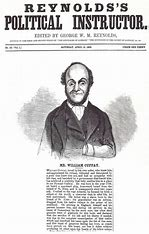
25th September 1848: Black leader of London Chartism, William Cuffay, sentenced to transportation to Australia
It is the 178th anniversary of the effective beginning of the British 1848, the Chartist protest on Kennington Common on Monday 10th April 1848, and it’s worth also paying attention to the efforts that the Government made to frustrate protest in that year of revolutions in Europe.
John Saville in his authoritative book on 1848 (CUP) argues these were decisive.
The actual machinery of Government in 1848 was limited but the forces it could command were considerable as were the laws it had to deal with threats to order.
For example the current Treason Felony Act dates from 1848 when it brought together several earlier Acts and replaced the death sentence for treason with a felony- in practice at the time transportation to Australia.
The Act was discussed in the House of Commons on the evening of 10th April 1848 and passed within 24 hours despite concerns that a clause on ‘open and advised’ speaking could lead to a treason sentence for political dissent.
The State had reason to do this. Juries were reluctant to convict where the death sentence was involved and in the revolutionary year of 1848 the State wanted convictions to frustrate any attempts at revolution. Hence the first two people to be convicted under the newly amended Act were the Irish Republican Chartist John Mitchel and the leader of London Chartism William Cuffay.
Cuffay was arrested for his alleged role in an attempted Chartist rising in mid-August 1848 and sentenced on 25th September 1848 to be transported to Tasmania.
Cuffay told the Court
I expected to be convicted, and I didn’t think anything else; but I don’t want to be pitied. No, I pity the Government, and I pity the Attorney-General for convicting me by means of such base characters. The Attorney General ought to be called the Spy-General. and using such men is a disgrace to the Government, but they only exist by such means. I am quite innocent, my locality never sent any delegates at all and I had nothing to do with the ‘luminaries.’ I have a right to complain of the other spy Davis being kept back till the last moment, and he had read the evidence of the miscreant with so many aliases. As to my having a loaded pistol, I only carried it for my own protection, as my life had been threatened. This, however, it what I have always expected, I always thought it would come to something like this. I am not anxious for martyrdom, but after what I have endured this week, I feel that I could bear any punishment proudly, even to the scaffold. This new act of Parliament is disgraceful, and I am proud to be the first victim of it after the glorious Mitchel. Every good act was set aside in Parliament–everything that was likely to do any good to the working classes was either thrown out or set aside, but a measure to restrain their liberties could be passed in a few hours. I have nothing more to say.
A full account of Cuffay’s Trial is here:
http://cuffay.blogspot.co.uk/2011/01/reply-at-trial.html
Cuffay (1788-1870) had been born in Chatham to a former slave from St Kitts. He went on to lead the resistance to the imperial Government at its centre in London and ended up, still active as a trade unionist in Hobart Australia.
The British State, the oldest in the world, was concerned to crack down on political opponents and to avoid creating martyrs. Beyond the boundaries of the UK, British imperial policy was not so nuanced.
More detail on William Cuffay from the admirable Chartist Ancestors site


Leave a comment