
Monday 21st October 5.30pm Fabrice Bensimon, The Chartist Meeting at Kennington Common, 10th April 1848. The daguerreotypes, the crowd and the coachman. In person, Room 301, Institute of Historical Research.
The daguerreotypes of the Chartist meeting on Kennington Common in London on 10 April 1848, often considered as the first crowd photographs, are among the most reproduced photos of the Victorian era. But they have not yet yielded all their secrets. This paper discusses the old question of the number of people attending the meeting. Re-examining the daguerreotypes in the light of other sources, it additionally addresses issues relating to the depiction of labour. It looks at what the daguerreotypes tell us about the relationship between the Chartist movement and London’s working class. It attempts to identify places and objects. Finally, it focuses on the place of individuals in the images of this anonymous, faceless, and voiceless crowd. It suggests the name and identity of a little-studied Chartist figure who can be seen on a photo, the coachman, carpenter and builder Henry Cullingham (1791–1873), and considers what we may derive from that.
Fabrice Bensimon: ‘Kennington Common, 10 April 1848: The Photographs, the Chartist Crowd, and the Coachman’, published in the Journal of Victorian Culture.
Notes (Keith Flett)
Below are my notes (only!)
Understanding what the dageurrotypes of the Chartist meeting on Kennington Common 10th April 1848 mean
The pictures in themselves don’t tell us that much without interpretation
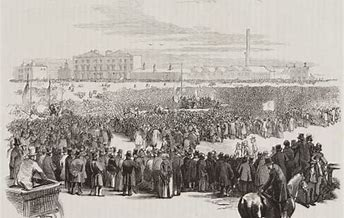
There were three not two photos. One is missing but the drawing in the Illustrated London News is based on that.
We can’t get an understanding of the noise, music, speeches that were central to the occasion
A long standing issue is how many people were at the meeting. The press and Government promoted a figure of 10-15000 people, the Chartists 100,000 or above. The photos suggest towards the former but it depends when they were taken. If it was before the 12.30pm peak then the full number is not captured. If, another possibility, it was as the petition was being loaded on to cabs to go to Westminster much of the meeting had dispersed.
The photos are good enough to make out some individuals and some faces. One person who has been identified is Henry Bellingham who built the coaches seen at the Common. ‘The coachman’ had them constructed at the Chartist land settlement at Snigs End near Gloucester.
Understanding who was in the Chartist crowd on the Common is so far little explored.


Leave a Reply