
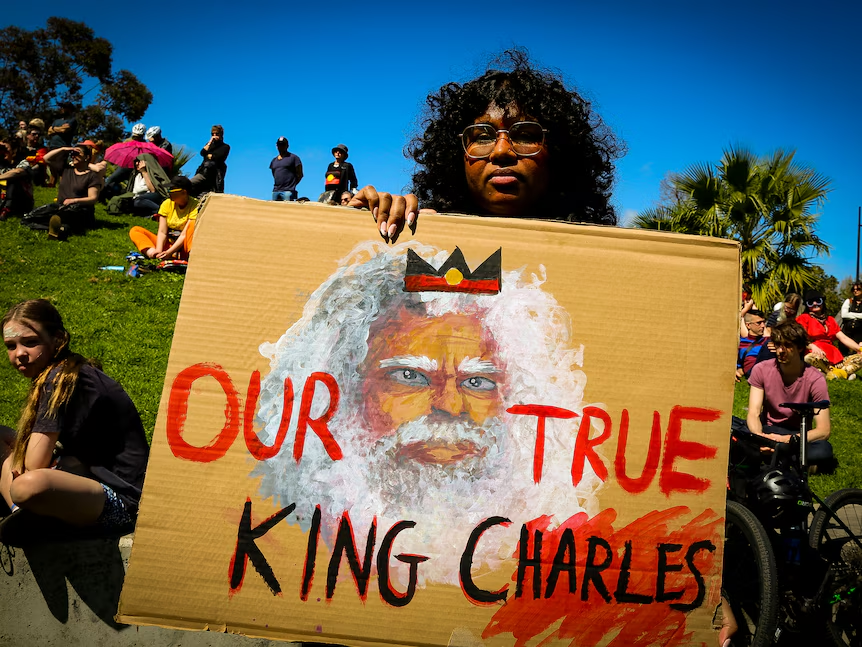
Senator Lidia Thorpe led a protest against King Charles and the Monarchy on Monday. Anyone familiar with Britain’s colonial occupation of the country will understand she had a very good argument.
There was another feature of the protest that struck a chord with the history of anti-imperial protest going back to Victorian times
Protest at Monarchy, a British tradition. The 1897 Jubileeting the tone which he describes as ‘disrespectful and insulting, it gloated over royal tragedies’. Yet Reynolds’s a Sunday newspaper sold 300,000 copies a week.
St Pauls Cathedral, the church of Empire, was the scene for Queen Victoria’s Jubilee ceremony on 22nd June 1897. Earlier in the day Victoria had been at the central Telegraph Office in St Martins Le Grand to send a message worldwide to her subjects. It was the equivalent to sending an e-mail or arguably posting on Twitter.
Victoria had not always been a popular monarch. After the death of her partner Albert the Queen had become reclusive and as often seems to be the case the activities of some of the Royal children were an embarrassment. By the early 1870s a strong Republican tradition had developed with the formation of working class republican clubs. The leadership of this movement was not entirely from the left but was to be found with radicals like Charles Bradlaugh and elements of the Gladstonian Liberal Party. They were certainly not consistent opponents of monarchy or imperial power but it symbolised a class divide in society and Victoria was its figurehead.
What of opposition in 1897 itself?
Reynolds’s News, as noted a best-selling Sunday Paper, which dated back to the Chartist period had a strong record of support for Republicanism and Opposition to the monarchy. It’s issues record some of the opposition there was in 1897.
It reprinted an anarchist leaflet that refers to Queen Victoria as a ‘fat old lady’ and end by arguing that despots should go to hell. Entertaining though it is, its publication in Reynolds’s probably reflected its maximum impact.
Elsewhere the paper reported events. A bonfire built to celebrate the Jubilee on the highest point of the Cotswolds was set alight before the appointed day, and the authorities sought to arrest the miscreant who had done it. Meanwhile in Bristol, the Mayor had invited local trade unions and friendly societies to join a Jubilee procession. They all refused on the grounds that the Jubilee was not something that felt they were included in.
Reynolds’s returned to the fray with its post-Jubilee edition on 27th June 1897.
It reported the sermon of a Durham vicar TJ Dent from Haslington who concluded that the Bible showed that the existence of the monarchy- a ‘worn out fraud’ it was called was delaying the Kingdom of Heaven.
An Editorial on the events noted ‘the Jubilee celebrations with their curious mixture of real enthusiasm with sickening flunkeyism’. It concluded that ‘at last the ghastly farce is over. The Jubilee show has passed’ and argued that ‘Radicalism and servility do not go well hand in hand’. It finally suggested that ‘the final great lesson of the Jubilee is that the people now have to fight wealth’
The detail of the Jubilee day however is perhaps as interesting as the protests. It was a fine sunny day as the Royal procession made its way from Buckingham Palace to St Pauls and afterwards to the poorer areas of Borough via London Bridge.
There were crowds in some places and police horses and troops were used to control numbers. Some who had camped out overnight for a view of the Royal Party complained that they had been pushed into side streets by the police as crowds grew.
However the areas where crowds gathered were quite limited and in most places there were few bystanders. Reynolds’s speculated that many may have preferred to avoid the occasion or leave London for the day, even though in this long before TV age the only way to actually see the event was to attend in person. Another possibility that has a strong contemporary echo is that police closed off roads surrounding the Royal procession so that only those who had arrived very early could get a glimpse.
The fall out, reported in Reynolds’s of 4 July 1897 made the point. A businessman successfully applied to Southwark Council for a return of fees he had paid to erect a stand for spectators in Westminster Bridge Rd. There had it seems been very few takers. In an even odder report several traders applied to a judge for permission to cut up 500 pairs of stilts they had been given to sell for firewood. The owner had disappeared, the police had banned the use of stilts to watch the Royal procession and very few people were interested anyway.
Yet the main opposition was not at the centre of Empire but at the periphery. There were anti-Jubilee protests in Dublin organised by socialists including James Connolly which led to rioting. The Irish nationalist MP Redmond proposed an amendment to the Loyal Address to the Queen outlining the destruction her reign had caused in Ireland back to the Potato Famine and before.
There were also significant protests in India. The Editorial of Reynolds’s on 4 July 1897 had reflected that ‘there is more food for reflection in the condition of India than in the inanities of Jubilee No.2’. It reported a flypost in Poonah that stated ‘none but demons would celebrate a Jubilee when the famine, earthquake and plague prevailed’. Several British soliders were shot and injured during the Jubilee period.
Commenting on the Diamond Jubilee Honours List in Reynolds’s of 4 July 1897 Gracchus noted that ‘militarism is acclaimed as the chief glory of the Queen’s reign’
The opposition to the Jubilee across the Empire is something that is rather missing from UK focused accounts and that does need to be addressed. At the same time the underlying argument of this paper is that opposition to the monarchy ebbs and flows as does support for Republican alternatives. There is an element of calculation about how far pro-monarchy celebrations can be pushed out and it was clearly judged that an event marking the imperial power of the Empire in 1897 would find a public echo. That it did, but we should not take from that universal support or lack of protest.


Leave a Reply