
RE Swift Policing Chartism, 1839–1848: The Role of the ‘Specials’ Reconsidered
The English Historical Review, Volume CXXII, Issue 497, June 2007, Pages 669–699
At a recent socialist history seminar at the Institute of Historical Research, Fabrice Bensimon presented some new research on the Chartist demonstration held on Kennington Common on 10th April 1848.
One area touched on was the role of Special Constables on that occasion. There is not a huge amount of research specifically on this subject. The details of one fairly recent paper are above. Davod Goodway in his book on London Chartism has some estimates for numbers enrolled which were substantial. While the assumption has been that most were from the middle class, because workers would be supporting the Chartist cause, this is both erroneous and one-dimensional.
Goodway notes that in some workplaces workers signed up as Special Constables specifically to protect their own workplace, if need be, and no more than that.
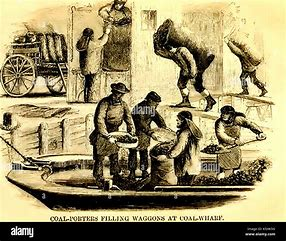
Bensimon raised the issue of the coal whippers (essentially a form of coal porter that carried coal of barges in the Thames). As the exchanges from Hansard in 1848 and 1857 show a large contingent of coalwhippers did sign up to be special constables in March 1848.
Whether they were deployed or not remains uncertain. Their willingness to serve appears to be related to legislation in 1843 promoted by Gladstone that gave them, almost uniquely at the time, a degree of employment protection. Previously the work had been casual and available reports suggest largely at the behest of pub landlords.
Certainly Mayhew saw the Whippers as part of the general class of costermongers, general labourers, who were not noted for political affiliation, but when they were tended towards the Chartist cause
Coalwhippers 13th March 1848. Question posed by Gladstone
MR. LABOUCHERE
I have great satisfaction in answering the question of the right hon. Gentleman. It is perfectly true that the coalwhippers on the Thames, of whom there are 2,500, have tendered their services as special constables to the Secretary of State for the Home Department. Their services were accepted. About 300 of their number were sworn in on Saturday, and the magistrate is in attendance to swear in more if necessary. With regard to the measure for the benefit of those persons which the right hon. Gentleman introduced, I am bound to state that it has fully met the views and intentions of the right hon. Gentleman. It has greatly conduced to the improvement of the moral habits and general condition of the coalwhippers.
SIR G. GREY
Allow me to confirm the statement made by my right hon. Friend the President of the Board of Trade. In the course of last week an offer was made on the part of the coalwhippers, to the number of 2,000, to be sworn in as special constables, and that offer was accepted. But I am anxious, in
consequence of what fell from the right hon. Gentleman (Mr. Gladstone), that he disclaimed, and very properly, drawing an invidious contrast between one class and another, to express the conviction that such conduct presents one of the most valuable results which has been developed by the recent attempts at disturbance. I am happy to say that those attempts have elicited from the great body of the community of all classes, both in the metropolis and in the large towns throughout the country, the strong expression of their resolute determination to give their cooperation and aid for the suppression of disturbance and the maintenance of order, which is necessary for the protection of the property and comfort, not only of one class, but of all. In Glasgow a great number of special constables were sworn in, including a large body of operatives, and that in the course of one day. I am assured by the Lord Advocate, who proceeded immediately to the spot on receiving intelligence of the disturbances, that in Glasgow 20,000 special constables could have been sworn in, had it been necessary. The accounts from Liverpool are of the same gratifying description; and everywhere the same feeling prevailed in favour of giving every support to the authorities against those whose only object is plunder.
upon the celebrated 10th of April, when the country was saved from bloodshed by the conduct of the working classes, the poor coalwhippers had shown their gratitude for the protection that had been afforded to them by the Legislature, by coming forward in a body and enrolling themselves as special constables. The noble Lord concluded by moving, that the Coalwhippers Bill be referred to a Select Committee, under Standing Order No. 175, respecting Bills for regulating Trade.
Lord Kinnaird, Select Committee July 7th 1857 Coalwhippers Bill


Leave a Reply