
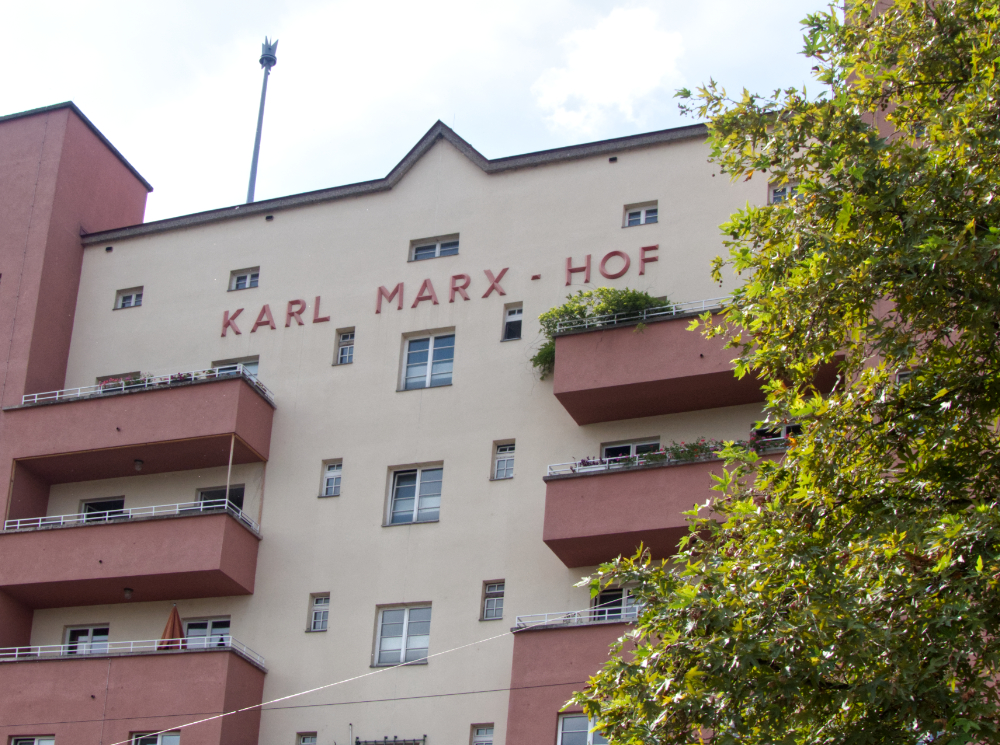
Between 1919 – 1934, the socialist council of Vienna built over 64,000 homes, supported by health, education and welfare services. Clinics, free (!) dentists, mother and baby centres, kindergartens, play centres, nurseries, psychiatric services (Freud provided a free weekly clinic), cinemas, theatres, parks, gardens, allotments, youth centres and clubs and associations and much else.
The housing programme was paid for through city-wide taxes in which landlords and the rich paid proporitionately the most. Rents were 3 – 7 percent of an average workers wage.
Leading architects and designers were involved, including Josef Frank, Adolf Loos and Margarete Schutte-Lihotzky. The high quality of the design and build continues to shine today. Some of this housing is now over 100 years old and continues to provide the core of public housing across Vienna.
The last housing of the socialist council was opened in 1933, as the grim power of fascism began to take hold. Karl Seitz, the mayor of Vienna declared:
‘Even if the world is to be filled with devils, this Vienna will stand unmoved and firm, a haven of democracy, a haven of the spirit, a haven of liberty, a bulwark against fascism and dictatorship’.
Come along and see some fine photographs of this fantastic achievement and explore the ideas and dreams that made it possible; and what lessons there are for today, both in terms of housing and fighting reaction.
Danny Bee will speak on Red Vienna on Monday 17th February at 5.30pm in Room 301, Institute of Historical Research, Senate House, Malet St, London, WC1.
Organised by the Socialist History Seminar at the IHR and the London Socialist Historians Group.
contact @keithbeard.bsky.social
Report– Keith Flett
A very well attended seminar where Danny Bee gave a broad ranging overview of the social democratic housing project in Vienna between 1919 and 1934.
The project situated itself between on the one hand more traditional Labour administrations and on the other Bolshevik Russia arguably showing what was possible within the confines of a ‘reformist’ political perspective.
The building programme was impressive and focused on places for workers to live which were not like the mechanised environment of the factory. There was significant provision given to green space and buildings were restricted to five stories. The view was that this was as far as someone might carry a sack of coal or a pushchair with two children!
The scheme concluded as the Nazis took power and as the speaker noted at least some of those who had lived in the housing schemes of Red Vienna ended up in concentration camps.
Many of the housing projects of Red Vienna remain and perhaps offer a model for housing to be built by future socialist Governments…
Danny Bee runs radical walks in London. Details from danny@beingdigital.co.uk


Leave a Reply