
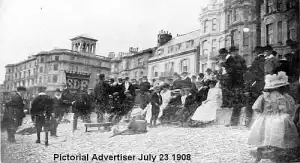
SDF meeting, Hastings Beach,July 1908 (Hastings Museum)
Saturday 15th February sees another national march for Palestine which will go from Whitehall to the US Embassy at Nine Elms. It comes after police disrupted the last march, placing restrictions on it and arresting people. Several cases are in the judicial system together with calls for an investigation of the policing of the demonstration.
The right to protest and the State’s efforts to undermine it are of course not new as the details below show
The current political climate, perhaps enhanced a little by social media is raising some issues about where the left is able to meet and put across points that may be controversial to some.
The situation is not new, although the present conjuncture provides a particular focus. Anyone who has organised events for the left or the labour movement will know that there are some venues that are relaxed about allowing meetings and some that just wont entertain the idea.
What is less usual are venues that will accept bookings from the left and labour movement cancelling because of threats from individuals hostile to the left. Traditionally, though I think it must be accepted that this is not a better alternative, they would have tried to break the meeting up, often violently.
However there is a long history of the authorities trying to frustrate the left’s right to meet and speak out.
Perhaps one of the best known examples is in pre=1914 Hastings when the Social Democratic Federation (formed 1881) was banned from holding meetings in the town and had to resort to holding them on the beach. On occasion speakers had to use a boat just offshore to address crowds on the beach to avoid arrest.
One of the SDF’s activists in Hastings at the time was Robert Tressell (Noonan) who was working as a painter while writing the Ragged Trousered Philanthropists.
The SDF had been part of the 1900 meeting which set up the Labour Representation Committee, which led to the formation of the Labour Party but continued to operate independently. It split over the issue of support or otherwise for the First World War and some anti-war members joined the Communist Party from 1920. It had a specific focus on free speech for the left which reflected its own approach to politics. That is for another post though.


Leave a Reply