
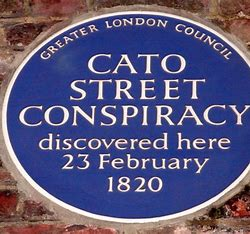
Cato St 206th anniversary an alternative tradition of protest
It is 206 years since the Cato St conspiracy was ‘uncovered’ on 23rd February 1820 and the leaders duly despatched at the scaffold or to Australia
It warrants a section in E P Thompson’s classic account of the Making of the English Working Class (1963) but until recently has been largely overlooked both by mainstream and left historians.
The conspirators, who like others before them, had been infiltrated by Government spies, a reminder that Spycops are nothing new, planned to attack a ‘Cabinet Dinner’ in central London, murder the Prime Minister, Home Secretary etc and display their heads on poles.
The dinner did not exist except with the purpose of entrapping the conspirators led by veteran activist Arthur Thistlewood.
The plan was to spark a series of uprisings around the country in revenge for the Peterloo Massacre in Manchester in August 1819 where troops killed and injured numbers in a crowd protesting for the vote.
Cato St, off the Edgware Rd near Marble Arch, hinted at the existence of a revolutionary underground network, which has been historically controversial.
Thompson doesn’t dismiss the idea but there remains remarkably little work into the armed tradition in British working class politics. Many in 2026 might be surprised that it existed at all.
Certainly the conspirators had the support of some sections of the London working class, notably the shoemakers, who might well have risen had the conspiracy to murder the Cabinet worked. How widespread support for a rising was remains the subject of research. Certainly a significant section of Irish nationalists backed it, and Irish workers were a key part of London radical politics. There are also suggestions that there was a broader sympathy amongst middle-class radicals.
The Government had restricted the right to democratic organisation and protest with the Six Acts in December 1819 and 1820 saw Governments overthrown in Spain, Portugal and Italy.
Thompson argues that the likely result if Cato St has succeeded would have been a bloody few days in London while the army restored order.
The Cato St conspirators Thompson points out were amongst the last outcrop of those in a Jacobin political tradition who preferred to plot secretly rather than agitate and organise openly. That of course was the path eventually taken by the British working class notwithstanding a very nearly successful armed Chartist Rising at Newport in November 1839.
Recent research has suggested a much wider perspective to Cato St than previously supposed. News of it was celebrated by French radicals as an indication that the revolutionary traditions of that country also existed in Britain.
Further one of the conspirators William Davidson was a black man born in Jamaica and he brought to the politics of Cato St a knowledge of the resistance to slavery and an imperial angle to the matter.
Thompson however argues that it was not Cato St or the Six Acts that had the lasting influence on events but Peterloo itself. He notes ‘it served notice on the middle class reformers and Whigs as to the consequences that would flow from their loss of influence over the unrepresented masses… Second the experience of the post-war agitation shook the confidence of the ancient regime in itself and some of the loyalists of 1819 became, in the 1820s, willing to admit the need for limited concessions’.
It was the road of mass organisation not conspiracy that was the way forward
Thompson’s point remains valid although it now seems likely that there was a much wider context to and impact of Cato St than he allowed for
This post originally appeared in the Morning Star


[…] Cato St 23rd February 1820. An alternative tradition of protest […]