
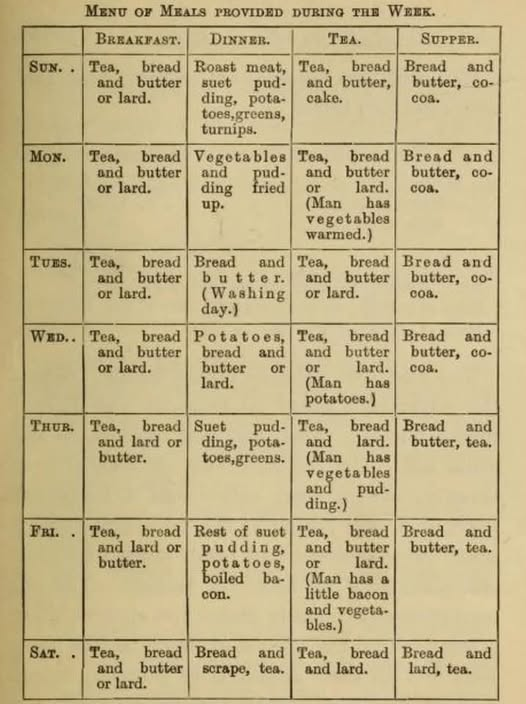
This chart shows the average weekly diet of one working class family from Oxfordshire in England, in 1912.
It was included in the book “How the Labourer Lives: A Study of the Rural Labour Problem” by B. Seebohm Rowntree and May Kendall, published in 1917.
Source: “How the Labourer Lives: A Study of the Rural Labour Problem”, Rowntree & Kendall, pp. 59-63, pub. 1917.
From the People’s Britain on FB
The above post as been on my FB page for a while and attracted some comment.
It seems unusual in that no beer is included and hence appears to be worse than Workhouse diets of the Victorian period.
The question of the working class diet has long attracted historical research and controversy. In his 1968 postscript to the Making of the English Working Class E P Thompson admitted that the section on Standards and Experiences which covered diet was inadequate. He was attacking right-wing economists who saw economic growth in the early Victorian era is the key point and were not too concerned about the diet of the workers whose work provided the basis of growth.
This point does seem also to have a rather contemporary note to it in 2025
As Thompson notes that the popularity of the song the Roast Beef of Old England related to the reality that meat was not a regular part of the working class diet in the 1830s except arguably for better, skilled urban workers.
The diet of agricultural workers who were paid less might charitably be described as frugal, hence the Oxfordshire diet sheet above.
A lot of research has gone on since Thompson published the Making in 1963 but issues around how much workers in different jobs (skilled/unskilled) and locations (rural/urban) were paid and what this meant in terms of their diet and of course their health and well being.
Indeed Thompson returned to the issue in a relatively little known postscript to the Unknown Mayhew a selection of the writings of Henry Mayhew from 1849-50 (1973) where he looked at some of the evidence on working class living standards Mayhew had gathered and looks at the relationship between income and diet. Here beer is definitively included as Thompson puzzles whether porter or (less expensive) ale would be the most common drink
Thoughts very welcome


Leave a Reply