
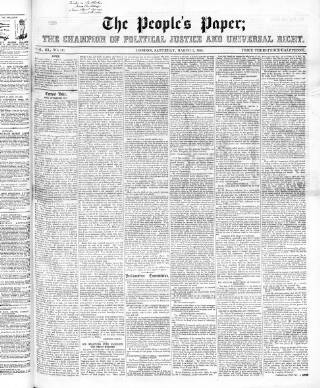
Marxism & Education: the case of Karl Marx’s 1856 Speech to the People’s Paper
A couple of days I was involved in a social media campaign with a well known Arsenal fan, author and broadcaster. The occasion was some comments by well known Head Teacher Katharine Birbalsingh who was involved as she often is in a Culture War with the Government about education. She claimed Government policy is Marxist in favouring equality rather than equality of opportunity.
In fact as most large companies (at least in the UK and who haven’t had their heads turned by the far right rants of Musk) the two go together. Unless there is equality in recruitment and promotion, rather than the rule of clean shaven white men in suits, equality of opportunity will not exist.
None of that however is Marxist. It is arguably social democratic but it does not address questions of wealth and power.
There are alternative ways of looking at things. One might be that the outcome of education is to produce people who think critically about the world they live in and understand that to grasp what happens one needs to look beyond surface events.
Marx’s speech to a meeting of supporters of the Chartist People’s Paper in 1856 put the matter well. Marx gave the speech in German and he was not, reportedly, a great speaker anyway, so how many of those present (who would have included German emigres) understood it at the time we don’t know. It was however reprinted in English in the paper.
He draws clearly the difference between what is said to be happening and what is actually happening. For example:
In our days, everything seems pregnant with its contrary: Machinery, gifted with the wonderful power of shortening and fructifying human labour, we behold starving and overworking it
He goes through a number of other examples. If education can produce students who look beyond what is said to the reality of what is taking place we may be on the way to a better world
The Speech (14th April 1856)
The so-called revolutions of 1848 were but poor incidents — small fractures and fissures in the dry crust of European society. However, they denounced the abyss. Beneath the apparently solid surface, they betrayed oceans of liquid matter, only needing expansion to rend into fragments continents of hard rock. Noisily and confusedly they proclaimed the emancipation of the Proletarian, i.e. the secret of the 19th century, and of the revolution of that century.
That social revolution, it is true, was no novelty invented in 1848. Steam, electricity, and the self-acting mule were revolutionists of a rather more dangerous character than even citizens Barbés, Raspail and Blanqui. But, although the atmosphere in which we live, weighs upon every one with a 20,000 lb. force, do you feel it? No more than European society before 1848 felt the revolutionary atmosphere enveloping and pressing it from all sides. There is one great fact, characteristic of this our 19th century, a fact which no party dares deny.
On the one hand, there have started into life industrial and scientific forces, which no epoch of the former human history had ever suspected. On the other hand, there exist symptoms of decay, far surpassing the horrors recorded of the latter times of the Roman Empire. In our days, everything seems pregnant with its contrary: Machinery, gifted with the wonderful power of shortening and fructifying human labour, we behold starving and overworking it; The newfangled sources of wealth, by some strange weird spell, are turned into sources of want; The victories of art seem bought by the loss of character.
At the same pace that mankind masters nature, man seems to become enslaved to other men or to his own infamy. Even the pure light of science seems unable to shine but on the dark background of ignorance. All our invention and progress seem to result in endowing material forces with intellectual life, and in stultifying human life into a material force.
This antagonism between modern industry and science on the one hand, modern misery and dissolution on the other hand; this antagonism between the productive powers and the social relations of our epoch is a fact, palpable, overwhelming, and not to be controverted. Some parties may wail over it; others may wish to get rid of modern arts, in order to get rid of modern conflicts. Or they may imagine that so signal a progress in industry wants to be completed by as signal a regress in politics. On our part, we do not mistake the shape of the shrewd spirit that continues to mark all these contradictions. We know that to work well the newfangled forces of society, they only want to be mastered by newfangled men — and such are the working men. They are as much the invention of modern time as machinery itself.
In the signs that bewilder the middle class, the aristocracy and the poor prophets of regression, we do recognise our brave friend, Robin Goodfellow, [1] the old mole that can work in the earth so fast, that worthy pioneer — the Revolution. The English working men are the firstborn sons of modern industry. They will then, certainly, not be the last in aiding the social revolution produced by that industry, a revolution, which means the emancipation of their own class all over the world, which is as universal as capital-rule and wages-slavery. I know the heroic struggles the English working class have gone through since the middle of the last century — struggles less glorious, because they are shrouded in obscurity, and burked by the middleclass historian. To revenge the misdeeds of the ruling class, there existed in the middle ages, in Germany, a secret tribunal, called the “Vehmgericht.” [2] If a red cross was seen marked on a house, people knew that its owner was doomed by the “Vehm.” All the houses of Europe are now marked with the mysterious red cross.
History is the judge — its executioner, the proletarian.


Leave a Reply