
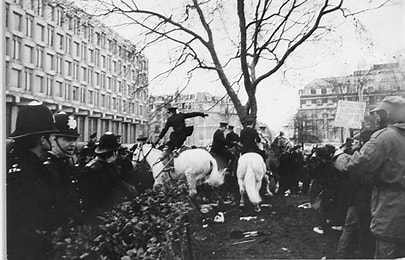
The tradition of protest Grosvenor Sq 17th March 1968,Vietnam; Kensington 22nd March 2025,Gaza
On Saturday 22nd March thousands will gather near the Israeli Embassy in Kensington in central London to protest against continuing genocide and starvation in Gaza.
Such protests have a long tradition now and the actions of America are often a key focus of them
1968 was a year of demonstrations and protests across the world. The May events in France are often taken to be the starting point for this but in reality matters had been stirring well before that.
A key influence was the Vietcong’s Tet Offensive in Vietnam from the end of January 1968. It had underlined that the might of US military power and imperial policy was not invincible and the atrocities committed as the US pushed back the advance of Communist forces gained worldwide media attention.
The well-known demonstration against the Vietnam War in London in 1968 took place on 27th October. There were books written about it and no doubt we will hear something of the 57th anniversary later in the year.
There was however an earlier protest that took place on 17th March 1968 and set much of the tone for what was to follow.
It gathered in Trafalgar Square for a rally and then marched to Grosvenor Square. The official police estimate for attendance was 10,000 which it may be taken was somewhat on the low side. The October demonstration was officially estimated at 25,000 but generally agreed to have been 100,000 strong.
According to the BBC’s report of the day the demonstration ‘turned violent’. It noted that ‘More than 200 people have been arrested after thousands of demonstrators clashed in an anti-Vietnam war protest outside the United States embassy in London’.
One of those arrested was the author Michael Rosen who recounts the episode in his memoir ‘So they call you Pisher!’. Rosen refused to give his name and a police officer simply noted him as being ‘big’. This was not sufficient for the police to proceed with a charge and in the end he was released.
According to the BBC ‘stones, earth, firecrackers and smoke bombs were thrown’ and pictures and footage of the day do bear that out. Much was made of injuries to police officers, with less media interest in injured protesters.
Such was the impact of the day that it led to a debate in the House of Commons. While an uproarious demonstration hardly seems unusual 50 plus years on, it was unusual in 1968 and likewise while the numbers involved appear limited compared to more recent times, again such sizeable protests, those of CND aside, were also not common.
The debate was initiated by the Labour MP Peter Jackson who had been present in Grosvenor Square. He told the pre-Murdoch Times: “I was particularly outraged by the violent use of police horses, who charged into the crowd even after they had cleared the street in front of the embassy.”
Again while police violence was hardly unknown against, for example, anti-fascist protesters the crowd on 17th March had included well known 1960s public figures such as actress Vanessa Redgrave and Rolling Stones singer Mick Jagger. That changed the context. It was one thing giving a working-class protest outside of the public eye a good kicking but this was a high profile media occasion.
57 years on it can be reflected that those who marched on 17th March 1968 played an important role in starting to mobilise wider opposition to imperial wars that led to the 2 million strong anti-Iraq war march in 2003. A tradition of protest against war that continues today.
There was and is certainly work to do. The ‘liberal’ Guardian reported of Grosvenor Square that ‘the demonstrators seemed determined to stay until they provoked a violent response’ while an Editorial argued that far from exerting violent force the police had merely acted in ‘self-defence’.
A reminder that the Guardian’s ‘Love Me I’m a Liberal’ perspective is nothing new


Leave a Reply