
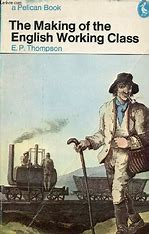
E P THOMPSON & THE MAKING OF THE CHINESE WORKING CLASS
We are in another moment of enhanced Sinophobia so the opening paragraphs of a piece on the Making of the Chinese working class which uses, in part, E P Thompson’s 1963 as a frame of reference is worth reading. It appeared in a recent issue of New Left Review.
Thompson wrote in the Preface to the Making, ’causes that were lost in England might, in Asia or Africa, yet be won’. Discuss…
One way to understand the remarkable political and economic transformations of the People’s Republic of China from 1949 to the present is to take Edward Thompson’s The Making of the English Working Class as the starting point. Thompson’s classic study captures vividly the emergence of a working-class consciousness in England during the crucial years between 1780 and 1832, even as he places his narrative in a much longer history. As the paradigmatic proletariat in the initial stages of industrial capitalism in the West, the English working class offers an ideal lens for examining the emergence of another proletariat of global significance on the opposite edge of the Eurasian landmass, one that is in many respects emblematic of capitalism’s latest stage: the Chinese working class.footnote1
While Thompson’s focus is the evolving class consciousness of the English worker, he frames his analysis in terms of the Enclosure Movement, dating to the late fifteenth century, which dispossessed peasants of their land and left them with no option but to sell their labour. In China, too, a dispossession of peasantry is occurring that is often referred to as a New Enclosure Movement (xin quandi yundong). However, the two differ notably in their temporal and spatial scope. Processes that took place over a period of several centuries in England are being telescoped into just three decades in China. What is more, they are taking place in the opposite order: the initial commodification of industrial labour in the 1990s that gave rise to China’s gleaming skylines was accompanied by a seemingly inexhaustible stream of migrant labourers into cities even without the large-scale commodification of rural land. Why, then, dispossess a peasantry that has already submitted to capital voluntarily—that is, under economic duress, obviating the need to resort to forcible dislocation?
New Left Review 151 Jan/Feb 2025
Teemu Ruskola, The Making of the Chinese Working Class, NLR 151, January–February 2025


Leave a Reply