
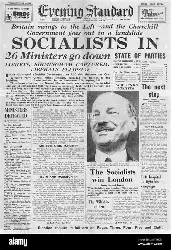
On 26th July 1945, 81 years ago, the result of the 1945 General Election was announced. Labour won 393 seats giving it a majority of 159 seats over all other parties. Labour leader Clement Attlee became Prime Minister aged 62.
On the 70th anniversary on 22nd July 2015 I was pleased to speak to a large audience (certainly for a Wednesday afternoon) at the Working Class Movement Library in Manchester on the 1945 Government and after.
One of the questions asked was what EP Thompson the socialist historian made of 1945, particularly given his active role in World War Two and the murder of his brother Frank by fascists in it. Below is a short extract from a piece he wrote for the London Review of Books before the 1987 General Election about the importance of 1945
EP Thompson on 1945 (London Review of Books Diary 7th May 1987)
The notion that Edward Thompson is dedicated to avoiding fuss will surprise my old acquaintance, not least any survivors of the leadership of the British Communist Party of 1956 or Lord (‘Flash Harry’) Butterworth, late of Warwick University. I have made one or two public fusses in my day. But a fuss about one’s private convenience – a claim to privilege – is different. There entered here a taboo. And any claim to priority in matters affecting the chances of life was taboo most of all. It was not just the discipline of war, whether active service or being bombed and rationed, when the young, above all, gave priority to the injured, the sick, the children and the old. It was far wider than that. In that almost-democratic, half-anti-Fascist time, the chances of life were shared; in 1941-45 this island was fanned by strange airs of égalité, when the pursuit of private privilege seemed contemptible. And this most of all for the socialist young, who went to the polls in 1945 to vote Labour, Commonwealth, Communist, ILP.
The Health Service, even more than the nationalisation of the pits, expressed the spirit of that time and extended it forward into the future in institutional form. It was designed by the ablest and most socialist minister in Labour’s post-war government. And it expresses in transparent form the first of socialist egalitarian principles: to each according to his or her needs. Of course things are never as simple as that. But the lay person supposes that, in the chances of health and life, medical science is able to determine priorities according to criteria of need, and that no other consideration need enter. In this way the NHS replaced the vocabulary of class with that of citizenship.


Leave a Reply