
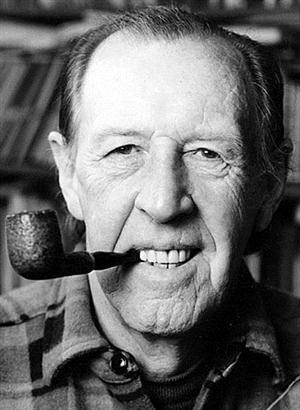
Raymond Williams died in 1988.
A Welsh Marxist and leading writer on literature and language, he was key figure in the first new left from 1960.
I remember him as a softly spoken, pipe smoker. I recall disputing with the Guardian on his death that they were not taking his significance seriously enough, but in the intervening years, that significance has continued to grow.
Of the key figures of that old new left in March 1968 EP Thompson was lecturing on William Blake in America. Raymond Williams however was on the anti-Vietnam War protest in Grosvenor Square and wrote about his reasons why in The Listener, 25th April 1968.
Robin Blackburn in a New Left Review piece on Williams death (NLR 1/168, Raymond Williams and the Politics of a New Left) quoted the Listener article as follows:
‘Today in a score of countries, the protest march has become a regular part of political activity. In the past in Britain, as at Peterloo and in the marches of the Chartists, there was a style of demonstration that pre-dated liberal democracy, the march of men without votes representing that majority who were excluded from political decision, and a march through the streets with banners because this was still the quickest and most visible means of communication. Today the means of communication are much more developed. . . . Yet parliamentary democracy has become increasingly formal under the pressure of consensus. . . . Moreover the theory of representative democracy, with all its strengths and limitations, is being itself surpassed in practice by the pressures of modern organized capitalism to channel decisions to many non-elected bodies. And a key role in this replacement of representative democracy is being played by the modern communications system, which is not, and does not pretend to be, democratic at all, except in purely negative ways. When the German students, after the shooting of Rudi Dutschke, demonstrated against a press monopoly, they were taking into the streets, and for their own good reasons, what had been for many years a central part of New Left theory: that in any large and complicated society, the communications system in newspapers, broadcasting and television is a major political institution—in its supply of necessary information, in its capacity to select, emphasize or exclude, and in its power to influence and campaign. But this institution . . . is permanently up for auction to rich men, to the new communications combines, who then claim by simple purchase this immense political power. . . . Parliament itself has conceded many decisive areas of power, in economic planning and in communications, to wholly undemocratic institutions which it is in no way prepared to fight. The measure of the failure of the social democratic parties in Western Europe is that by compromising on just those issues, they’ve excluded themselves from any serious consideration as the means to democracy and socialism. It is in the gap left by that failure that the new movements are being formed. . . . It is necessary to say soberly and quietly that the decay and corruption of the political system, and the intolerable violence now actually directed against the poor of the world, will go on being fought by all effective means.’


Leave a Reply