
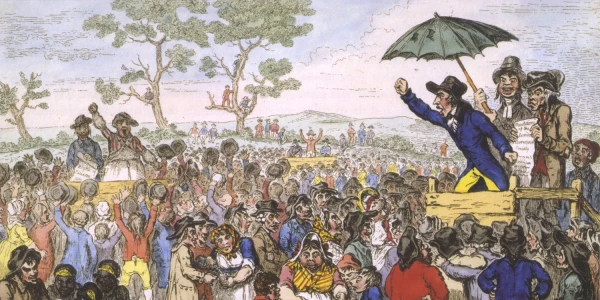
August is holiday season for many. On 12th August 1839 the Chartists declared a Grand National Holiday to bring down capitalism
Yet 187 years ago at the start of the development of the liberal market economy the Chartists tried a very different kind of idea of a holiday
The Grant National Holiday has been ignored or derided as a failure by many historians but it was an early attempt at a General Strike- its aim being to bring down capitalism.
The ‘Holiday’ was the idea of William Benbow. Like many radical activists in the nineteenth century he ranged across a variety of occupations, from pornographer to coffee house keeper to grocer and journalist, to survive.
He had been pushing the idea of a Sacred Month for decades in radical circles with no great immediate impact. He did however publish it as a pamphlet in the early 1830s and this can be freely accessed on the internet today
Benbow’s plan might well have stayed simply an interesting idea were it not for the fact that the Chartist Convention of summer 1839 adopted it as policy and determined to put it into operation in August of that year, starting on the 12th of the month.
It is very much a view of the early labour movement. We are familiar with General Strikes around the world which are in protest at something or which are demanding specific things. The Grand National Holiday was neither of these. It simply planned to disengage from capitalism until the system stopped working.
This meant that not only was no work to be done, but that supporters of the Sacred Month should withdraw any savings they had in banks or other institutions. They were also required to abstain from all excisable articles such as drink and tobacco. On 12th August 1839 in many, mainly northern areas, the pubs were shut.
It was argued that aside from anything else this prevented any disorder and drunkenness as the month got underway.
How was the call for the Sacred Month implemented?
Again as with more recent General Strikes it was not and could not be a matter of trade unions issuing instructions to members to stop work, mounting picket lines and so on. The labour movement infrastructure for this did not exist in 1839.
Instead the method used- and it was one to be echoed in the 1842 General Strike, which is better known to history-was different.
The weekly Chartist newspaper The Northern Star for the 17th and 24th August 1839 reported meetings across the north, often with very large turnouts comprising a majority of the working population of particular areas, which then proceeded to march to surrounding locations to pull others out in support of the Sacred Month.
Perhaps the best way of describing it is a mass flying picket, but before the motor vehicle, the only way to do this was to march on foot.
There is not a uniform picture of how long people stayed out for- some days in a number of areas- but not the whole month. Again the logistics were complicated. With so many out, and long before any kind of welfare system, people had to balance support for the holiday with the need to survive in terms of eating and providing for those unable to work.
Perhaps some had small holdings that allowed them to survive without wage labour, possibly being only recently agricultural workers. This was part of the project that became in the later 1840s the Chartist Land Plan, but for the Sacred Month itself detail on this remains, as yet, scarce.
Even in areas where the strike did not take hold there was at least symbolic support. In London on 12th August there was a mass Chartist meeting on Kennington Common for example.
Why did the strike fail?
Firstly because many leading Chartists were preoccupied with State persecution, arrests and trials, relating to the 1839 Convention.
Secondly because the 1839 Metropolitan Police Act had seen the introduction of new police forces in some areas. For example in Manchester the police, known as the ‘bludgeon men’ attacked and arrested strikers.
Yet this was not the last of the Chartist Challenge. The Sacred Month was just part of a repertoire of strategies that were being tried, mostly for the first time anywhere in the world, to see which might succeed in bringing an end to capitalism.
In November 1839 in Newport South Wales there was an attempt at armed revolution. It almost succeeded.


Leave a comment