
Engels on the need for a new working class party
The below is extracted from a series of articles that Engels wrote for the Labour Standard in 1881. Some will be familiar with them. Indeed they have in the past been available as a cheap printed pamphlet. Now they are free on-line at the Marxist Internet Archive.
Engels was writing at a time of change in party politics, with the formation of the Marxist Social Democratic Federation in the early 1880s (Engels was not enthusiastic seeing it as dogmatic and not particularly Marxist) and in 1893 the Independent Labour Party (Engels was more enthusiastic)
Below he writes of the importance of forming a working class party and what it might achieve with reference to the Chartists. Engels died in 1895 so we can’t know what he would have made of the Labour Representation Committee (1900) the Labour Party in its current form (1918) or the Communist Party (1920) but his points remain of political interest.
He refers of course to working men. Women did not fully get the vote until 1928
And yet there never was a more widespread feeling in England than now, that the old parties are doomed, that the old shibboleths have become meaningless, that the old watchwords are exploded, that the old panaceas will not act any longer….
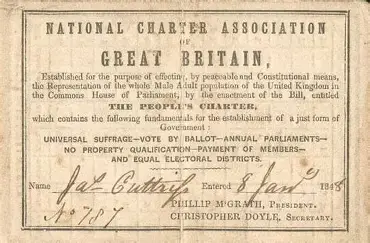
… Of Radical shams there has been unfortunately enough since the break-up of the first working men’s party which the world ever produced — the Chartist party. Yes, but the Chartists were broken up and attained nothing. Did they, indeed? Of the six points of the People’s Charter, [6] two, vote by ballot and no property qualification, are now the law of the land. A third, universal suffrage, is at least approximately carried in the shape of household suffrage; a fourth, equal electoral districts, is distinctly in sight, a promised reform of the present Government. So that the break-down of the Chartist movement has resulted in the realisation of fully one-half of the Chartist programme. And if the mere recollection of a past political organisation of the working class could effect these political reforms, and a series of social reforms besides, what will the actual presence of a working men’s political party do, backed by forty or fifty representatives in Parliament? We live in a world where everybody is bound to take care of himself. Yet the English working class allows the landlord, capitalist, and retail trading classes, with their tail of lawyers, newspaper writers, etc., to take care of its interests. No wonder reforms in the interest of the workman come so slow and in such miserable dribbles. The workpeople of England have but to will, and they are the masters to carry every reform, social and political, which their situation requires. Then why not make that effort?
Engels, Labour Standard 1881


Leave a Reply