
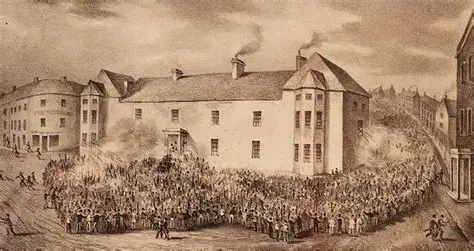
Newport 4th November 1839: could revolution have worked?
It is 186 years since the failed Chartist uprising in Newport South Wales.
I have written about the detail elsewhere and while the anniversary was well marked in the town itself on Saturday don’t expect to see much elsewhere.
One interesting issue since most historians agree it was an abject failure [it was- over 20 Chartists were shot dead] and even those who are sympathetic struggle to find positive things to say about it, is whether it could in fact have succeeded.
A criticism of the more sympathetically minded is that not all of the Chartists who marched on Newport on 2 and 3 November 1839 really knew what the leaders had in mind [nor it turned out did the leaders] and indeed that some may have been dragooned into taking part by coercive means.
There is not a great deal of evidence for that-indeed it sounds like a version of the ‘rent-a-mob’ which is a commonplace of the modern media. The total number of Chartists mobilised was thought to be around 9,000, probably around 25% of the industrial workforce of the South Wales Valleys at the time.
They were not unorganised by any means. Chartist meetings had gone for days in the Valleys outlining plans and making sure local leaders were aware and on board. Before the days of the telephone and social media that was probably as much as could be done. Certainly the Government, while it was aware that something was planned, does not appear to have been able to infiltrate these meetings, in the way, for example, that spies did in London in 1848.
They were also armed, some with guns and pikes others with clubs.
As is hardly unknown for the Valleys in early November there was heavy rain so those marching can hardly be criticised for stopping at local pubs to dry off and gain refreshment. Whether any became inebriated or not is not relevant.
The final Chartist push on Newport gathered at Tredegar House at the edge of Newport in the early daylight of Monday November 4th. If any had been drunk the worse they would then have been suffering is a hangover.
Around 5,000 it appears began the final push on Newport.
Victory should have been assured because the opposition amounted to local police and special constables. They had a violent reputation but they could not deal with those numbers.
As we know and some Chartists certainly also knew, also in Newport on that Monday morning was a small detached of the 45th Regiment of the British Army, perhaps around 30 soldiers. They were the crack regiment of the day.
Here we need to confront exactly what the plan of the Chartists was.
It appears that the original idea was to take control of Newport and then move on to Monmouth to free the jailed Chartist leader Henry Vincent.
Taking control of Newport seems to have meant occupying the Workhouse on Stow Hill and dealing with the police and specials. This could certainly have been done.
At some stage the Monmouth strategy was dropped and the plan became focused on Newport. A decision was made to march on past the Workhouse in Stow Hill, it seems, and confront the soldiers and special constables who were concentrated in the Westgate Hotel at the bottom possibly with some Chartist prisoners.
Why this decision was taken, considering it was the one that led to the fatal defeat of the whole enterprise is less than clear.
Perhaps the Chartists did not realise that the soldiers concerned were the 45th Regiment and therefore most unlikely to be sympathetic to the Chartists or refuse to fire on them.
As likely there was a confusion- also seen in 1848- as to what kind of uprising was planned. The available model was one of violent uprising based on conspiratorial plans. This was partly what happened in Newport.
However not only do you not need 9,000 people for such an operation, to have anywhere near that number is a positive hindrance to it. The numbers suggest that there was also an element of what we would call ‘people power’ to the operation. That is that the Chartists would take Newport by sheer force of numbers.
Indeed if they had avoided having a confrontation with the 45th Regiment on entering the town they could have done.
It may be objected that the soldiers would have come after them, as they undoubtedly would. However given the numbers while there would have been deaths and injuries on the streets the soldiers would have been overwhelmed.
It might also be objected that the Government would have sent more troops.
Again, indeed it might have done if the plan was that Newport rose alone, but it was not. A successful rising in Newport was designed to spark Chartist risings across England as well. In those circumstances the Government would not have had enough troops.
The point is then that while Newport was a failure, it need not have been, but given where the Chartist movement was at the time- looking to a past insurrectionary model and not quite yet in tune with the mass politics that was developing-its success was always going to be problematic. But not in fact impossible


Leave a Reply