
I’m no fan of the Treasury focused orthodoxies of Rachel Reeves although it can hardly be claimed they are out with of Labour tradition. Philip Snowden, Labour’s first Chancellor in 1924 was just the same.
That said she is the first ever woman Chancellor and its clear that a certain amount of criticism she receives is from a certain type of man and a certain type of right-wing media that thinks finance and economics are something that must be dealt with by men in suits.
Hence the latest ‘controversy’. Its well known that Reeves was good at chess as student (and probably still is) but it seems that while she was genuinely an under-14 chess champion, there was another championship which was mixed gender where she was not the champion.
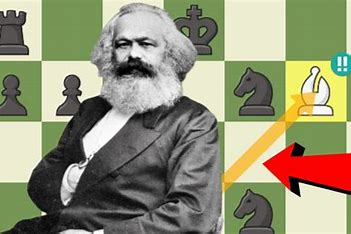
Hmmm. I think we also need to know from Ms Reeves that in winning the championship she did not use any of the chess moves favoured by Marx and described below
William Liebknecht’s 1896 memoir of Marx mentions in some detail his interest in chess and, in the 1850s, a certain obsession with playing it. While chess is mentioned in the many volumes of Marx and Engels correspondence it relates to political analogies rather than Marx playing chess games
Marx was an excellent player on the checkerboard. He had acquired such a dexterity at this game that it was difficult to win a game from him. He also liked to play chess, but here his art did not amount to much. He tried to make up what he lacked in science by zeal, impetuousness of attack and surprise.
In the beginning of the 1850s, chess was played frequently in our society of fugitives; we had more time, and in spite of the adage “time is money” less money than was agreeable to us, and under the direction of the red Wolff, who had chanced to gain access to the best society of chess players in Paris and had learned something, the “Game of the Wise” was zealously cultivated. We had many a hotly contested chess match. The loser did not have to provide any derision; and even while the match was in progress, the hilarity was always great and sometimes very loud. When Marx was hard pressed, he lost his temper, and when he lost a game, he was furious. In the model lodging house[1*] of Old Compton street, where several of us lived for a time at three shillings and sixpence per week, we always were surrounded by a circle of Englishmen who watched our game – chess is much cultivated in England, particularly among workingmen – with great attention and were amused by our merry, noisy ways. For two Germans make more noise than six dozen Englishmen.
One day Marx announced triumphantly that he had discovered a new move by which he would drive us all under cover. The challenge was accepted. And really he defeated us all one after the other. Gradually, however, we learned victory from defeat, and I succeeded In checkmating Marx. It had become very late, and he grimly demanded revenge for next morning, in his house.
At 11 o’clock sharp, very early for London, I was on the spot. I did not find Marx in his room, but he would be in immediately. Mrs Marx was invisible, Lenchen did not make an over-friendly face. Before I could ask whether anything had happened, Marx entered, shook hands and at once fetched the chessboard. And now the battle began. Marx had studied out an improvement of his move overnight, and it was not long before I was in a tight place from which I could not escape any more. I was checkmated, and Marx was Jubilant – his good humour had suddenly reappeared, he ordered something to drink and a few sandwiches. And a new battle began – this time I was the winner. And thus we fought with changing luck and changing humour without taking time to eat, satisfying our hunger by hastily taking from a plate that Lenchen had brought us meat, cheese and bread. Mrs Marx remained invisible, neither did any one of the children dare to enter, and thus the battle raged, surging up and down, until I had checkmated Marx twice in succession – and midnight had arrived. He insisted on playing more, but Lenchen, the dictator of the house under the supremacy of Mrs Marx, declared categorically: “Now you stop!” And I took leave.
Next morning, when I had just risen from my bed, somebody knocked at my door, and in came Lenchen.
“Library”- the children had dubbed me thus and Lenchen had accepted this title, for the title “Mister” was not in use among us. “Library, Mrs Marx begs that you play no more chess with Mohr in the evening. When he loses the game, he is most disagreeable.” And she told me how his bad humour had vented itself so severely that Mrs Marx lost her patience.
Henceforth I did not accept any more invitations from Marx to play chess in the evening. Chess playing, moreover, was forced to the background in proportion to our regaining regular occupations. As for myself who had acquired a certain reputation as a player in our little circle, I convinced myself in the course of time of the correctness of Lessing’s criticism of chess: “For a play too earnest, for earnest too much play.” I was Invited by prominent players; and in the company of professionals I soon found out that the moves I had invented and of which I had been so proud had been discovered centuries before my time; I thus saw myself placed in the position of that farmer in the Pyrenees who had discovered anew during the reign of Louis Philippe the tower clocks that had already been discovered four centuries before. I learned that a voluminous literature on chess existed and that, if I expected to excel, I should have to study this literature and devote myself entirely to chess. And to take up chess as a vocation I could not well make up my mind. So I gave it up. I have not played a game of chess since, but I delight in watching good players when I have the opportunity.
https://www.marxists.org/archive/liebknecht-w/1896/karl-marx.htm
Some more detail at this blogpost
https://tartajubow.blogspot.com/2020/04/the-chess-of-karl-marx.html


Leave a Reply