
30th December 1850, Fraternal Democrats end of year festival
The Fraternal Democrats were a left-Chartist group focused on international solidarity with links to Marx and Engels. They were organised by the Chartist leader George Julian Harney.
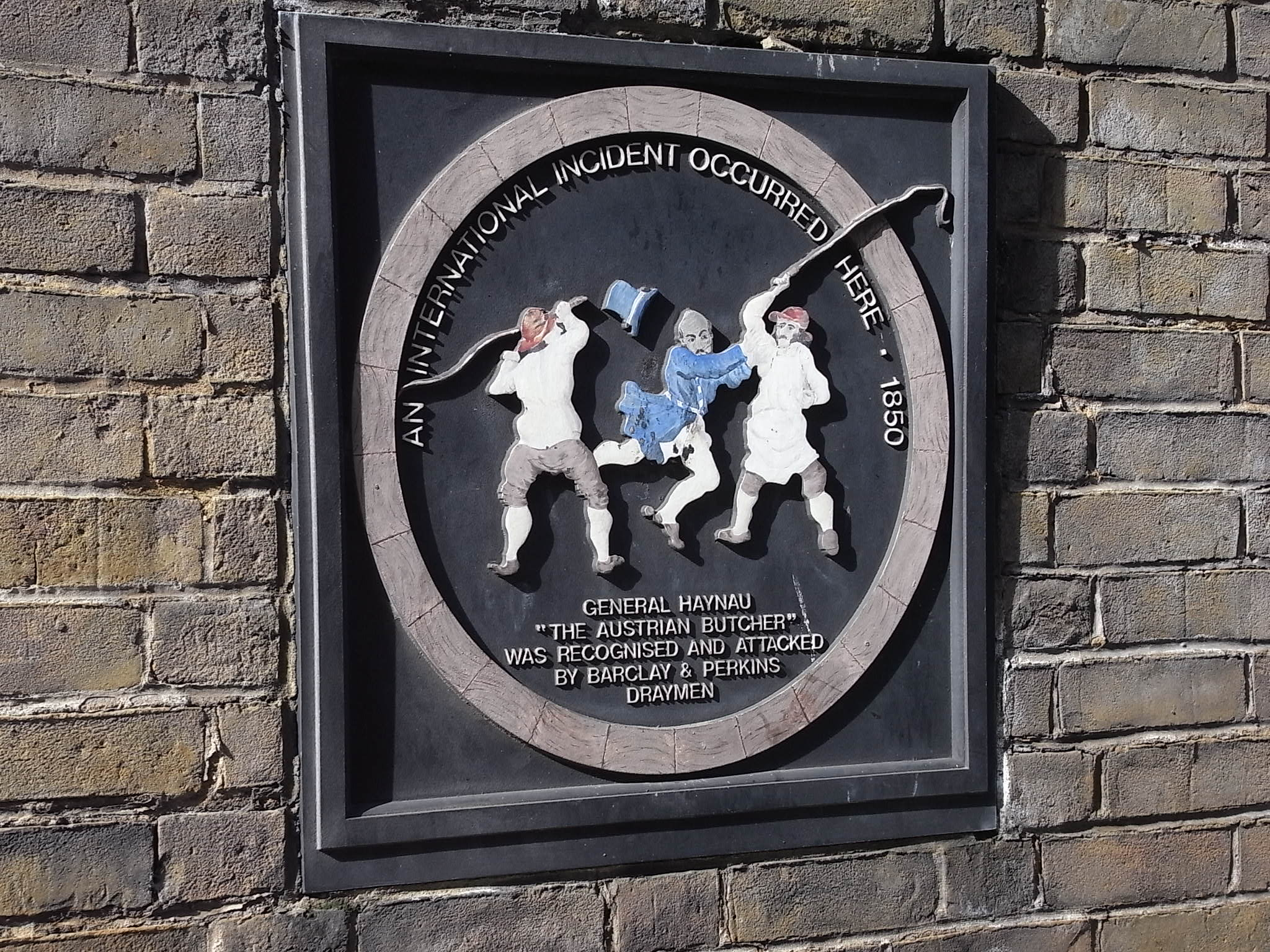
The text below makes reference to the Austrian leader Haynau who was chased by workers from the Barclays (later Courage) brewery when on a visit to London. The text is from the Northern Star 4th January 1851. It’s available free on-line where more speeches can be found!
The Literary and Scientific Institute was just off Tottenham Ct Rd in central London, a centre for radical activity in the second half of the nineteenth century
FESTIVAL OF THE FRATERNAL DEMOCRATS.
The annual festival was held on Tuesday evening December 30th, at the Literary and Scientific Institution, John-street, Fitzroy-square. About seven o’clock a very respectable party sat down to an excellent tea. After the repast was concluded G. J. Harney was called to the chair, and commenced the proceedings by giving a resume of the business and leading events connected with the Society during the twelve months which had elapsed since their last festival. In European politics they had but little cause, for encouragement—nowhere had the people become possessed of those institutions which could alone ensure them prosperity in return for their toil. In England the chief incidents in connexion with their society were the four days’ debate, in the House of Commons, on Lord Palmerston’s Foreign Policy ; the chastisement of Haynau by Barclay’s draymen, and the liberation of their, lately imprisoned brother, Ernest Jones. In reference to the policy of Lord Palmerston, the speaker showed the fallacy of his boast, that the rights and liberties of Englishmen had been duly protected abroad, and instanced the case of Mr. Baker, who had edited a publication culled the Radical, in Vienna, during the year 1848, and who had been put to death within twenty-four hours after the heroic Blum, and for whose murder Lord Palmerston had never demanded satisfaction of the cowardly, butchering, Austrian government. Not-withstanding his professed liberality, Lord Palmerston was as great an enemy to true democracy as was the Tory Aberdeen. The lynch-law, applied to Haynau by Barclay’s draymen, and the meetings called by their society to defend the conduct of those men, had drawn down upon them the condemnation of a portion of the press ; but it had at-attracted public attention to them, and extended their sphere of operations. A correspondence had lately taken place between the Austrian and English governments relative to the treatment of Haynau, in which the latter denounced the conduct of his castigators; but this would weigh but little compared with the approval stamped upon it by the British public. Mr. Barney then dwelt upon the services of Ernest Jones ; apologised for his absence on the ground of the illness of his wife; and denounced the conduct of those who were endeavouring to injure him in the public estimation. He then reviewed the progress of events in Schleswig Holstein, Hesse Cassel, and the larger Germanic States and denounced, in eloquent terms, the slavish doctrine of non-intervention, which was only adhered to when the people’s liberties were endangered, and ever broken when monarchy was threatened. The policy of the Fraternal Democrats was war to all tyrants. The same feeling which actuated an individual to assist his fellow-man when menaced with destruction, should actuate a nation to support another nation menaced with political death. He then called upon their continental brethren present to unite with each other, if no question of principle hindered, and show one undivided and gallant front to the unholy alliance of their monarchical and aristocratic opponents, until all Europe resounded with the cry of ” the Republic, Democratic and Social (cheers)…
Mr D W Burke gave the toast of “The Ladies,” .and a vote of thanks was given to the Chairman who duly acknowledged the same. Dancing and singing then commenced,, which was kept up to an early hour, and all seemed to enjoy the festive scene. Deputations from the, German, Hungarian, Polish and other Societies were in attendance and the Apollonic Society connected with the Institution sang many spirited choruses between the various sentiments.

 Kmflett's Blog
Leave a comment