
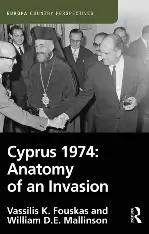
Socialist History Seminar Monday 26th January Vassilis Fouskas, How NATO powers divided Cyprus 1954-1974
Report
The seminar based on detailed archival research, looked at the strategic impact Cyprus’s location in the Middle East has had on NATO’s strategy after both Greece and Turkey (but not Cyprus) joined NATO) at the conclusion of the Korean War in 1952. The UK and US have a significant military presence in Cyprus to this day but the country remains divided following the conflict of 1974.
Conventional wisdom and ideologies hold that responsibility for the partition of the Republic of Cyprus in the wake of Turkey’s multiple advances on the island in summer 1974 rests on domestic ethnic and religious tensions between the Turks and the Greeks. This book, drawing on a wealth of archival material, shows that this is not the case at all. As the detailed report of the United Nations mediator, Galo Plaza, had shown in 1965, the Turks and the Greeks living on the island could easily have co-existed if left alone to determine their future. This did not happen. The partition of the island had been inscribed in NATO’s policy since the 1950s, rewarding the strongest component of NATO’s southern flank, Turkey, at the expense of Greece, the weaker component. The volume details the role of CIA agents in Greece and the machinations of the Greek junta of Dimitrios Ioannides to overthrow the charismatic leader of Cyprus, Archbishop Makarios, who had been fighting for an independent and non-aligned Cyprus. It also explains how the partition of Cyprus in 1974 has opened up prospects for the partition of the Aegean Sea between Greece and Turkey, with Greece’s eastern Aegean islands becoming ‘NATOlands’ in the service of the war against Russia.
Organised by the Socialist History Seminar at the Institute of Historical Research & the London Socialist Historians Group
Contact Dr Keith Flett keith1917@btinternet.com


How times change. Or not
Gill