
When the English working class made, how change happens & the case of Bank Holidays
E P Thompson’s Making of the English Working Class situated that process between the 1790s and the 1830s. The timespan may have been purely practical. His partner Dorothy Thompson worked on the Chartist period and the book was already nearly a thousand pages long.
Eric Hobsbawm (Worlds of Labour) countered that the hiatus between the Chartist period and the late Victorian one meant that it was more accurate to see the working class being made between 1870 and 1914. Characteristically for Hobsbawm he evidenced statistics on the building of seaside piers and Bank Holiday train excursions as evidence for a mass working class public.
Yet at least some of the institutions that remain characteristic of the working class in 2025 in fact date from the period between 1850 and 1870, for example the Co-Operative Movement and the TUC.
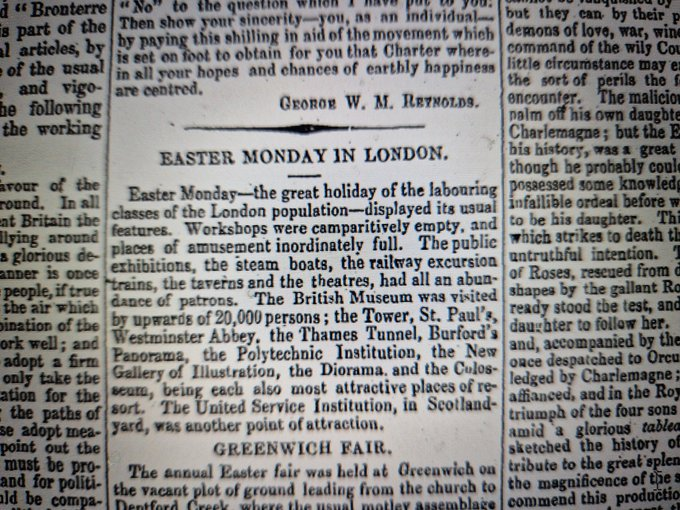
Easter Monday did not become a Bank Holiday until 1871 but evidence suggests that it was taken as a working class break- a practice known as Saint Monday-much earlier. The Chartist Northern Star reported on Easter Monday in London in 1850, 176 years ago, noting it as the ‘great holiday of the labouring classes’ where workshops were comparatively empty and places of amusement inordinately full.
From this it can be argued that the presence of an organised working class after 1850 from the New Model Unions to the Reform League and International Working Men’s Association meant that the State had to act to formalise Bank Holidays that many workers were in fact taking anyway- the traditional practice of Saint Monday.
Research work in progress, thoughts welcome, perhaps in particular whether (and for example) the London practice of observing Easter Monday as a holiday was also to be found in the mill towns of northern England where work-discipline was perhaps different..


Leave a comment