
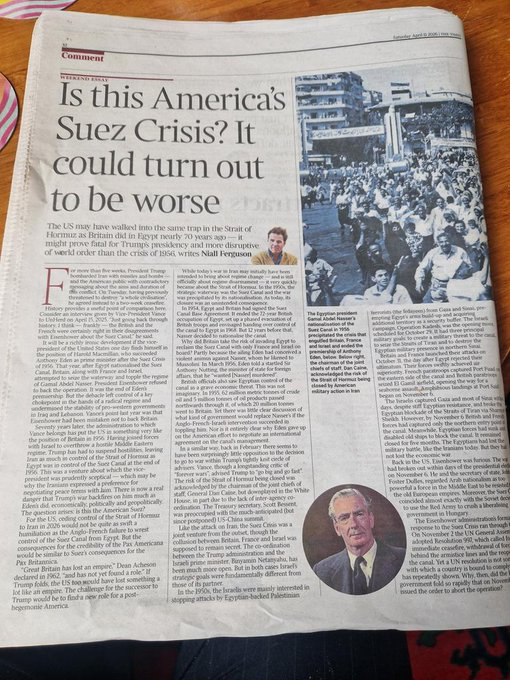
Right-wing historian Niall Ferguson argues that the Strait of Hormuz may end up worse for the US than Suez did for Britain
In October 1956 Britain along with France and Israel launched a military operation to gain control of the Suez Canal from Egypt which had nationalised it. The US did not back the mission and it ended in short order primarily because it was destabilising the British economy. It marked the end of Britain as an imperial power, and it might be argued that the ruling class has looking for a replacement role ever since.
Niall Ferguson is a veteran right-wing historian. That is not meant to denigrate his historical research much of which is interesting even if the conclusions can be debated. In recent times Ferguson has, perhaps, cast doubt on his professional judgement by becoming a Trump fan.
No more. In a lengthy piece in The Times (11th April) he suggests that Trump’s war with Iran may turn out even worse than Suez did, Trump knows nothing of history but JD Vance is aware of Suez, arguing that the US should have joined in. Now he is trying to find a way of extricating the US from the Strait of Hormuz debacle.
Ferguson who has clearly had his time with Trump suggests that the likely impact of the war on the US economy and a failure to achieve whatever the aim of the Iran War were supposed to be will also lead the US to find itself in a post imperial rolr.
He concludes ‘the core lesson of Suez is that time is not on the side of an overstretched hegemon because the economic costs of war pile up faster than the strategic benefits can be reaped’


Leave a comment