
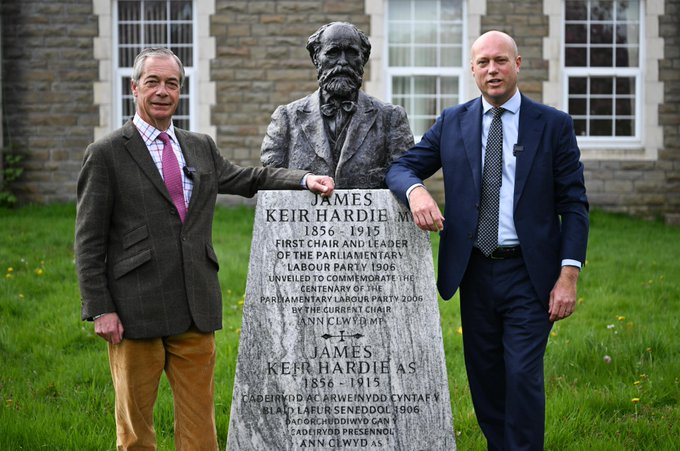
In another political stunt Nigel Farage has posed leaning on the statue of Keir Hardie in Aberdare, South Wales. With him is the former Tory leader of Barnet Council.
Farage’s knowledge of labour history is risible. If he was better informed he’d know that Hardie was a temperance campaigner and hardly a kindred spirit for Lunchtime O’Booze Farage.
Keir Hardie’s original base, from the late 1870s, was amongst first the Lanarkshire and then the Ayrshire miners in Scotland. He was a trade unionist, a full time organiser, with a Lib-Lab, that is a trade unionist within the Liberal Party, perspective on the world that focused strongly on issues of respectability such as temperance and religious observance.
Hardie stood as an independent labour candidate election in Lanark in April 1888 and in August of the same year he became the first Secretary of the new Scottish Labour Party.
In 1892 he travelled to the East End of London, another centre of a newly organising working class, to stand, without Liberal opposition, as a small ‘l’ labour candidate for Westminster. Hardie won and in August 1892 took his seat as an MP.
Questions were asked about where Hardie’s campaign funds came from. While Hardie presented himself as moving beyond his trade union background, as Caroline Benn’s definitive biography underlines, unemployment was even more of an issue in West Ham than it was in Ayrshire. The Scottish miners understood the link well enough and certainly gave some of the money for Hardie’s election.
The following year he was one of those who formed the Independent Labour Party.
When it came to the 1900 General Election Hardie, in era when it was possible to stand in more than one seat, was nominated in Preston and Merthyr in South Wales.
Preston was never likely at this point, on a still restricted franchise, to return a labour MP.
Hardie’s chances in Merthyr weren’t thought to be too good either. After all he was a Scot who had held a seat in London’s East End and was largely unknown in the area.
Hardie however had two things going for him. Firstly he had been a miner and a miner’s union official. Merthyr was a mining seat, but one which remained firmly Lib-Lab. This though was the period when the new Trades Councils were being formed in the area, and they were often a bedrock of support for independent labour politics
In a two member seat Hardie was elected MP and in the 1906 General Election was re-elected with an increased majority.
Hardie’s politics remained as they had developed from his background. A pacifist, he opposed war, and the First World War on that basis, not that of anti-imperialism. He was a determined advocate of an independent labour politics (although one that did deals early on with the Liberals) and a supporter of women’s suffrage which at that time placed him on the left of the labour movement. On the left, but certainly no revolutionary as Victor Grayson the MP for the Colne Valley was
The central historical point is that Hardie’s trajectory as a union and labour activist demonstrates that while issues of national independence are important ones, class politics transcends boundaries.
The spectre of united working class internationalism that Hardie in a way personified, continues to not only haunt the right but be of great relevance for the labour movement.


Leave a comment