
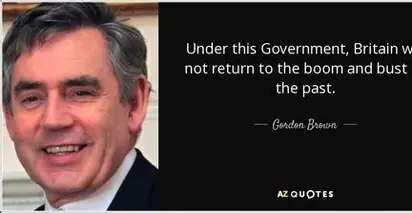
Remembering Gordon Brown 2008-10. Boom & Bust & nationalising the Banks
Starmer has appointed Gordon Brown as an envoy on global finance and cooperation. There is no question that Brown does know something about these matters. One half of New Labour (the other being Blair) Brown was a long time Chancellor and the PM.
Since he left Parliament he has not, unlike Blair, spent the time enriching himself or urging wars but has focused on child poverty and more recently on pushing for prosecutions in the UK over the Epstein scandal.
It is 18 years since the demise of Lehman Brothers caused a worldwide financial crisis the impact of which is still being felt today.
The late historian Eric Hobsbawm argued at a meeting of the Communist Party Historians Group in the 1950s that they ‘must become historians of the present too’. That is historians should be able to provide an historical context which will help understanding of what happens in the current day.
Many will think that Hobsbawm was a much better historian than he was political analyst and it remains to be seen whether his Forward March of Labour Halted will be seen over time as much more than an intellectual apologia for the rise of New Labour.
Even so Hobsbawm had a very good point when it comes to histories of the present. In the 24-hour news cycle, fed by the sound bite, there is little room for analysis let alone context.
Gordon Brown was Prime Minister when Lehmans went under and before that he had been the New Labour Chancellor since 1997. He set the Bank of England free from direct Government control and focused on a Labour policy that was pro-market capitalism. He claimed that his economic policy had moved beyond the boom and bust cycle that is inherent in capitalism. Clearly Brown had read even less of Marx’s Capital than Harold Wilson apparently managed.
2008 underlined big time that Brown most certainly had not abolished bust. He acted to shore up the capitalist system and it is worth reflecting that while he had some success in preventing a total collapse the then Tory opposition led by Cameron and Osborne offered no ideas whatsoever about what might be done to sort out the crisis.
Of course by 2010 they had had an idea of sorts. They still did not know how to address the fall-out from Lehmans but they were determined that their class was not going to pay for it. A policy of austerity was introduced, with the assistance of the Liberal Democrats in a Coalition Government.
The plan was simple. Market capitalism and market capitalists had suffered a near catastrophic crisis, largely due to their own greed and in some cases stupidity. Yet they were not going to pay for it either in corporate or personal terms. On the contrary those who had had absolutely nothing to do with the crisis, the working class, were going to pay through relentless cuts to public services.
We might also reflect, as Tony Benn did in his diary at the time, that 2008 was also the time when a New Labour Government had to do something it was in principle ideologically opposed to. Namely nationalise large parts of the British banking system.


“Since he left Parliament he has not unlike Blair spent the time enriching himself or urging wars”
Commas after “not” and “Blair” would have saved me much head-scratching and repeated rereading…