
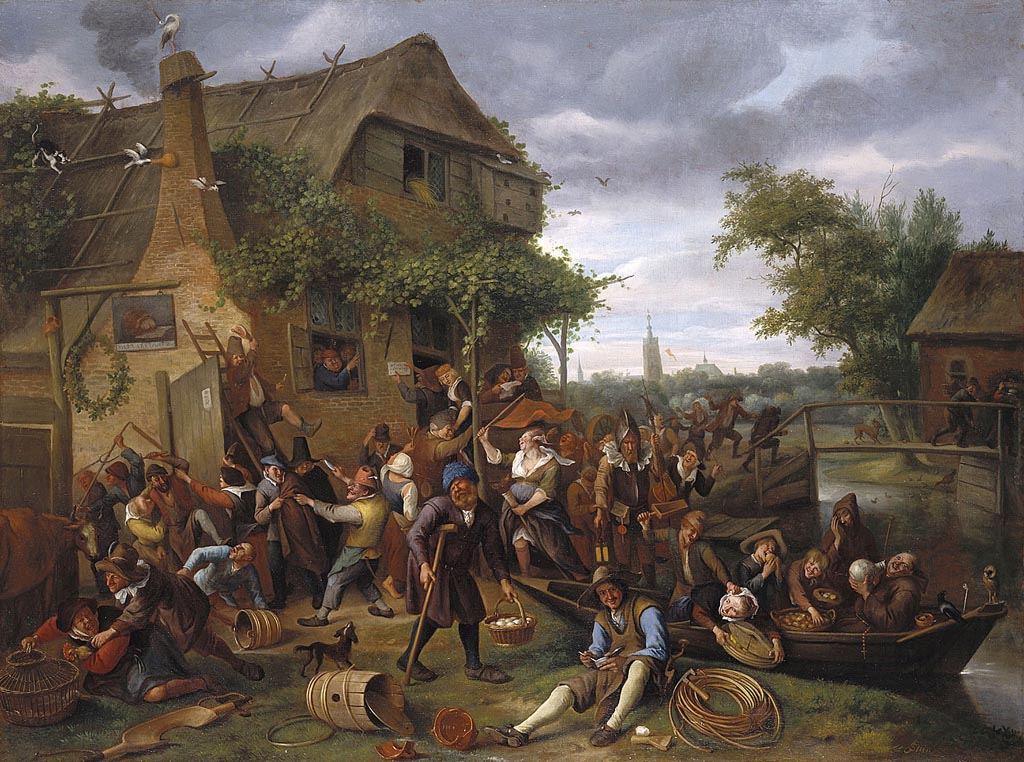
The moral economy was a term used by the late historian E P Thompson. It was focused on how local communities established a fair price for the staples of life in particular bread but also beer.
It applied in the later eighteenth century and relied on local ruling classes believing that while the system indicated there were rich and poor that did not mean the poor should exist in absolute poverty.
Hence local Assizes determined a fair price for bread, depending on the cost of wheat ,the quality of bread to be produced and a fair profit for the miller.
It was not a revolutionary process but one that sought an unequal social harmony within limits. Issues arose where millers sought to subvert the system and in particular where middlemen, regraters and forestallers appeared. They would raise the price of grain and take their own profit.
Thompson noted that on such occasions crowds might gather and seize the grain to make bread at a fair price. This was the exception not the rule.
He also argued that with the rise of industrial capitalism the concept of a moral economy didn’t work. He later relented and agreed that its application was so widespread as to be pointless to confine it to a specific time period.
The economist James Meadway has suggested that the cost of living crisis is a moment demanding the return of a moral economy. He has a point. It’s not about national inquiries. It is about local organisation to make sure, for example, food staples are sold at affordable prices and protests where they are not. It is also about regional protests on energy prices. Of course the companies involved are global but cracks in the monolith can appear at its weakest point where people organise and push back
How it would work: mixing the methods of E P Thompson’s Eighteenth Century with 2026
There are two key elements:
The Assize to fix a fair price-say for energy or transport. This might meet twice in a year (historically annually) including local councillors, trade unionists, community reps and where amenable representatives from the utility being reviewed. Historically it was a disputed but ultimately consensual process where a fair price and a fair profit were agreed
The pursuit of those that did not charge a fair price- often due to the intervention of middlemen- regraters. This was very much a ‘from below’ activity where protests might occur at markets, shop premises or HQs but with the framework of the agreed fair price.


Leave a comment