
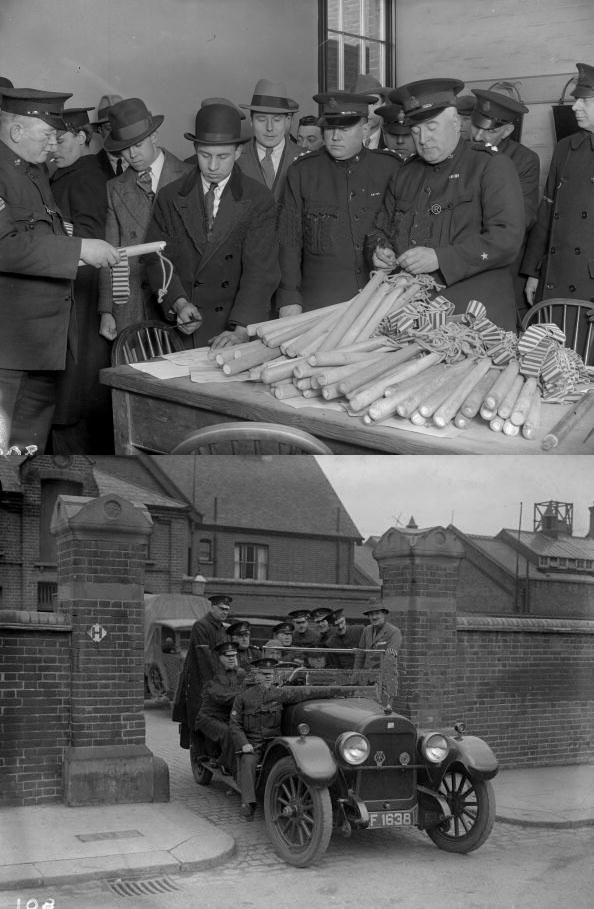
The Hornsey Special Constabulary in the 1926 General Strike
Socialist History Seminar. Adrian Weir, The General Strike & after. Global & local, the Comintern & Hornsey in the 1920s & 1930s. Report
The Hornsey Special Constabulary in the 1926 General Strike
Monday 15th June Adrian Weir, The General Strike and after. Global and local, the Comintern and Hornsey 1920s, 1930s
This was the second seminar in the summer term on the 100th anniversary of the 1926 General Strike. In May Edd Mustill spoke on his new book on 1926, Revolutionary Summer.
Convenor Keith Flett noted that the headline details of the Strike were mostly well known, perhaps with exception of the international solidarity referenced in Charlie Kimber and Judy Cox’s new book on 1926. There is plenty of room for discussion about, for example, the role of the Communist Party in the Strike and this was the subject of an event at the Marx Memorial Library in May where Mary Davis and John Foster spoke.
However there is much scope for further research on the impact of the Strike at local levels
Adrian Weir spoke on some new research on the Communist Party in Hornsey, North London, in the 1920s & 1930s looking particularly at the role of CP militants in the Hornsey and Wood Green branch of the National Union of Railwaymen.
As often his research both provides important new details of the Strike, before and after, but also peculiarities of the local area.
While the Red International of Labour Unions was focused on building new ‘red’ unions, in Britain the CP continued to work within the existing union structures. The National Minority Movement had been formed in 1924 but there was not a rail NMM conference until 1929.
However the local NUR branch produced a regular 4 page bulletin, the Hornsey Star, which emphasised class struggle. It did not call for NMM organisation however.
While the strike concluded after 13 days in May, the miners lock out went on until the end of 1926 and in January 1927 the Hornsey Star was calling for a levy to support the miners.
The NMM gave way to the National Vigilance Movement in the early 1930s its publication the Railway Vigilant achieving a circulation of 12,000.
Adrian Weir highlighted the work of local activist and CPGB member W C Loeber. He was Secretary of the local NUR branch and played a leading role in the Communist Party until he stepped back in 1929, possibly because of disagreement with the new Third Period line.
A carriage cleaner he stood for NUR General Secretary in 1933 but not win and left the CPGB in 1940. He retired from the rails in 1956 and died in 1965.
The long tail of an important figure in the General Strike in North London, over the next thirty years underlines that the Strike itself and its impact was about far more than the thirteen days in May.
These are my notes from the seminar and errors are mine. Hopefully Adrian Weir’s research will get wider circulation and also promote further research into trade union and socialist activity in North London both in 1926 and in the decades after.
Organised by the London Socialist Historians Group


Leave a comment