
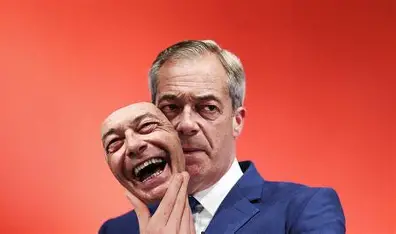
The two parties who voted against the Employment Rights Act both claim to be the workers party.
One of Nigel Farage’s operatives has posted an invite on social media for unions to ‘affiliate’ to Reform. Quite how any union can affiliate to Farage’s political business is unclear notwithstanding that has nil democratic structures and processes anyway.
The TUC and major unions such as the GMB and Unite have rejected Farage’s call pointing out his policies which oppose workers’ rights.
It’s certainly true that there are trade unionists who back Reform but they are late to the Party as it were.
The Tories have occasionally used slogan that the Tories are the Workers Party in the past
I have been a trade union activist nearly 50 years and I can well remember a time when Tory trade unionists had a reasonably serious presence as activists in the movement. They would traditionally oppose the involvement of Unions with ‘politics’ and were often to be heard saying that they wanted lower taxes because they could decide themselves how to spend money.
There is a well-known study of the working-class Tory voter by McKenzie & Silver, Angels in Marble (1968):
This is often seen in the same framework as the deferential voter and until the 1950s the Tories controlled some large northern cities such as Liverpool (the last time was 1972)
Some trade unionists still do vote Tory, but perhaps more voted Reform in 2024.
Most recent Tory thoughts on unions have been around issues like raising the bar on how many must vote for strikes or bashing the facility time of union representatives in the public sector or trying to make sure that workers have no employment rights until they have done two years in the job (now much lower under the new ERA)
Several Tory leaders ago there was some attempt to engage with genuine representatives of workers in the form of trade unions
Even before he came to Office David Cameron appointed Richard Balfe [a former Labour politician turned Tory MEP] as the Tory trade union envoy.
Mrs Thatcher who was a trade union member herself when working in industry had pursued a similar angle but the approach had lapsed.
Balfe was of course not universally popular in the labour movement. The link here gives a flavour of his views:
Balfe is now a Lord and the role of Tory trade union envoy appears long defunct.
Perhaps one of the ideas of the Tories as the workers party is that they aim to represent those [far too substantial] sections of the working class who are not trade unionists.
In reality the workers party boast in 2026 whether Reform or the Tories is just an empty slogan. To give it any substance both would have needed to back the Employment Rights Act. Given that the current Reform and Tory leadership, elected or otherwise, see one of the key reasons for leaving the EU, as a chance to have a bonfire of employment rights, it seems an unlikely scenario.
To be clear if Reform or the Tories or a combination of them, win the next General Election they will not protect or extend workers rights, they will abolish them. It underlines the need to build union organisation at the grassroots to push for better pay and working conditions. Something neither Farage of Badenoch will be found doing.


I remember seeing a documentary about the late 60s, with footage of Norman Tebbitt as a striking pilot/trade unionist, at the same time as being a Conservative prospective parliamentary candidate (PPC).