
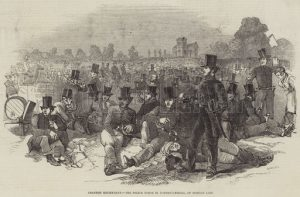
12th June 1848: a missed chance of Revolution?
Rob Sewell’s new history of Chartism, rightly argues that while most historical studies have seen the Chartist rally for the vote on Kennington Common on Monday 10th April as a failure, the events of 12th June were more significant but usually meriting little more than a footnote.
As Sewell rightly notes the Chartist challenge of June 1848 was more serious than that of April and regarded as such by the authorities. The reason was because the Chartist agitation was not only geographically widespread but also on a broader basis.
At least in terms of London the State tried to mobilise the same forces that had been used in April, although considerable resistance was met from special constables.
The Chartists had seen April 10th as a failure in the sense that the plan to march to Parliament and present the petition was frustrated. A reorganisation had taken place during May, although without arguably, a total degree of clarity.
The motor for renewed agitation was the conviction of the Irish radical Mitchell towards the end of May. He was found guilty under the repressive Crown and Treason Felony Act and sentenced to 14 years transportation, initially to Bermuda and subsequently to Australia.
The verdict provoked nightly demonstrations in London from the end of May, which brought together Chartists and Irish Confederates. The numbers involved were sometimes considerable with reports of 80-90,000 marching in central London.
In Bradford the Chartists and Confederates engaged with the military and control of the city was in dispute for several days in early June. As The Times noted ‘if fighting with pluck and courage could make a revolution, then the Bradford Chartists ought to have succeeded’
A London rally was planned for Bishop Bonner’s Fields in East London on Monday 12th June. Feargus O’Connor was elsewhere in the country promoting the Chartist Land Plan on the day. It was very much a plan of the Chartist left who wanted to complete the work of April 10th.
What exactly completion meant is open to question. As expected the Commons had rejected the petition for the vote and ideas of appealing to the Queen were seen as futile. Perhaps some kind of plan for a rising was in place.
Certainly the Government took precautions on this basis while trying to avoid the alarm of April. All meetings were banned and the Chartists were clearly told that the East London meeting would be illegal.
The Chartist organiser on the day was McDouall who was certainly present on Bishop Bonner’s Fields. Considerable numbers of Chartists gathered in the environs, and the police presence only asserted itself after this had happened to avoid a confrontation for the space.
Even so no actual meeting took place. As the Northern Star (17th June 1848) reported a thunderstorm cleared the police from the field by which time most Chartists had also dispersed.
As with April 10th it was not the end of Chartist attempts at change in 1848 and the picture of what took place around the country is far from complete.
As a Times Editorial (2nd June 1848) noted of Chartism ‘the snake has been scotched not killed’


Leave a comment