
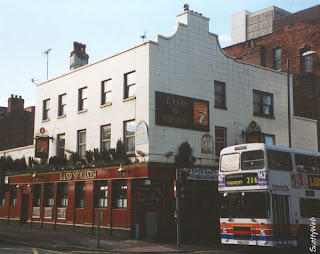
The site of the Griffin pub
Burnham plans a No.10 of the North in Ancoats, where the world’s first working class political party was formed in 1840
Andy Burnham has revealed plans to set up a No.10 Downing St of the North in Ancoats in Manchester’s Northern Quarter.
185 years ago the world’s first working-class party was formed at a meeting in a Manchester pub
The National Charter Association, the first working class party anywhere in the world, was formed at a delegate meeting which began 186 years ago on 20th July 1840.
The NCA provided an organised structure to attempts to win the vote for working men around the Six Points of the People’s Charter.
It had an elected provisional Executive, and a branch structure with a paid membership. It lasted until 1860.
The concept of a trade union focused party came much later in the nineteenth century, although the NCA did work with the trade unions of the day which were often Chartist focused. The NCA did however encompass a wide range of views from moderate Parliamentary reformers to those who supported a socialist revolution such a George Julian Harney.
The meeting took place in the Griffin pub in Great Ancoats St, Manchester. The pub dated from 1791 and was closed in 2005 by which time it was known as the Land O Cakes. It is now the Bem Brasil restaurant*
Perhaps typically of how much of Britain’s working class history is either forgotten or not remembered at all I don’t believe there is any current plaque on or near the spot to mark the event.
*thanks to @gwilty200 for info on what the pub is now
Who attended (the conference started on a Monday)
Source: Manchester Conference 1840 | chartist ancestors
The following names are those of the delegates to that first Manchester conference (source: History of the Chartist Movement, 1837-1854, by R.G.Gammage ).
John Arran and Joseph Hatfield, West Riding of Yorkshire.
James Leach and James Taylor, South Lancashire.
J.Deegan, Staleybridge and Liverpool.
David John, Merthyr Tydvil and Monmouth.
J.B.Hanson, Carlisle.
W.Tillman, Manchester.
George Halton, Preston.
Samuel Lees, Stockport.
Richard Littler, Salford.
Mr Andrew, Glossop.
Mr Lowe, Bolton.
Samuel Royse, Hyde.
William Morgan, Bristol, Bath and Cheltenham.
James Cooke, Leigh.
George Black, Nottingham.
James Williams, Sunderland.
Thomas Rayner Smart, Leicester and Northampton.
James Taylor, Loughborough.
Richard Spurr, London.
Richard Hartley, Colne.
What the meeting decided
A NCA Executive Council, consisting of seven full-time, paid members, was responsible for the co-ordination of the national Chartist movement.
- The general secretary was to be paid £2 a week, and members of the executive were to receive 30 shillings a week while they were sitting.
- The Executive Council was to be elected annually by a ballot of all NCA members with each county being able to nominate one candidate.
- Members of the NCA had to sign a declaration agreeing to the Association’s principles and buy a 2d quarterly membership card. Where possible members were organised locally into classes of ten under a class leader who was responsible for collecting each member’s 1d subscription.
Classes were grouped into wards or divisions and monthly ward meetings heard reports from class leaders.
- There was to be a ‘collector’ for each ward responsible for forwarding subscriptions to the National Executive.
- The membership was divided into classes of ten, whose leaders fed into was, town, ‘county and riding’ that had its own councils with officers elected democratically.
- There were to be local branches, and an annually elected general council and an executive.
- Half of the money collected by local branches was to be at the disposal of the executive and plans were formulated to stand Chartist candidates at the next general election.


Leave a comment