
Ed Miliband became Foreign Secretary on 20th July and a statement has already made clear his position on some key issues:
“My parents came to Britain as Jewish refugees from the Nazis. To them, Britain was both a sanctuary and a beacon of hope in the global fight against fascism. I will carry my parents’ faith in that spirit of Britain to my role representing our country.
“I will be a Foreign Secretary who fights for Britain’s interests and our values of democracy, freedom and the rule of law on the world stage.”
He promised to maintain close ties with both the EU and the United States, as well as upholding Britain’s commitments to Nato and the United Nations. Miliband added: “The FCDO (Foreign, Commonwealth and Development Office) I lead will also be at the forefront of issues which pose profound and substantial threats to justice and equality in Britain and across the world.
“We will work with others on tackling the climate crisis, strengthening our partnerships for international development, and reforming our international institutions so they deliver for all countries, including the world’s poorest people.”
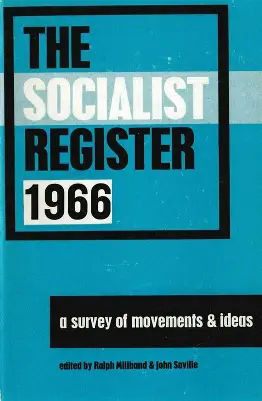
Below is an extract from Ralph Miliband’s 1966 assessment in the Socialist Register, an annual survey which he co-edited with John Savill, of Harold Wilson’s Labour Government. I’ve picked out a section on foreign policy.
Of course Ed Miliband is not his father and he is certainly somehow required to echo his views, despite the persistent efforts of the right-wing media to suggest this. Even so he is on the left so to compare and contrast the positions is interesting. Sixty years different contexts apply politically and any analysis must account for that. However while US imperial power still exists, as it did in 1966 it is weaker having suffered a series of defeats.
Its not a question of reaching a judgement but of organising and campaigning for a left position. Here I think Ralph Miliband made some good points, albeit his views of course did vary over the years.
Ralph Miliband, Socialist Register 1966
As in home affairs, so in the field of foreign affairs, colonial affairs and defence. Whatever measure of comfort Labour supporters may be able to find in some of the Government’s actions at home, there is no such comfort to be found in relation to foreign and colonial affairs or defence policy. In these fields, the Government has shown a degree of conservatism and orthodoxy more consistent and unswerv- ing than would have been thought likely by even very sceptical people before it was elected, the writer included. After all, it was only a few months before the General Election that Mr. Wilson, then Leader of the Opposition, asked the then Prime Minister, Sir Alec Douglas Home, to “make it quite clear-as we asked him to make it clear in March-that we would not support any extension of the war into North Vietnam”;4 and it was only a few months before that that Mr. Wilson had said that “there never has been a time when the world, through the U.N., or the Commonwealth, has looked more anxiously to Britain for a lead, a lead on disarmament-instead of tamely following every American statement-a lead in the attack on world poverty, a positive stand on racial discrimination and racial oppres- ~ion”.~ Whether the world was waiting quite so anxiously for Britain may be in doubt, but if it was, it must have discovered its mistake fairly early on in the life of the Wilson Administration. For “tamely following every American statement”, and act, and policy, is precisely what the Labour Government has done throughout its period of office. The notion of a “special” British relation to the United States has sometimes been discounted in the recent past. It should not be, for it has been reinvigorated by the Labour Government, in a special sense: no government, apart from satellite and client states proper, has been quite such an eager and faithful supporter of American pur- poses and enterprises. Vietnam is of course the most obvious as well as the most ignoble instance of the spirit which has moved Mr. Wilson and his colleagues. In the face of one of the clearest and most authentic cases in this century of a popular struggle for national and social liberation, the Labour leaders have not hesitated to support America’s attempts to drown that struggle in blood, or to endorse the most spurious Ameri- can claims as to the nature of the conflict.


Leave a Reply