
On August: no home but the struggle
In the labour movement calendar August is often seen as a quiet month.
Of course as Mayhew’s costermonger had it when it seems quiet, preparations are going on for future activity. However trade union conferences are completed and the annual festivals, the Durham Miners Gala and Tolpuddle, have also been and gone.
As Eric Hobsbawm noted from the 1880s August became a month for the working class to take a holiday even though there was no legal time off until 1938. Rail excursions and the construction of seaside piers were symbols of the change. The 1871 Bank Holidays Act set the August holiday as the first Monday of the month, as this was the busiest holiday period, coinciding with the annual closure of many mills and factories.
The labour movement year traditionally resumes with the TUC Congress, in 2026 in Brighton.
Yet August was not always a quiet month
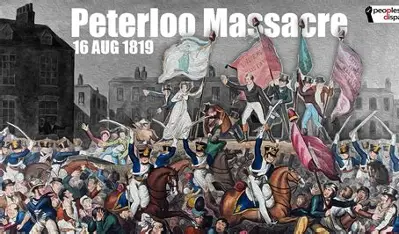
On Monday 16th August 1819 60,000 people from neighbouring towns and villages marched for a rally at St Peters Field in central Manchester. They were demanding the vote and an end to the Corn Laws which raised the price of bread. While the protesters could have been armed- veterans of Waterloo were present-the decision was made to make it an entirely peaceful affair. The Government had other ideas. The Yeomanry, local businessmen on horseback were sent in to break the protest up. 18 were killed and hundreds injured.
A wave of repression of meetings and demonstrations followed but a template had been set.
Twenty years later in 1839 the Chartists still pursuing the vote adopted the long held idea of veteran radical William Benbow and called for a Grand National Holiday to end capitalism. The Holiday started on 12th August 1839. The plan was to stop work and refrain from all taxable items such as tobacco and alcohol so that the rule of capital became unsustainable. It was well supported but could not be sustained.
In August 1842, still associated with the Chartists, a different strategy was deployed. Strikes had started in Staffordshire in July but on 8th August 1842 a sustained attempt was made to stop mills and factories working across North-West England. History has condescendingly recorded this as the ‘plug plot’. In fact it was a well organised General Strike. It involved groups of workers marching from mill to mill and pulling the plugs from the boilers which powered them. It was an early version of what we know as the flying picket. Again while it was well supported it could not be sustained.
The final August event was the attempted Chartist insurrection in Seven Dials, Central London on 16th August 1848. The motor for an armed attempt on the Capital stretched back to frustrations after the Chartist demonstration on Kennington Common on 10th April was prevented from reaching Parliament.
A key figure in August 1848 may, or may not have been the black leader of London Chartism William Cuffay. He was sentenced to be transported to Tasmania, where he continued to be politically active.
It turned out to be a fiasco because it was built by series of secret meetings, a conspiracy. Early Spycops infiltrated the meetings, arrests were made, and the plan to seize power fell apart.
All these August events took place 175 or more years ago yet there remain lessons for today. Opening organising was essential, and a variety of strategies and tactics were deployed. That they failed does not mean that used again in a different context they might not work this time.
This post appeared originally in the Morning Star


Leave a comment