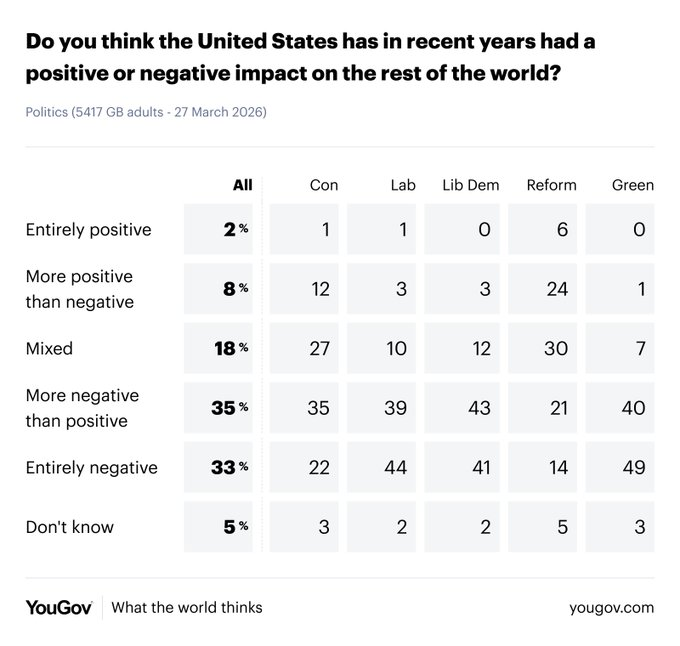
Nigel Farage doesn’t agree and Keir Starmer is not sure yet…

Nigel Farage doesn’t agree and Keir Starmer is not sure yet…
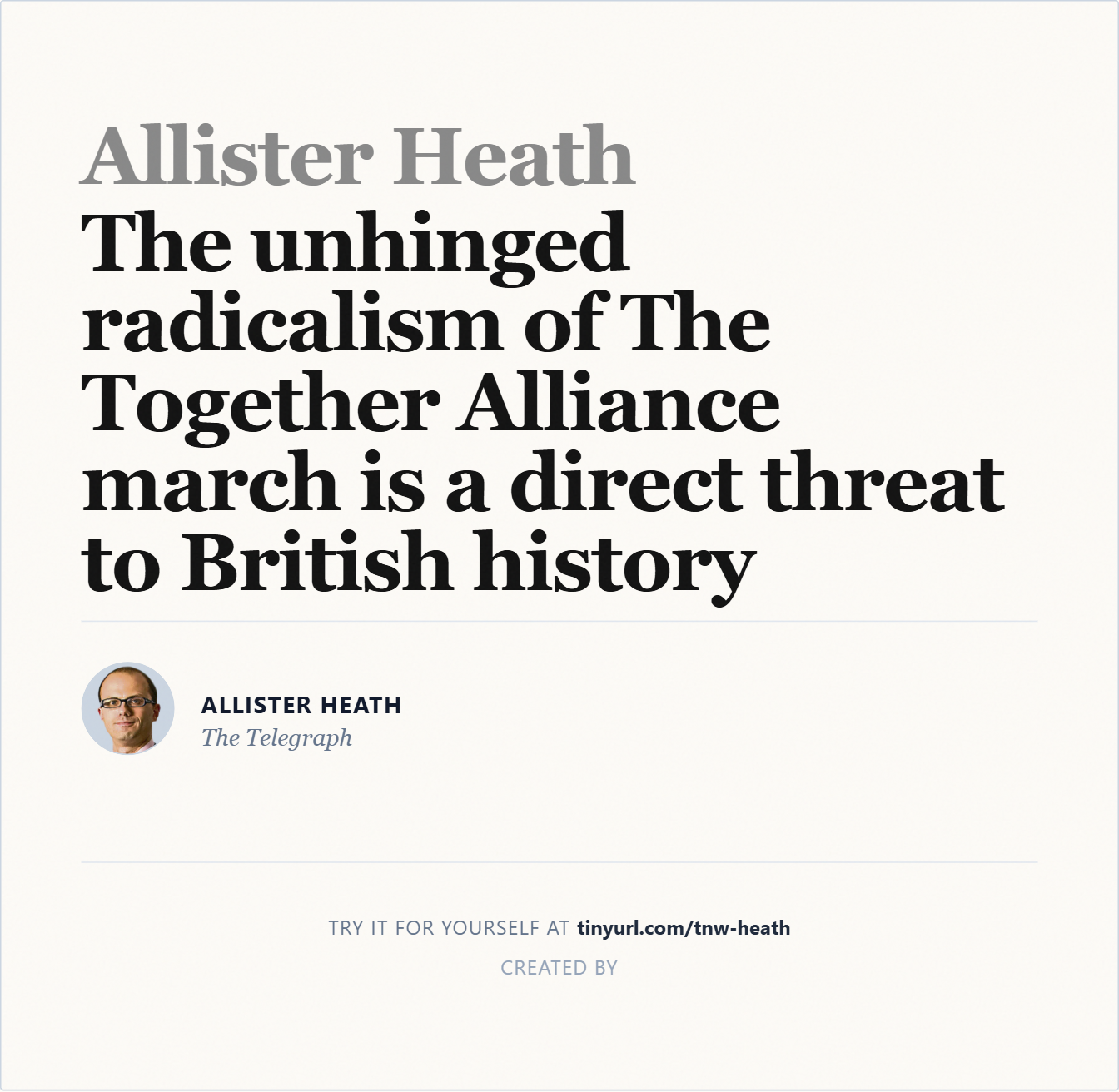
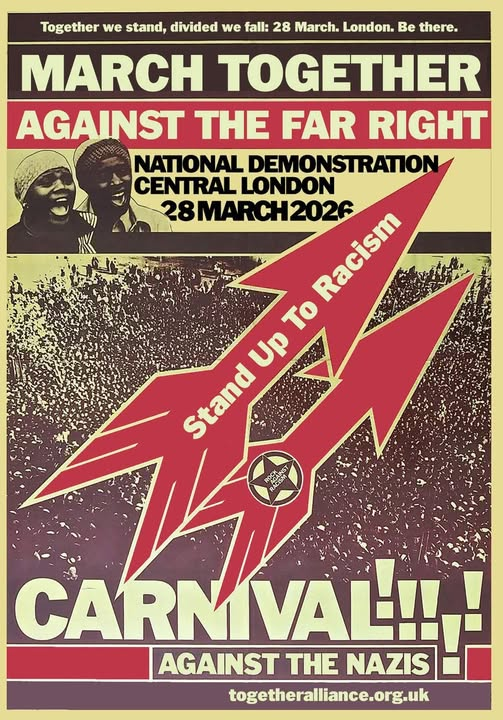
On 28th March 500,000 people marched against racism and far right under the banner of the Together Alliance.
This New World generated random headline may yet make it into the Telegraph. Allistar Heath is the Editor of the Sunday Telegraph
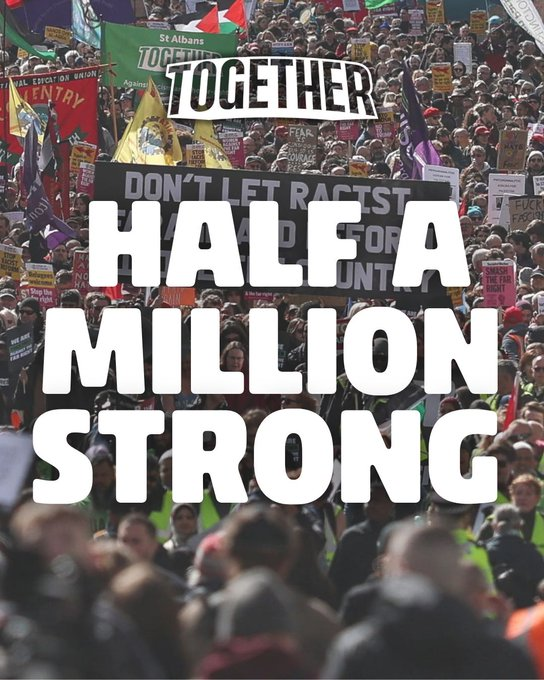
The Together Alliance protest in central London on 28th March brought an estimated 500,000 on the streets against racism and the far right.
The number of trade union banners was significant but so also were the home made placards a sign of a movement that reached well beyond the ‘usual’ protest crowd.
The Metropolitan Police not usually regarded as a body that has a strong relationship with reality claimed 50,000 had marched although they weren’t really sure. Indeed for a long period the Met gave up counting numbers on protests since they were simply inflicting further reputational damage on themselves.
The Met not known for competence seems unaware that it has a Twitter account that posts time stamped details of central London demonstrations and pictures of them. Count as you will if the back of the march is still in Park Lane and the front is in Trafalgar Square that is a very large protest.
It is indeed difficult to be precise on numbers as on many very large demonstrations which invariably move slowly, people come and go. On 28th March there was not only the main Together Alliance march but a feeder Palestine Solidary march too.
The downplaying of protest numbers has a very long history stretching back to the first mass demonstration captured by photograph, the Chartists call for the vote on Kennington Common on 10th April 1848. Official estimates claimed 20,000 while Chartist leader Feargus O’Connor suggested a much larger number. Probably around 100,000 were actually there, almost all from London.
The Together Alliance was a national protest and the numbers suggest a heightened intensity of protest.
On 30th April 1978 100,000 were in Victoria Park in East London for a Carnival Against the Nazis. The National Front were at best fourth in the polls and had no MPs. Reform marks a step change as does the 28th March protest.
The Birth of our Power to focus the work of rooting out the far right in workplaces and communities took place on 28th March.
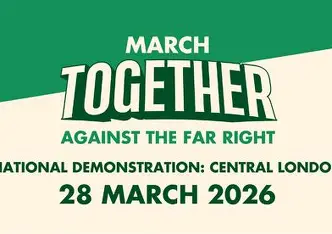
The Guardian is carrying interviews and details of the Together Alliance march against racism and the far right with journalist Robyn Vynter.
It reflects the scale of support and mobilisation and it is historically unusual. The Guardian’s coverage of demonstrations is patchy and nearly always is a report of the event after it has taken place.
In fact, much as they operate in an anti-democratic way the Met Police’s Twitter account is often the best place to find out what is happening on central London demonstrations because they post time stamped pictures of crowds and locations. Assuming these are saved for posterity they will be a useful source for historians,
Meanwhile, see you on the demo
The Guardian 27th March 2026
Where does this fit historically?
I am old enough to remember Red Wedge back in the 1980s, campaigning to try to boost Neil Kinnock’s hopes of ousting Margaret Thatcher. Indeed, figures like Paul Weller and Billy Bragg, who are backing Saturday’s march, were involved in that back in the day.
Robyn tells me that she has seen the march being relentlessly pushed by the algorithms on Instagram. “Even if it hasn’t had huge traditional media coverage, that kind of reach really matters now. I think it’s going to be big.”
Last year a reported 110,000 people attended a far-right protest in London organised by Tommy Robinson. Billed as a “festival of free speech”, the rally saw the spread of racist conspiracy theories and anti-Muslim rhetoric, and a contribution from Elon Musk. The scale of the crowd exceeded expectations and led to clashes with police, leaving at least 25 people arrested and 26 officers injured, as bottles, flares and other projectiles were thrown.
This time around, Robyn tells me she thinks there is “an element of fear” driving the organisation. “People saw the riots the summer before last, and the big far right demonstrations. It worried people, and I think it made a lot of them feel they needed to do something. A lot of people feel powerless watching politics and the rise of the far right, especially if they’re not party political or already involved in activism. This march gives them an outlet. It’s a way of saying: ‘we’re here too’.”
Whether Saturday’s march marks a moment of consolidation for the progressive left coalition or simply another chapter in a long-running cycle of protest and counter-protest may not be clear immediately. But its expected scale – and the breadth of support behind it – tallies with a sense in British politics right now that people are more easily prepared to come together to act against a possible outcome rather than for a specific cause.
London Socialist Historians Group
March 27th
Contact LSHG Convenor Dr Keith Flett @keithbeard.bsky.social
March against hate & division Together on March 28th. Make history from below
The London Socialist Historians Group which organises the socialist history seminar at the Institute of Historical Research has said it is backing the Together Alliance march against racism and the far right in central London on March 28tn.
The historians say that while the media focuses on Nigel Farage and often promotes racism and division, history can be made on the streets and from below. That history can be one of anti-racism and unity.
Some of the biggest and most progressive changes in British society in the last 50 years have come through mobilisations of communities and workplace around the country. From the Victoria Park Carnival on 30th April 1978 to the march against the Iraq War on 15th February 2003 to the sustained national demonstrations on Palestine from October 2023, popular protest has reached the parts that Parliament and Head Offices cant.
LSHG Convenor Dr Keith Flett said, the Together Alliance march is history in the making. Its time to make that future now
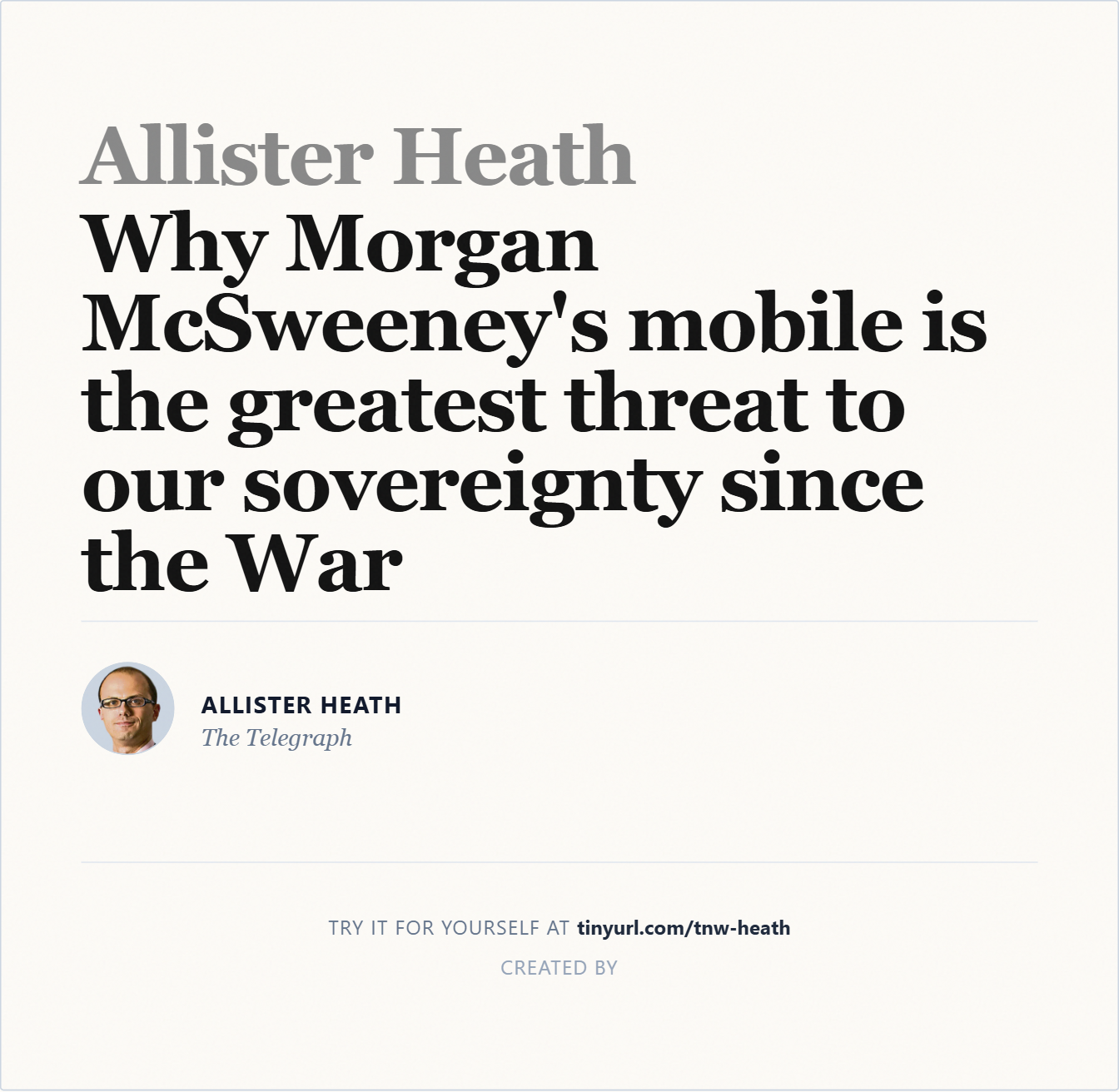
Allister Heath is the Editor of the Sunday Telegraph but this of course is the New World’s random headline generator
McSweeney has gone down a little in my estimation. Why didn’t he have a burner phone for his chats with Lord Mandelson?

Marcus Rediker is a long standing socialist historian standing in the tradition of history from below associated with E P Thompson and others.
Rediker’s work has focused on slavery, sailors, ships and the sea and the global political importance of links between them. In an interview with Socialist Worker about his new book Freedom Ship, Rediker criticises what he calls terracentrism. The idea that history takes place on dry land. Rather Rediker’s researches underlines a lot of history has taken place at sea, on ships and on the waterfront.
E P Thompson’s Making of the English Working Class contains a surprising amount about the sea and sailors. For example writing about the 1797 naval munities at Spithead and the Nore Thompson notes that it was only the British Navy that stood between Britain and the ideas of revolutionary France.
The Socialist Worker interview discusses history from below
The essence of your work is history from below. Would you explain why this is integral to you?
History from below is an insurgent approach to the study of the past seeking to understand the lives, thoughts and actions of the mass of people who have been left out of the top-down narratives.
The goal is to study the workers of the world, not only as subjects, but as makers of history.
In my case, the ultimate challenge of history from below was to write The Slave Ship: A Human History, 2007. How to write a history of millions of people, forced onto thousands of slave ships and carried across the Atlantic to slave away on plantations, when those people left very few documents of their own?
I argued that the resistance of enslaved people on the lower decks of slavers was crucial to the growth of an anti-slavery movement and ultimately to the ending of the slave trade altogether.
I picked up that theme again in Freedom Ship, showing that the quest for self-emancipation in the 19th century were a direct continuation of those that began among an earlier generation of struggles aboard the slave ships.
Harriet Tubman captured this continuity of oppression and resistance when she described escaping slavery by sea as a “middle passage” to freedom.
Freedom Ship: Uncovering the story of escaping slavery by sea
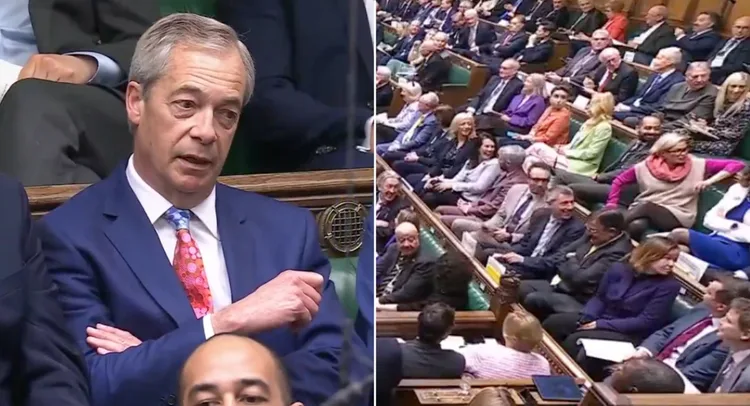
There may not be too many people who feel the need to leave a space after being criticised by Keir Starmer. Some might regard it as badge of honour.
Yet, and unusual full marks to Starmer here, that’s exactly what Farage and his crony MPs did at Prime Minister’s Questions in the Commons on 25th March after Farage was called out for the grifter that he is
Keir Starmer
My hon. Friend makes a powerful point. The Communities Secretary will make a statement later on the Rycroft review, which sets out the stark threats posed by illicit finance. I can tell the House that we will act decisively to protect our democracy. That will include a moratorium on all political donations made through cryptocurrencies, and I hope that will be welcomed across the House. There is only one party leader who has shown that he will say anything, no matter how divisive, if he is paid to do so.
(Clacton) (Reform) “Smash the gangs”—that is what the Prime Minister promised us. “Trust me, I will stop the boats from coming.”
Beard Liberation Front
25th March
Contact BLF Organiser Keith Flett @keithbeard.bsky.social
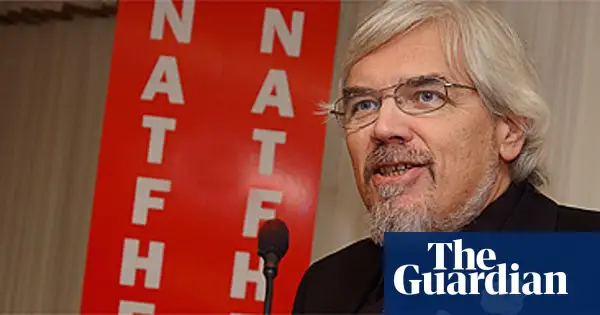
The Beard Liberation Front, the informal network of beard wearers, has sent 76th birthday greetings to Paul Mackney.
Mackney was declared joint Beard of the Year along with cricketer Freddie Flintoff in 2005.
https://www.theguardian.com/education/2005/jan/04/furthereducationdiary.furthereducation
He was General Secretary of NATFHE at the time and then became briefly joint General Secretary of the then newly formed UCU.
https://en.wikipedia.org/wiki/Paul_Mackney
BLF Organiser Keith Flett said, we’re sending virtual beard power to Paul Mackney on his 76th birthday. He was one of the great early supporters of and advisers to the Beard Liberation Front and we’re pleased that he and his beard remain very much intact.
View more by category: Uncategorized (13,695). .

 Kmflett's Blog