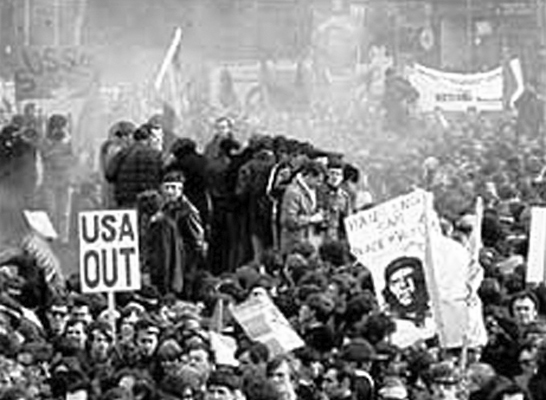
Grosvenor Square 1968 (railings came afterwards)
It is the 50th anniversary of the events of 1968, events that shook the world west and east and did a good deal to give rise to many of the ideas and movements, from womens and gay liberation to a new left politics that were to be key features of the decades that followed.
How 1968 is remembered and assessed 50 years on is, as it were, up for grabs.
It is a moment when those who were there will, either want to make sure their contribution makes its way into the historical record, or depending on their position in society now, do everything possible to make sure it doesnt.
The 20th anniversary in 1988 saw a number of books including David Caute’s The Year of the Barricades and the 30th anniversary in 1998 saw the publication of Tariq Ali and Susan Watkins Marching in the Streets.
More recently Michael Rosen’s memoir So They Call You Pisher! has interesting passages on being a radical student in 1968
The London Socialist Historians will be holding some seminars and events at the Institute of Historical Research from May onwards.
Meanwhile the assessment on the 10th anniversary by David Widgery sums up well I think what 1968 felt like for those who were there:
_________________________________________________________________________________
David Widgery Ten Years for Pandora (Socialist Review May 1978)
https://www.marxists.org/archive/widgery/1978/05/10years.htm
THERE ARE TIMES, remarkable times, which clear up in weeks the disorders of centuries. 1968 was such a time – of the audible end of eras, of a collision of turning points, of new possibility. 1968 was the critical year in the Vietnamese three-decade-long war for independence, the year of the most important popular movement in Eastern Europe since 1956, the biggest ever general strike in European history and street battles in Derry which took the Irish question out of the impasse set by the settlement of 1921. All the social authorities which had seemed eternal were unsettled as ’68’s semaphore signalled from the ditches of Da Nang to the corridors of Nanterre, passed on to the car factories of Billancourt and Le Mans to the squares of Bratislava and Prague, then onto the bloody pavements of Mexico City and Chicago, Belfast and Grosvenor Square.
1968 acts as a marker of the end of the long boom and the re-emergence of socialism to the left of the Communist Parties, and, slightly later, revolutionary feminism as active, organised political forces. Suddenly the post-war double-act of a Communist world which denied communism and a Free World which wasn’t free looked the farce it was. The Emperors – De Gaulle, Lyndon Johnson, Brezhnev – had no clothes. The powers-that-be were scared of us, their once obedient servants.
The year began politically in central Vietnam with the Tet offensive, which can now be seen as a tour de force of strategic warfare. The Pentagon generals had in the mid-60s embarked on the most hideous phase of their war, an attempt literally to annihilate the rural societies in which the Viet Cong had their political roots. Search and destroy operations were carried out with routine brutality, peasants suspected of disloyalty were herded into concentration camps called strategic hamlets, rebellious regions became free fire zones for artillery, computerised B-52 runs and helicopter gun-boats. The clouds were seeded, the crops dried up or flooded, children scorched. Babies are to this day born twisted and deformed from that aerial poisoning. The Vietnamese resistance was to be obliterated by the technology of Coca Cola and Cape Kennedy.
The solidarity movement in the West which sought to awake the blunted moral responses to this macabrely efficient war of annihilation was itself marked by an appalling sense of ineffectuality. Inevitably we cast the Vietnamese as victims – how could they not be overwhelmed by the most powerful empire in human history?
But, after the initial feint at Khe Sanh and the swift and peaceful capture of Hue on 31 January 1968, it became clear that the National Liberation Front of South Vietnam had launched a sustained and general urban assault, opening prisons, overrunning arsenals and bases, knocking out US equipment on the ground, revealing simultaneously the inertia of the South Vietnamese puppet forces and the extent of their own underground civilian support. The NLF struck at 34 out of 44 provincial capitals, 64 district capitals, destroyed over 1,800 aircraft and bombarded the US Embassy and airstrip in the heart of Saigon.
Clustered round the radio news from Hue, deciphering the only nearly reliable reports, in Le Monde, we suddenly grew brave.
In Paris on 21 February 1968 a mass student demonstration took down the street signs and renamed the Latin Quarter ‘The Heroic Vietnam Quarter’. The spirit of Hue had arrived in Europe. Here its partisans were not the patient, proud peasants, but the avenging angels of various ’isms. The student enragés were fuelled, not with national pride, but with social disrespect, political derision a desiring for revolution and a proclivity for madness as political method. The children of affluence, the workers in the brain factories, were restive, too. Time bombs, buried and ticking away since the global settlement of 1945, were going off, crashing against the conformity and stupidity of higher education, the remorseless banality of the media, the repression of real love and free sensuality.
The French student movement was originally founded by Resistance veterans and shaped in the bitter struggle against France’s colonial war in Algeria. But its political reflexes were now sharpened by groupuscules – the nuclei, groups, gangs and small parties of the far left. For it was (hey who pressed the agitation born in Nanterre forward to Paris, then built the movement to re-open the Sorbonne and remove the police from the university. Carefully, imaginatively, they pushed their demands to the point the authorities would make their mistake and unleash the repression that caused the explosion.
On the night of 11 May 50,000 college and school students and young workers met a massive force of riot police with their gas masks, grim overcoats and black rubber clubs. Barricades were thrown together out of parked cars, grills, railings and comradely trees. With the advice of passing building workers, the students learned how to lever up the cobble stones. ‘Under the cobbles, the beach’ they scrawled on the walls.
In the Rue Gay Lussac the fighting went on for five hours, hours of gasping lungs, scorched throats, cracked rib cages, bloodstained trousers. It was so bad taxi drivers and concierges, no friends of the enragés, hauled the injured away from the vengeful black mosquito swarms of CRS (the CRS? Well, they make the SPG look like Dixon of Dock Green). Radio reporters coughed and wept into their tape recorders till their worried producers switched over to soft music. The world’s TV showed the cliché streets of Parisian tourism, now illuminated with fire bombs, misty with tear gas, serenaded with shrieks.
Two days after the night of the barricades, ten million French workers went on strike. At last the oldest of political reflexes – solidarity – had operated. The Sorbonne was re-opened and occupied as a centre of revolutionary debate, confession and confusion. In the audience were the most adventurous young workers: ‘(We) rediscovered there in the Sorbonne the historic idea of the revolutionary traditions of the working class and started to talk the language of revolution.’ And in that process Marxism recovered its own meaning from under the shrouds of Stalinism, social democracy and small-group sectarianism. At the entrance to the Odeon amphitheatre is written: ‘Run forward comrade, the old world is behind you’.
Bread and roses
IN THE FACTORIES the young workers were getting the message, both of Hue and Rue Gay Lussac. At Nantes, Sud-Aviation workers occupied, shutting the manager up in his plush office. Then Renault-Cleon was occupied. La grêve sauvage spread through cars, aircraft and engineering to mines, shipping and transport. Strippers, footballers and TV announcers made their demands.
Calmly a nation went on strike, not just for bread but for roses. The workers at the occupied Berliet factory re-arranged the lettering outside, the front gate to read ‘Liberté’. The boom had exploded in its makers’ face. The bureaucracies of the reformist left were stuck in the clichés and sloth of the past. Finally it was the Communist Party that De Gaulle had to depend on to get people back to work… Indeed, one of the most retchworthy aspects of the anniversary will be the professors of King Street’s amnesiac attempts to hail May as some little known by-way on the British road to socialism.
For it was the East bloc as much as Western capitalism which felt May’s challenge to the stilted, finished, stale mutilations of Marxism we had been offered for thirty years. ‘What was proved in Prague and Bratislava’, writes Rudolf Bahro, the East German communist, now arrested, listen King Street, as an ‘imperialist spy’, ‘was nothing less than the capacity of our social order to exist without the dictatorship of a politbureau’. The reform policy of Dubcek and the thousands of political flowers which had begun to blossom from it were destroyed by the Kremlin as casually and as completely as a boot might crush a daffodil head.
Imagination takes power
AND IN CHICAGO the whole world watched while Mayor Daly’s police thugs brutally restored order outside the Democratic Convention in another episode in that profound crisis in American bourgeois democracy which was to reach its climax over Watergate.
It was as if an international political pageant was being acted out – the ideas we had treasured in pamphlets and argued about in tiny pub back rooms were now roaming, alive, three dimensional. Marxism had come out of the cold. The simple lessons of 1968 were simple to read off and important to re-emphasise. The working class, written off by dumb sociology and depressive ‘marxism’, remained, when the chips were down, decisive. Conversely, the Communist Parties and the bloc to which they owed their loyalty were revealed as a central element in the status quo. And, most practically, those still stranded on the astral planes of May in the misery of June had to realise that out of the flash of euphoria must emerge the politics and the organisation of the long haul, the preparations for the fire next time. The business of engaging socialist politics with the working-class reality from which it derives its meaning, without compromising the clarity of our political and personal goals in those useful cages of routine and meetings and like machinery, this has been the stuff of our lives for the last decade.
But to me it’s more fascinating to trace the ideas which winged from May’s Pandora’s Box without us orthodox politicos knowing quite where they might alight. For one of the most valuable, but easily forgettable, legacies of May and any genuine revolutionary upsurge is that sense of personal possibility, a sudden enlargement of the appertures of the political imagination.
One of the particular emphases of May, but present in every revolutionary movement and in the theories of Marx, Trotsky, Reich and Brecht, is the realisation that challenges within culture and against political, educational and sexual hierarchies are necessary, essential, inherent parts of taking political power, It’s, of course, tempting to overstate the progress that can be made in the cultural and sexual spheres. This is habitual among intellectuals, who mistake their mental and sexual battles with bourgeois ideology for the real engagements. But understanding is doubly important now the right is on the offensive again, attempting to regain the social and cultural ground we surged across almost by accident in the aftermath of May, by the Tyndale inquiry, the Criminal Trespass Act, in the Gay News trial and the Gould report, in the entire intellectual Operation Julie which seeks to track down the places of manufacture and distribution of the contamination of ’68.
It is important for our morale that we stand rightly appraised of our real strengths and appreciate the much enlarged social presence the revolutionary left has unofficially won over the last ten years, especially as the liberal British bourgeoisie, unlike the French, still seeks, hopelessly, to ignore us out of existence.
Only two decades ago, every wretched book published by Lawrence and Wishart was an intellectual event. Even ten years ago, the range of readable socialist literature (outside the Aladdin’s cave at the back of Collett’s) didn’t overtax a kitchen table-top. To say that the pre-’68 revolutionary left consisted of clumps of bespectacled gents with pamphlets in their coat pockets arguing about what went wrong with Russia, collectively as ingrown as a toenail, is, unfortunately, not too much of a caricature. The range of socialist ideas and idioms displayed, say, at the Socialist Book Fair or Pluto’s current list, in comparison with the intellectual barrenness of social-democratic and liberal thought, is an enormous advance in a country which has such an offhand approach in matters of Marxist theory.
Likewise, culturally it has taken a full decade to see even part of the fruit from the Maytree’s seeds. But again and again, one can trace back the most artistically daring intiatives, in theatre, film and design especially, and now music above all, to the catalyst of ’68, which opened up the struggle, by art and media workers, for political control of the means of communication.
Pandora was a woman
IT’S QUITE SILLY to see this expansion of the socialist cultural menu as estranged from political power. The bourgeoisie certainly doesn’t and yet is impaled on its own inability to produce any artistically worthwhile alternative. No wonder the National Front hates Rock against Racism – you just can’t pogo to Elgar. The Hornsey Art School students’ visions in 1968 may have been smothered by the office boys of the bourgeoisie but they got their revenge. Let Alderman Bains tell Johnny Rotten to do what he’s told. Let us fill Victoria Park and rock it against racism, exactly ten years after the first, tiny, postwar Mayday ’68 festival experimentally set up its puppet show and waved its agitprop top hats.
And in another still more broken line of descent, it is not unreasonable to trail back the first stirrings of modern feminism to the joyous if utterly male-defined subjectivity of May. ‘One must remember’, writes Guy Hocquenghen, ‘before May, France was the most Victorian of countries, the most puritan, the most reactionary on sexual questions’. Yet by April 1971, 343 women publicly declared themselves to be among the million French women forced each year to have illegal abortions. And by its emergence, women’s liberation, which, like the student movement, is a quite distinctive response, in form as well as demands, to modern forms of oppression, alters the very definitions on which political struggle takes place.
‘The Communist Revolution is the most radical rupture with traditional property relations; no wonder that its development involves the most radical rupture with traditional ideas’, says the Communist Manifesto. Now the women’s movement has become as large and as international a radical movement as the anti-Vietnam movement of the 1960s, some of the dejected male chauvinists of the revolutionary left might reflect how merciless the revolutionary process can be, especially to its own adherents. But by placing an analysis of power firmly on the realities of everyday life, rather than always about somewhere and someone else, the women’s movement has brought the relevance, the necessity of socialist emancipation, into an unnervingly sharp focus. Pandora was, of course, a woman, of an enquiring nature.
But what of our organisational standing in the workplace, where the great majority of men and women still spend a great deal of their time and where they are still most potently organised? For it was the building of a permanent organised presence there for the full range of revolutionary ideas that most of us saw as the future after ’68.
Had this report been five years after ’68 rather than a decade, it might be easy to sound very optimistic. For, paradoxically, it was in Britain, traditionally but inaccurately known as a revolutionary backwater, that the far left made a real impact on trade unionism. For here we are not sealed off from the factories by an organised and industrially effective Communist Party apparatus but are rather sucked into a unified social-democratic union structure which already possesses a strong tradition of independent rank-and-file organisation to which the ideas of revolutionary trade unionism articulate well. With all due modesty, IS’s political perspectives proved highly influential on the British far left. The gusto of May fed directly into an upward trajectory of class militancy.
Perfunctory and insufficiently daring
OUR IDEAS OF a new vigour in wage militancy, of industrial action over ‘political’ rather than ‘economic’ issues (an unreal distinction but one beloved of social-democratic thought), the tactics of work-in and factory occupation, the spreading of organised solidarity movements, the framing of demands which develop working-class political power, the extension of union organisation into traditionally middle-class jobs whose actual jobs were increasingly proletarianised, all these pressed forward. Indeed, in the industrial sense, the May events were one incident on the sharply rising curve of struggle which was to climax in our ’68, that remarkable year of 1972, of the miners’ strike, Pentonville and the builders’ national dispute, when it almost seemed we were pressing against the limits of capitalist power.
And with us pressing round the world was a synchronised wave of working-class revolt from the Norwegian docks to the Zambian copper mines, from the Indian train drivers to the Nigerian bank clerks, a revolt which in 1974 had smashed asunder the established power structures in Thailand, Ethiopia and Portugal. Perhaps more than even we had anticipated it was the urban working class who moved, in the Third, Second and First Worlds, in Bangkok, the Baltic ports and Birmingham. And if the 1960s had been the decade in which black America spoke out, the 1970s, stamped by the blinding courage of Soweto, hearing the roar of Africa and the Caribbean’s townships and cities.
Yet, only four years on from the high-point of 1974, such an optimism needs to be qualified. The system we face constantly changes itself in response to us. Already it is more centralised, more vicious, better armed … look again at Lisbon, Bangkok, the Ogaden. A photo of the massacre at Thammasat University now hangs over my desk in the place of warning once occupied by a Comment front page ‘Allende; Left Unity Brings Results’.
Across Europe in these last four dog years, it has been clear that capitalism has begun in earnest to raise its level of productivity in a new way, by a state organised re-structuring of industry, executed by social-democratic trade unionism. The social cost is the permanent but unannounced end to the main features of post-war capitalism – full employment, rising real wealth, the welfare state. Instead there is quite stark poverty, even if it i$ disguised by the giro and the rented TV.
In this world, I can feel no sentimental jollity about what we glimpsed in May, at the very pinnacle of the biggest boom in world history. When the immediate task is as basic as grouping and linking those who will take a stand against racism of the most open character, the slogans of the Odeon, ‘I take my desires as reality because I believe in the reality of my desires’ sound, well, distant. As the stodgy slabs of the Broad Left disintegrate, faster than we can possibly replace them, it’s difficult to reflect that our own conceptions of rank-and-file militancy have often been perfunctory and insufficiently daring.
It’s been a season in which to be grateful for little advances: for a small committee against a hospital closure, for a march of the unemployed which was still proud, for the firemen, just for fighting back, to the punks, just for existing. For Lewisham, at first sight so like Grosvenor Square, but ten times more real. For the American miners’ strike, perhaps the most-appropriate anniversary for May.
To those who stayed with revolutionary politics while the going was good and have found it now convenient to get out, good riddance. To those comrades who are taking a rest, in pain, or disagreement, or from exhaustion, we’ll see you again. To those who have stayed, a salute … we ain’t seen nothing yet. Like the reggae singer says, ‘we’re going to mash down Babylon, one of these days’, and we’ll have May in our hearts when we do.