Monday 17th November 5.30pm Room 301 Institute of Historical Research, Senate House, Malet St, London WC1.
This is an in person seminar only and it is currently fully booked. However it is often the case that not everyone who has booked attends on the day. If you are in the area you are welcome to stop by and see if there is space available
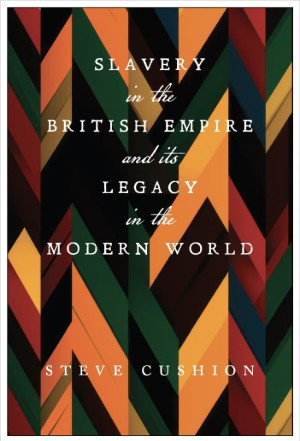
Title: The Legacies of African Enslavement and the Case for Reparations
Abstract:
Britain’s Industrial Revolution was, in large part, made possible by the capital accumulation generated by the “business of slavery,” and the genesis of Britain’s banking and insurance industries can be traced to this same “business”.
The enclosure of common land in England was often financed by the profits made by enslaving Africans.
The effects of slavery are still with us. Sugar, the foremost product of the Caribbean colonies, has left a world-wide legacy of ill-health. And the fossil-fuel based industry, which the profits from enslavement helped create, has caused the current climate crisis which threatens us all.
The colonial economy based on African enslavement caused deforestation and soil exhaustion, which has deprived the former Caribbean colonies of reasonable possibilities of development, and for this, along with the unpaid wages of millions of enslaved workers over centuries, reparations are both necessary and justified.
Part of our history: the tradition of Red Republicanism
With the newly named Andrew Windsor Mountbatten in the headlines for the wrong but at the same time absolutely the right reasons, a wider debate about whether Britain in 2025 needs an hereditary monarchy and the vast public expense it entails is underway.
The mood can perhaps be sensed with the cover of the centre-left magazine the New Statesman leading with a ‘No More Kings’ banner headline.
A the same time in the US continuing reports that Donald Trump plans to somehow have a third period in office as President, has inspired huge ‘No Kings’ demonstrations across the country.
These anti-monarchy sentiments while they appear and often are quite radical, have their limits. They mostly do not seek to change existing market capitalism led systems but simply to run them a bit more democratically
It’s not something that one expects to find mentioned in official political circles even when another Royal crisis is on but as we now look to British history with nothing left out, it’s worth recalling that there is a tradition of Red Republicanism
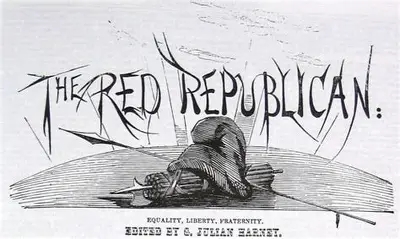
George Julian Harney (1819-1897) was born in Deptford and active in every phase of the Chartist movement from 1838 to its demise around 1860.
By the late 1840s he was a leading figure in Chartism and Editor of the Northern Star the biggest selling newspaper of the period. Disagreements with the paper’s owner Feargus O’Connor led to his departure and by June 1850 he had launched the weekly Red Republican paper.
Harney was a left Chartist and internationalist, friendly with and on occasion influenced by Marx and Engels. The Chartist colour had been green but after 1848 it changed to a socialist red.
Harney was clear in an Editorial in the first issue of the Red Republican on 22nd June 1850 that it was about more than getting rid of a monarch, in this case Queen Victoria. Simply replacing a monarchy with a republic as France had done was not enough. There was a need to get rid of all exploiters.
Harney realised and was proven correct that the paper’s name would lead to it being burked (boycotted) by the news trade and changed its name to Friend of the People in December 1850. Before that happened however the paper published the first English translation of the Communist Manifesto by the female Chartist activist and co-thinker of Marx and Engels Helen Macfarlane.
It was this translation that had a fearful hobgoblin stalking Europe rather than a spectre of communism with which we are familiar today.
Harney promoted a programme called The Charter and Something More. By this he meant not just political democracy, that is the vote for all, and the abolition of the monarchy, but also economic democracy. The socialist historian John Saville called it the most advanced political programme to appear on the left until the time of the Bolsheviks.
While Harney was to an extent a co-thinker of Marx and Engels, Marx was critical of his support for republican nationalist movements that had limited left-wing content. He labelled Harney ‘Citizen Hurrah, Hurrah’.
In the 1850s Harney moved to Jersey and ran a radical paper there but in later years he moved back to Twickenham, where Engels who had remained on friendly terms with him visited.
Despite its limitations Harney’s red republicanism and socialist programme is a reminder of an anti-monarchy tradition in Britain that moved some way beyond simply changing who ruled the country to changing the very nature of the State itself.
It is a history which is largely forgotten that in the present moment must be remembered
Wetherspoons reveals the impact of dropping steak on its financial results
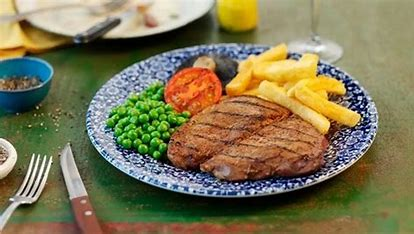
In the middle of May 2025 the 800 strong pub chain Wetherspoons scrapped its steak menu (gammon also went) to considerable comment from Spoons regulars. They were replaced on the menu by a new series of gourmet burgers.
Spoons steaks were not particularly cheap- certainly above £10 but they were still more competitively priced than elsewhere. Spoons suggested that there was too much wastage as customers sent back steaks that had not been cooked to their liking.
As any meat eater who has looked at the price of steak in a supermarket recently will know the cost has increased significantly. Of the major supermarkets Aldi probably comes out best where an aged steak costs around £6.79.
Towards the end of May the UK’s largest pub company Mitchells & Butlers (M&B) published its results showing a 10.4% increase in profits.
However one notable concern was the cost of meat. CEO Phil Urban commented that higher food costs was a significant issue particularly steak. However Urban notes that M&B have a steak brand, Sizzling Pubs ‘so we’re not going to compromise on quality’
Therein lies the Wetherspoons steak conundrum. Either reduce the quality of steaks served or charge a price many won’t pay. Alternatively don’t sell them..
In its latest quarterly set of results covering the 14 weeks to November 2nd 2025, drinks sales were up 5.7% comfortably ahead of the sector. However food sales were up only 0.9%. The Times reports (6th November) that analysts (market specialists who provide financial commentary) think this reflects the impact of removing higher cost items like steak from the menu. In other words without steak people are not spending as much on food in Spoons.
Whether Spoons customers would pay the higher prices steaks would now sell at is a conundrum for Tim Martin. It’s something that continues to attract lots of comment on Spoons related social media sites
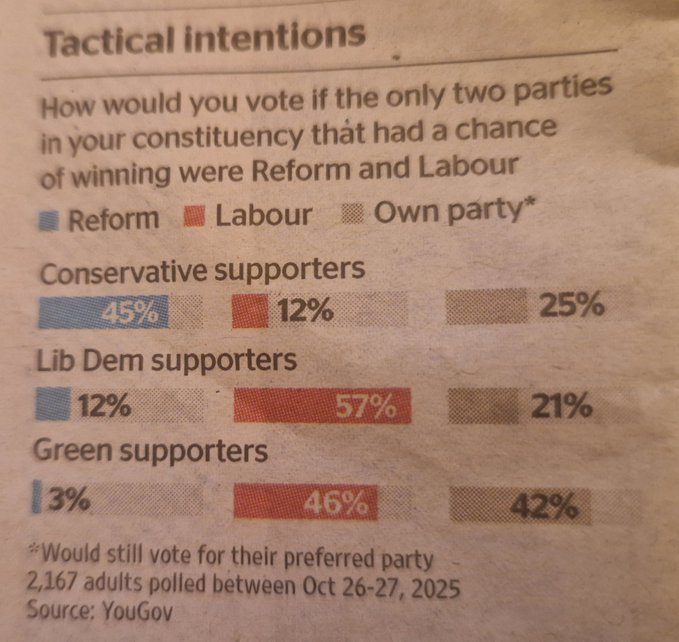
I continue to see commentary on polls by organisations such as Find Out Now and More In Common. Both are exponents of what E P Thompson as far back as 1959 called Ephology. That is they seek to shape opinion through polls (rather than report it) and they do so to promote their own polling businesses.
YouGov who are of course a commercial polling organisation are a bit more reliable. Their polls are mostly now in the area of business. Producing knowingly skewed political polls is against the business interests of YouGov.
The poll above suggests that in Constituencies where there is a straight fight between Reform and Labour, LibDem and Green voters are inclined to back Labour to stop Reform. What the graphic doesnt show is that 34% of Labour voters would back the Tories to stop Reform and 39% of LibDem voters would.
This tells us firstly that tactical vote in a first past the post system can have an impact. Secondly that there is anti-Reform majority. Morgan McSweeney is probably happy.
In a sense it replicates what has happened in France where a left coalition has so far been able to block the fascist National Rally from power. In France the coalition has a left programme that it continues to promote. That is not the case here.
So while it suggests Reform can be stopped, advances by the Greens and Your Party are also important. Just dont judge the advances by Find Out Now and More in Common polls
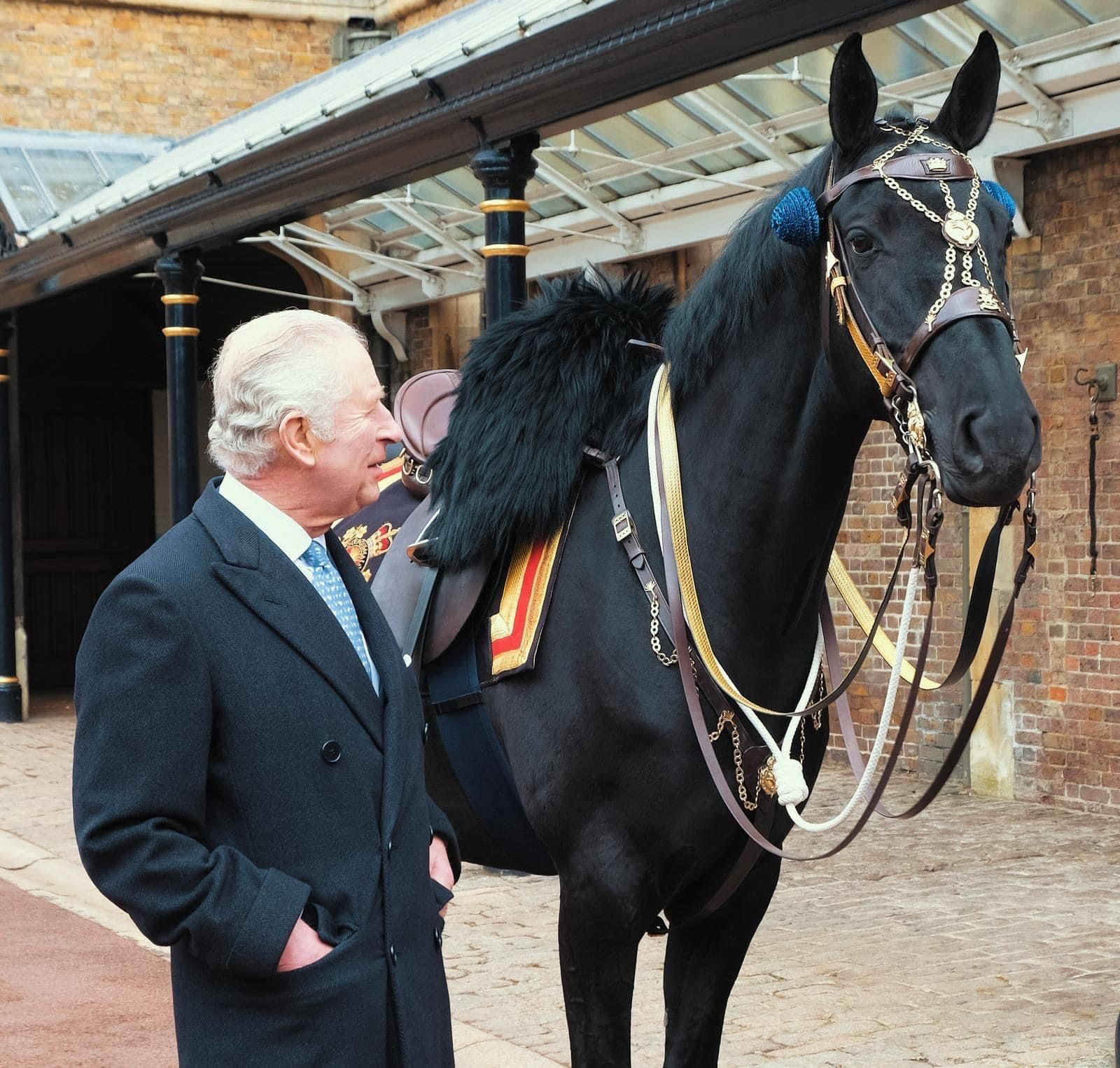
E P Thompson noted that the mother of William Hulton, the Magistrate who sent the Yeomanry in at Peterloo on 16th August 1819 owned a horse named ‘Church and King’. The name summarises the key principles of the Tory Party, although whether those in charge of the Party in 2025 know that is another matter.
In a perhaps surprisingly sneer free obituary of the left wing activist, journalist and author Richard Gott (1938-2025) one paragraph notes that Gott’s mother Mary joined CND and attempted to register a horse in the name of ‘Ban the Bomb’. The Jockey Club however rejected the registration…
Zohran Mamdani was elected Mayor of New York on Tuesday and in the days before had been out on the campaign trail.
The New York Review of Books has an interesting snapshot of his Saturday night and Sunday morning campaigning. It underlines how the campaign really went to the grassroots, in this case Mamdani was clubbing across NY.
11:24 PM in Williamsburg, where Zohran, promising “no sleep till it’s over” and looking crisp as ever in his uniform dark suit and tie, took the mic at Gabriela, a sweaty bar. An instant later it was 11:41 and Mamdani danced at Toñitas, a Caribbean social club. A little after midnight the candidate, who once rapped professionally as “Mr. Cardamom,” posted up behind the booth at Damballa in Bushwick. At 1:00 AM an Instagram influencer spread the news that “Zohran just showed up at the gay bar”—Mood Ring, on Myrtle Avenue, where he danced “with the gworls gays n theys,” as another user put it. At 1:14 Mamdani was spotted at Papi Juice, a roving Brooklyn art party that “celebrates the lives of queer and trans people of color,” according to its social media feed. At precisely 1:24, still spruce but shivering in a worsted overcoat, Zohran fueled up at a halal truck, then finished the night at a rally in Greenpoint.
Reform’s Traitors spin off at Kent Council. There were 57 Councillors. Now there are 48
In recent weeks the Reform led Kent County Council has been a running a Traitors spin off. Reform Councillors have been banished (although hopefully not murdered) after a video showing in-fighting in a Reform Group meeting was leaked to the Guardian.
With the final programme in the BBC’s Celebrity Traitors due to air on 6th November its been reported (Guardian report below) that a further banishment has taken place in the Kent spin off. The number of Reform Councillors elected in May 2025 was 57 but now stands at 48.
Reform have commented that comings and goings at local Councils are common, true and enough, but losing almost 20% of elected Councillors in six months is impressive. In addition, it may be recalled that Reform’s pitch was that they would do things differently to other parties. This seems to be true. Nowhere else has a Council run a Traitors spin off this autumn
Guardian report
Nigel Farage’s Reform UK has suspended yet another member of its ‘flagship’ county council in Kent as it held its first full meeting since the party’s councillors were thrown into crisis by a leaked meeting revealing bitter internal tensions.
The departure of Isabella Kemp, who has also been working as a data protection officer at Reform’s HQ, means that Reform has lost nine of the 57 councillors elected during the local elections in May.
Four Reform councillors were suspended shortly after the leak, while one of those and another who had been suspected over separate allegations have now formed an “Independent Reformers” group on the council.
Kemkaran faced questions at a full meeting of the council on Thursday about the real-world impact of the suspension of Kemp, who had been chair of the adult social care and public health cabinet committee.
The Liberal Democrats, who are the second largest group with 12 councillors, appealed to Kemkaran to restore Kemp, who now sits as an independent, as chair of the important committee.
The Government’s Rights at Work Bill is back in the Commons after the Lords made several amendments in an attempt to water down the contents. Keir Starmer has said that the amendments will be voted down. However the Tories who voted en masse against the Bill when it was first debated in the Commons, together with the right-wing media, have continued to demand that it is the rights of big business not workers that are important.
According to the not reliable source of the Telegraph, the Tony Blair Institute does not support day one employment rights. It agrees that the current two years is too long to wait for rights but argues six months is reasonable. The point at issue here primarily is unfair dismissal. If a worker is performing poorly it can be lawful to dismiss them at any time. The argument against day one rights seems to be one in favour of bad bosses who just want to hire and fire at will.
Tony Blair has history when it comes to watering down employment legislation.
The 1997 Labour Government headed by Tony Blair promised to address the years of Tory anti-union laws by reinstating what it claimed would be a level playing field at work. The bigger issue was the introduction of a National Minimum Wage. This was opposed by many business interests on the basis that it could not be afforded, (a strong echo is to be found in 2025) would not work and so on. However it was implemented and remains in force, albeit many would argue it should be higher.
The second was a Parliamentary Act on Employment Relations. Its notable that this did not become law until July 1999. It was not seen as a priority and there was a fair bit of time spent listening to business about it. It did not repeal any Tory anti-union law but instead gave legal force to trade union recognition and representation. It was a step forward from the Thatcher years but a modest one.
Cabinet Papers available at the National Archives give an indication to what had been going on.
In the autumn of 1997 there is a file note of what is described as a ‘long and fractious discussion’ between Tony Blair and John Prescott on Fairness at Work. Prescott said that changes had been bought as a package by the TUC and if changes were planned this would need to be agreed by the Cabinet. Blair responded that the changes were practical ones because of what he claimed were genuine problems in how they would work. Blair wanted to allow a right of appeal to the measure, eventually implemented, which would mean that if 50% of workers voted for union recognition it would be automatically given. Prescott again argued that he did not think what the TUC had put forward was up for negotiation.
Employment rights were not part of Prescott’s Ministerial brief and the matter does not appear again until we find a file note from Peter Mandelson on 9th March 1998. It says ‘Union Recognition. Moving in the direction of the CBI. Ideal response for the TUC to be grumpy but not refuse to co-operate’.
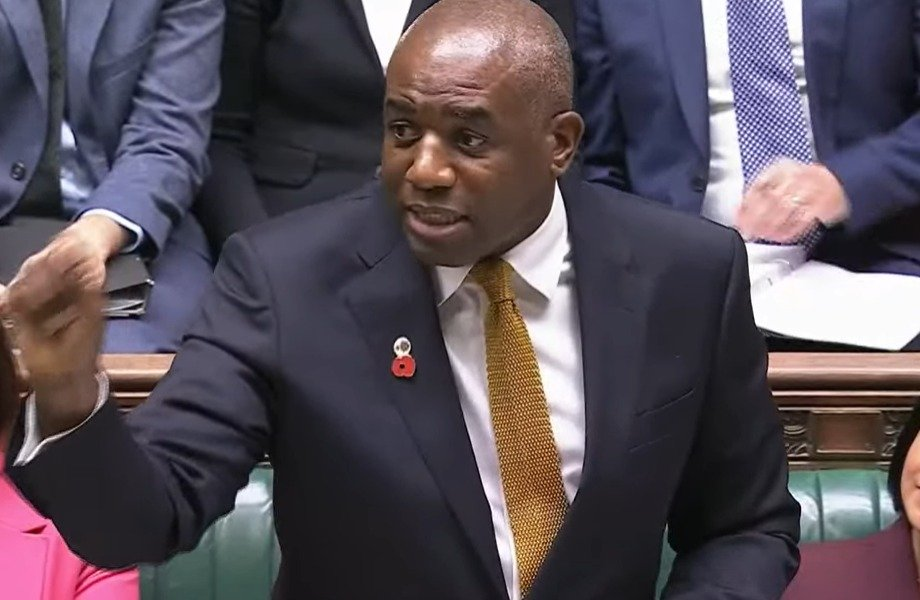
David Lammy standing in for Starmer at PM’s Questions on Wednesday fell an early victim of the annual poppy culture wars.
In 2025 the poppy worn by those in the public eye is not the traditional one sold by the British Legion but a small enamel version that looks like it is something used for eye tests by Spec Savers.
Anyway at the start of PMQs Lammy was not wearing one. Apparently he had a new suit on and had forgotten. Cue full blown culture war. Later on in PMQs one was found for him to wear.
I will need to make an admission here. David Lammy is my MP and has been for 25 years. As the previous long time secretary and chair of Haringey Trades Union Council I’ve worked with him over the years. He is decent on union issues and appropriately, mostly on the mark about racism and Windrush. These issues impact people in Tottenham, his constituents.
Of course there is a lot more that could be said. He usually faces a left opponent at Elections who sometimes save their deposit. David’s is not the only view in Tottenham historically on the Iraq War which he supported and now on Palestine.
However when it comes to poppy culture wars let’s remember all the ethnic minorities who fought for Britain in the First and Second World Wars and indeed in the wars the country has got involved with (usually ill advisedly) since.
I’ve never seen exact figures but I do know that numbers of young black residents in Tottenham serve in the forces. It’s a job and racism in the labour market narrows options.
In case anyone thinks I’m minimising the poppy issue my father fought at Monte Cassino in Italy in World War Two and was then at the liberation of Belsen. He rarely spoke of that but always wore a poppy. Not as part of a culture war but in memory of his friends and comrades who had died fighting fascism.