The Spectator on craft beer: do they ever wish they were better informed
There is plenty of media coverage currently about what was once called ‘craft’ beer and now is more frequently known as Indy. There is a reason for the change of name. Not all craft beer is independent. Camden is owned by Belgian based ABInBev and Beavertown by Heineken. Magic Rock, Purity, Brick and Brew By Numbers are owned by Keystone.
Much of the media coverage is about Brewdog the most well known independent craft brewery although in reality its de facto owned by private equity outfit TSG.
The Spectator who one might think should know something about how capitalism operates has published a piece about Sarf London brewery Gypsy Hill. It bemoans that a sale might be forthcoming. In fact it was sold in October 2024 to Sunrise Alliance who also own Wild Beer, Curious and Portobello. Brewing remains in situ and the flagship beer Hepcat is still brewed, Sunrise was spun out of Suffolk brewery St Peters but the precise details are a little opaque.
The Spectator Editor Michael Gove is not unfamiliar with craft beer pubs. Perhaps its time for him to appoint a beer correspondent.
You can imagine my sadness, then, in reporting the decline of the Gipsy Hill Brewing Company, my own local. While the brewery won’t be filing for bankruptcy any time soon, my sense is its heyday is behind it, and with it the heyday of many great independent breweries.
The Spectator 20th August 2025
Gipsy Hill Brewery sold to St Peter’s Brewery owner Sunrise Alliance Beverages to avoid administration
It comes after the brewer failed to hit a £500k crowdfunding target last year
Contact BLF Organiser Keith Flett @keithbeard.bsky.social
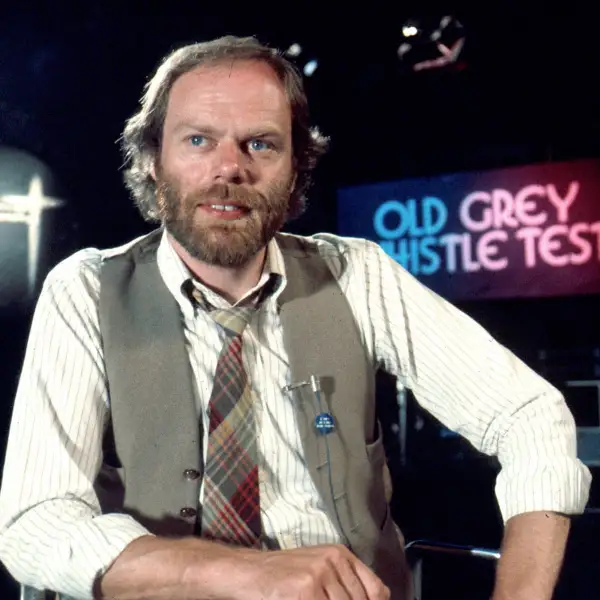
The Beard Liberation Front, the informal network of beard wearers, has praised veteran broadcaster Bob Harris as a ‘hirsute icon’ as he marked 55 years of broadcasting on 19th August.
He first appeared on BBC Radio One 55 years ago this week hosting Sounds of the Seventies. He became well known as a presenter of the Old Grey Whistle Test on BBC2 and continues to present Country Show on Thursday evenings and Sounds of the Seventies on Sunday on Radio Two today.
Bob Harris was named Hirsute Broadcaster of the Year as far back as 2011 and 2012.
The campaigners say that while some early photographs show Bob Harris with distinctive sideburns but no beard, he has been a standard bearer for a positive images and impacts of beard wearing in broadcasting over six decades now.
BLF Organiser Keith Flett said, I was a youthful listener to the Sounds of the Seventies programmes in 1970 and fifty-five years on Bob Harris has become a hirsute icon in broadcasting and a positive role model for gravitas on air.
The Bob Harris Archive (caution includes beardless picture)
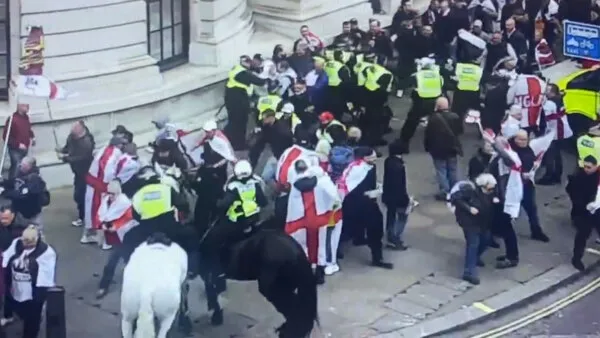
Keir Starmer has he often does has been supporting the display of the St George’s flag. It is of course that national flag of only one of the four UK nations and even that can be argued about.
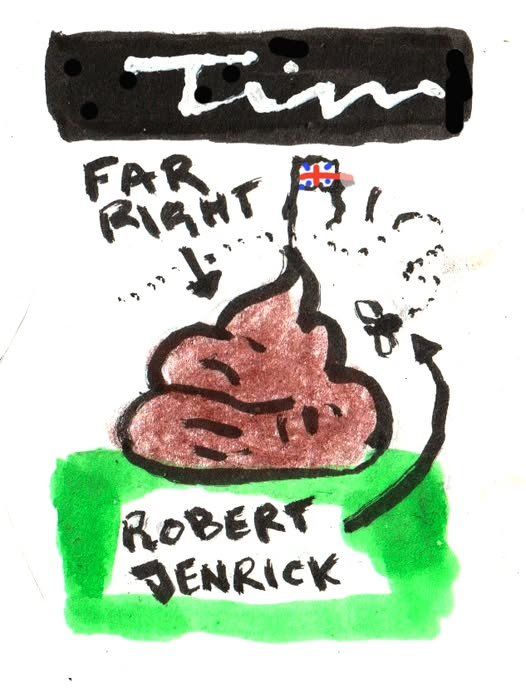
The current ad hoc hanging of the flag in various locations, given the context of time of year and wider events, has the hallmark of those who claim ‘I’m not far right’ while forgetting at least in some cases to add that they are racist and quite possibly a fascist.
Of course only a minority of those who display the flag fall in to that category. It can regularly be seen at sporting occasions when England teams are playing mostly un-controversially so. It is a relatively recent thing as was demonstrated by the recent culture war over exactly what form it should take on players shirts.
There has been a long history of the left trying to claim or reclaim the flag from the right. Whether Starmer knows about that is another matter but broadly its fits into to some kind of patriotic people’s history approach to at least English life. It might be argued that E P Thompson’s Making of the English Working Class also fits somewhere in that except Thompson’s flag remained resolutely red, tinged with a Chartist green.
There are St George’s Fields around England but perhaps the best known is in inner South London. It was an historic location for mass protest in the eighteenth century. On 10th May 1768 there was a riot in support of the maverick MP John Wilkes (later Mayor of London and Boris Johnson’s hero) who had been jailed. There were cries of No Liberty, No King. Troops were called in and there were dead and injured.
In 1780 as part of the Gordon Riots another large crowd assembled and burnt property particularly that belonging to religious minorities and specifically Catholics.
By 1795 a huge crowd of 100,000 assembled in June calling for the vote and annual parliaments.
Disputed history is a reality. It can be harnessed to political causes but with more nuance and insight than Starmer manages
The cartoon is by Tim Sanders one of the best known of the UK’s political cartoonists. His cartoons have appeared in Socialist Worker, the Independent, Private Eye and no doubt elsewhere.
Some years back we collaborated on a cartoon version of Chris Harman’s People’s History of the World. I did the words and Tim did the drawings. From memory we got to the early Medieval period before the sheer scale of the exercise defeated us…
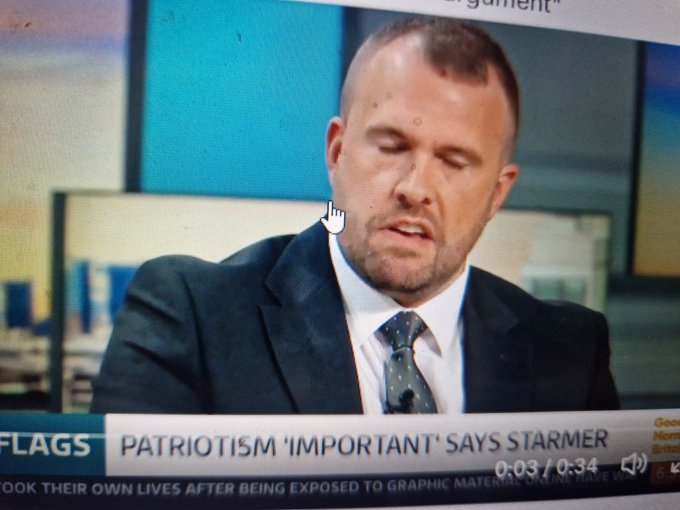
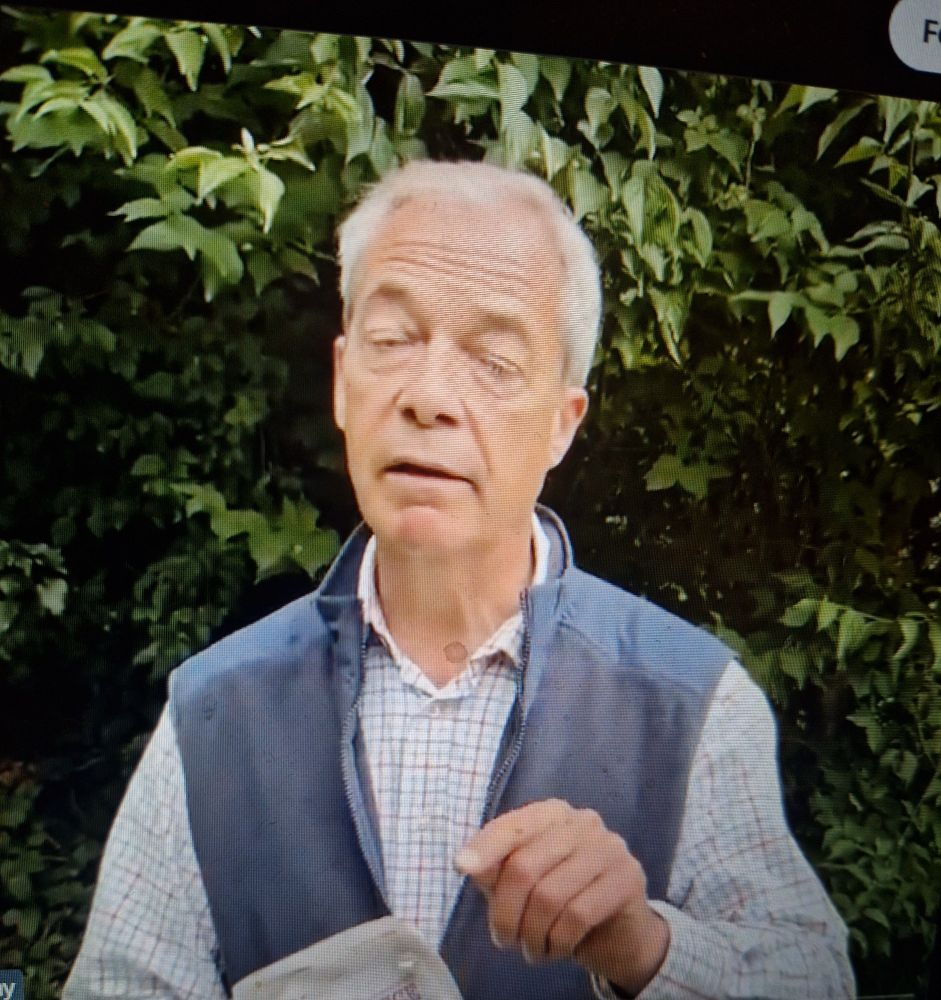
It might be thought that Jonathan Gullis would have given up bringing the hirsute into disrepute when voters ejected him as a Tory MP in July 2024. Unfortunately he is still at it.
Appearing on Good Morning Britain on 19th August having nothing else to do that day he opined on which flags can be flown and which cant:
Isabel Oakeshott is a hard right Telegraph journalist who is so patriotically British that she lives in Dubai because she hates Britain. Her partner is the Reform MP Dicky Tice.
Her latest Telegraph column calls for Britain to be ‘plastered’ with St Georges or Union flags. This includes of course Scotland and Wales whose flags or indeed existence are not noted by Oakeshott. Admittedly it can be difficult to work things like that out from Dubai.
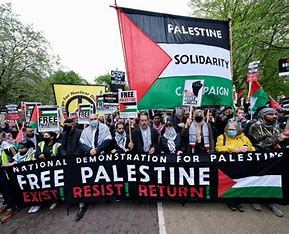
It is of course a Summer Culture War. Its aimed particularly at the display of Palestinian flags in solidarity with those struggling to survive in Gaza. It seems reasonable to suggest that Oakeshott is not overly concerned about genocide.
The article is paywalled and I wouldn’t link to it anyway. It contains a paragraph pointing out that white working class culture is superior to others around the world. Leaving aside what Oakeshott thinks that culture is, its the kind of racist sentiments I heard in the 1970s. A reminder that they never go away and have to be opposed again in each generation.
Karl Marx, Summer 1864, Ramsgate, British Museum, (Holland) Brighton
In 1864 Marx was researching for what became Capital Volume One (1867) and more immediately politically active with the formation of the International Working Men’s Association on 28th September 1864 in London.
While Engels was still working full time in the family company in Manchester, Marx did not have a paid job. In the summer of 1864. His devotion to work-life balance, as well as his health was admirable!
Ramsgate, 25 July 1864 46 Hardres Street Dear Frederick, You will see from the address that I am spending a few days in Ramsgate. It was a far from agreeable surprise to discover that my FURUNCLE was in fact an extremely malignant CARBUNCLE and, what is more, has had the impudence to erupt just above my penis. So, for ABOUT 10 days, I’ve been obliged to spend most of my time in bed—and in this heat, too! The thing is clearing up pretty quickly here; however, my confidence has completely evaporated now that the disease has unexpectedly cropped up again in such a malignant form. Jenny and Tussy are here with me; Laura is coming the day after tomorrow and in ABOUT 8 or 10 days we shall go to Holland
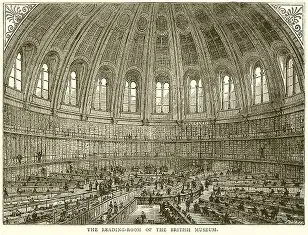
MARX TO LION PHILIPS IN ZALT-BOMMEL London, 17 August 1864 1 Modena Villas, Maitland Park, Haverstock Hill Dear Uncle, I found your letter waiting for me here when I came back from the British Museum yesterday evening. It was already too late for me to reply straight away.
MARX T O ENGELS IN MANCHESTER [London,] 31 August 1864 DEAR Frederick, I returned from Ramsgate3 exactly three weeks ago today. The trip to Holland has fallen through, because a maid in my uncle’s15 household suddenly contracted smallpox. Last week my wife had a severe attack of cholerine which did, for a spell, look like becoming dangerous. Yesterday she left for Brighton (solo).
Keir Starmer cancelled his summer holidays in 2024 claiming he was keeping an eye on what many termed the Farage riots. Notwithstanding the efforts of the police and firefighters, peaceful anti-racist protests played a significant part in restoring peace. Don’t expect any media acknowledgement of that in 2025.
In 2025 Starmer has reportedly been taking a holiday in Scotland, perhaps inspired by the recent examples of Trump and JD Vance, although since Starmer doesn’t do golf not at Turnberry.
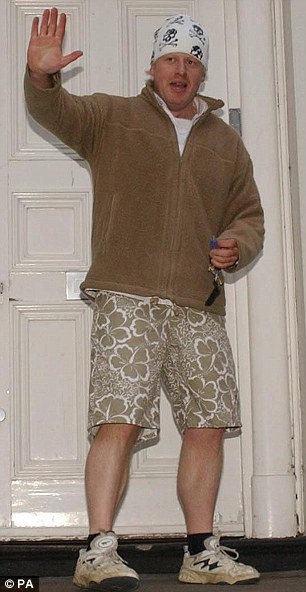
In 2024 Boris Johnson offered Starmer advice on where to go on holiday in the Daily Mail. To be fair Johnson is an expert on holidays and in particular holidays that someone else is paying for.
Johnson thought Starmer might head to Greece or the Dordogne. Parliament is in recess and Starmer deserves a holiday (as do others). Where he goes is of little interest, and only that because he is PM.
Starmer’s most recent reported holiday was in Majorca in 2022. He has a history of holidays in the Lakes (where the Starmer family went in earlier years) and in south-west Wales where he has friends.
Johnson has riot holiday form. When riots broke out in London on 6th August 2011 he was on holiday abroad. He was also Mayor of London at the time but didn’t make it back for 5 days.
The whole holidays issue reflects a country that historically has been uptight about what is called work-life balance, at least for the many, although not for the few.
Peter Hain, Palestine protest & the Repertoires of Contention
Peter Hain has criticised that Government’s decision (subject to legal challenge and protest) to proscribe Palestine Action. His points in the Guardian (13th August) are spot on as far as they go but not entirely unproblematic
It’s going to get worse [for the government] because I don’t see people from that ‘middle Britain’ background who have joined these protests in such large numbers to suddenly decide that all is OK,” he said.
“In fact, I think more are going to come out and face arrest because the approach to Palestine Action is contrary to every form of peaceful protest in British history, whether that’s the chartists and suffragettes or anti-apartheid and anti-fascist protesters.”
The activities of Palestine Action are mostly peaceful. That involves going on demonstrations, protesting outside arms factories and so on. Some, who may or may not be members, have engaged in more robust action against arms manufacturers, damaging property and equipment. That is still peaceful protest in the sense that it is an attack on property not people.
However there is no easy division between peaceful and more robust protest. The Chartist slogan was peaceably if we can, forcibly if we must. The Chartists petitioned for the vote, they held protest meetings and demonstrations, called several General Strikes and had at least two attempts at armed revolt. In Newport in November 1839 they almost succeeded. In Central London in August 1848 they did not.
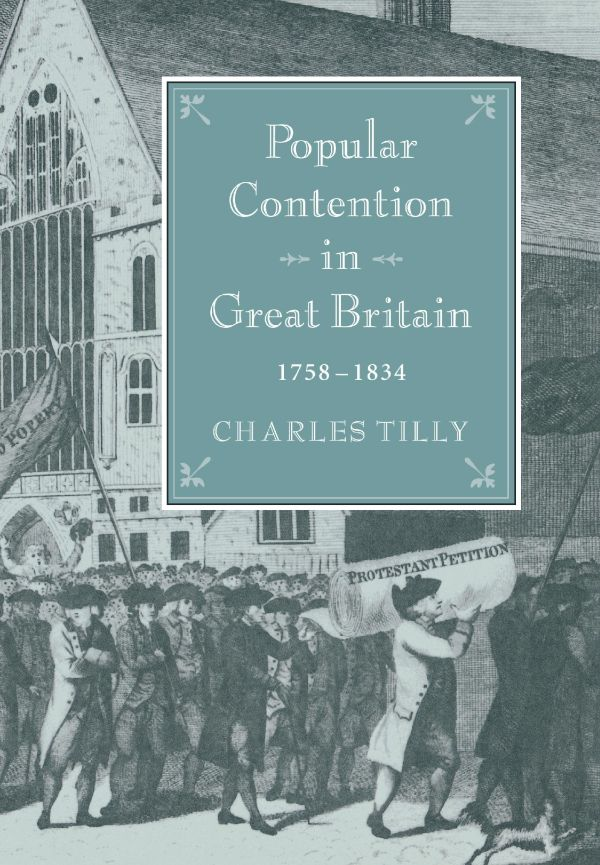
Charles Tilly’s Repertoires of Contention (publishers summary below) sees a hierarchy of protest from petitions to riot and revolt. That isn’t really how protest works. Some may protest only peacefully, others may decide to do whatever is necessary.
So for example Peter Hain mentions anti-fascist protests on which as a founder of the Anti-Nazi League he knows a lot. Of course the specific aim is to mobilise large enough numbers to simply stop fascist mobilisations. Often that works but not always. After all what was Cable St all about?
Charles Tilly
between 1750 and 1840 ordinary British people abandoned such time-honored forms of protest as collective seizures of grain, the sacking of buildings, public humiliation, and physical abuse in favour of marches, petition drives, public meetings, and other sanctioned routines of social movement politics. The change created–perhaps for the first time anywhere–mass participation in national politics.
Charles Tilly is the first to address the depth and significance of the transmutations in popular collective action during this period. As he unravels the story of thousands of popular struggles and their consequences, he illuminates the dynamic relationships of an industrializing, capitalizing, proletarianizing economy; a war-making, growing, increasingly interventionist state; and an internal history of contention that spawned such political entrepreneurs as Francis Place and Henry Hunt. Tilly’s research rests on a catalogue of more than 8,000 “contentious gatherings” described in British periodicals, plus ample documentation from British archives and historical monographs.
The author elucidates four distinct phases in the transformation to mass political participation and identifies the forms and occasions for collective action that characterized and dominated each. He provides rich descriptions not only of a wide variety of popular protests but also of such influential figures as John Wilkes, Lord George Gordon, William Cobbett, and Daniel O’Connell. This engaging study presents a vivid picture of the British populace during a pivotal era.