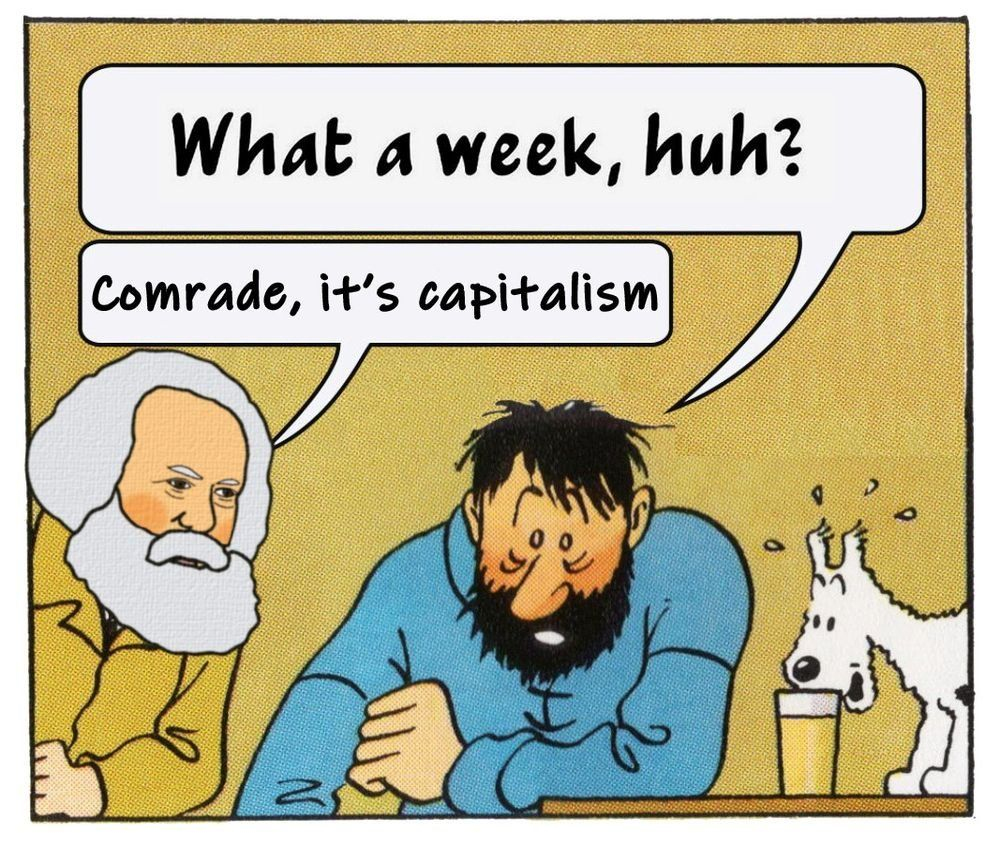

Bloody Panico: the decline of the Tory Party
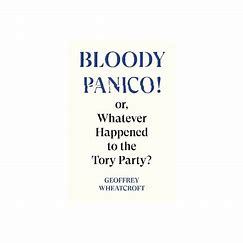
In May 2024 just before the July Election Geoffrey Wheatcroft published a new book on the history and decline of the Tory Party. He has predicted this before but Bloody Panico (Verso, May 2024) hits the zeitgeist.
The Tories were reduced to 121 seats on July 4th with a range of well-known Tory MPs losing their seats. Whatever the view on Starmer there was a cause for brief celebration on July 5th, as there was on 2nd May 1997 when Blair came to Office.
Wheatcroft’s book underlines that the Tories are the architects of their own destruction. What comes next on the right and far right of politics is concerning.
There is a Great Moving Right Show in progress. Some figures on the Tory hard right like Truss and Braverman are arguing that numbers of Tory MPs are not really Tories and look to Trump and Musk’s tour of destruction as the way forward.
Other right-wing Tories speculate about a deal or a merger with Reform UK Ltd- Jenrick and Rees Mogg. You cannot of course merge or do deals with a limited company and the history of the last 15 years underlines that the only person who ultimately benefits from efforts to work with Nigel Farage is Nigel Farage.
The left need to redouble efforts to combat racism- Stand Up To Racism is holding an event on 1st March and there is a broad Summit of Resistance on 29th March
A striking extract from Wheatcroft’s book:
Lord Salisbury, Stanley Baldwin,Winston Churchill and Margaret Thatcher each led the Conservatives for roughly fifteen years. In the thirty three years since the fall of Thatcher the Tories have had nine leaders including five Prime Ministers in the space of seven years..2022 will be remembered as the year of two monarchs and three prime ministers, not to mention four chancellors of the exchequer, five education secretaries and more than thirty resignations from Government.
Strong and stable it has not been
In the midnight hour. Working hours at the new Reform UK Ltd office

People are here till midnight — on Christmas Day we had people here until 10 in the evening
Extract from an interview with Farage in the London Standard magazine.
Reform UK Ltd have been in a Millbank office (a floor in Millbank Tower since the back end of 2024).
There are 18 staff but needless to say the hours above do not relate to the owner of Reform UK Ltd himself who will be found in a bar or restaurant most lunchtimes and evenings
Bob Marley at 80: still rocking against racism & miserabilism
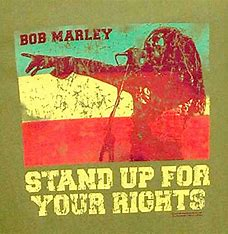
Bob Marley (6th February 1945-11th May 1981) would have been 80 today. In fact he died far too young in 1981 almost two generations ago now. The impact of his music and his politics lives on.
They came together in the form of a racist rant that Eric Clapton made in 1976, even though Clapton had enjoyed success with the Marley song I Shot The Sheriff. That incident sparked the formation of Rock Against Racism and reggae music became part of the celebration of our culture.
Philosophy Football have of course marked the 80th and Mark Perryman has provided a text as relevant now as it was in the 1980s
But this is a moment also to reflect on the meaning of Bob Marley and others like him. The writer and activist David Widgery had a neat way of describing his politics as against miserabilsm:
” There is a real danger of getting too depressed about the apparent triumph of a particularly tawdry and irresponsible sort of finance capitalism and the state of the labour movement and the cowardice and lack of vision of its leadership. But I’m very against miserabilism.”
https://www.philosophyfootball.com/philosophers/-bob-marley.html
35 years ago when Wetherspoons was a North London Pub Company
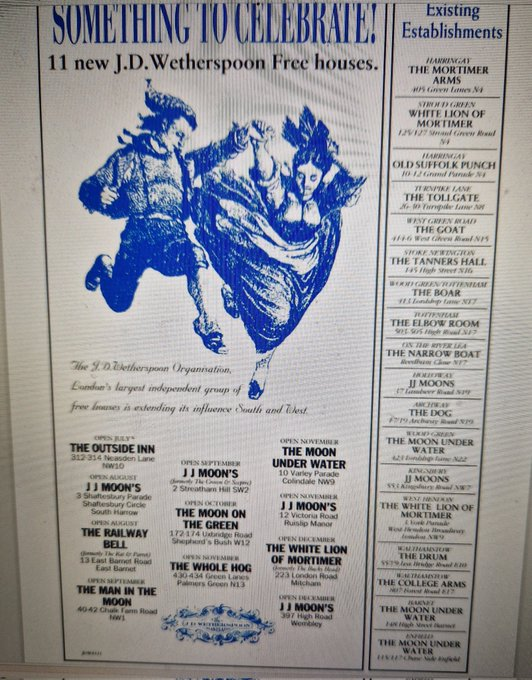
The advert is from CAMRA’s London Drinker magazine (still published btw) from November 1990.
It reflects the reality that after Wetherspoons started in Muswell Hill in 1979 and for some time only had pubs in the London Borough of Haringey by 1990 it had branched out across North London and was making early forays into Sarf and West London…
The Socialist Alternatives Project & Keir Starmer 1986-2025. This is the story of Morgan McSweeney
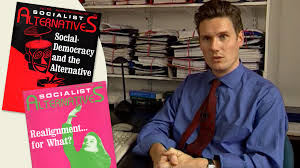
The Socialist Alternatives Project & Keir Starmer 1986-2025. Beyond Ripping Yarns
On Monday May 20th 2024 Benjamin Schoendorff spoke at a socialist history seminar at the Institute of Historical Research. As many seminars are now it was on Zoom and the attendance while fairly modest was fully engaged.
Schoendorff was the Editor of a magazine, Socialist Alternatives, for which a young Keir Starmer wrote and helped to run.
Schoendorff spoke about the Socialist Alternatives project. A magazine was produced that focused on red-green politics and orientated first around the 1980s Labour left and then the Green Party. The project had sprung out of one part of orthodox Trotskyism around Michael Raptis (Pablo) but as Schoendorff made clear it was very much seen as post-Trotskyist and an attempt at movement rather than party building.
One participant was a young Keir Starmer. Starmer seemed to have been involved with the Militant while at Leeds and initially at Oxford. However Schoendorff noted he made an easy transition to the rather different left politics of Socialist Alternatives.
While such changes are far from unknown they are usually accompanied by lengthy disavowals of the individual’s previous positions. This was not the case with Starmer.
Schoendorff noted that he had rather liked Starmer but remained puzzled how the person he knew then had ended up as Labour leader in 2024. One conclusion perhaps relevant to 2025 was that Starmer did not have strong political views but assimilated to whatever milieu he found himself in.
Reading extracts from a new book by Patrick Maguire and Gabriel Pogrund about Labour’s July 2024 Election victory, Get In, (Times 2-4th February 2025) I was struck by a reported view of Tony Blair that Starmer’s politics didn’t really come from anywhere except they were ‘vaguely progressive’.
The book’s largely unevidenced ripping yarns, are entertaining and like much that would be found in an old style paper diary column, having enough of the truth about them to be possibly true, don’t really get to the root of the Starmer enigma.
Jason Cowley, former Editor of the New Statesman, and well connected in Labour circles, has reviewed the book in the Sunday Times (9th February) and suggests that the core of it is the Morgan McSweeney story. McSweeney provided the political organisation Starmer lacks. A note of caution, which won’t be sounded in the media, is that McSweeney was the manager of Liz Kendall’s bid for the Labour leadership where she got 4.5%. In respect of the July 2024 Election it might be speculated that Labour would have won without McSweeney’s strategy, given how hated the Tories were, but perhaps not as big
The book does at least underline an already existing view that Starmer is much more a professional lawyer than a politician and in particular someone with a lack of political sensibility.
McSweeney however whose ideas, or lack of them, is a standard Labour right-winger. The Labour right has been bereft of ideas on how to change the world for the better or even make sure it doesnt get worse since at least the 2008 financial crash. That was a key reason why Jeremy Corbyn had the appeal he had, he did some have ideas.
Starmer is not a charismatic leader and at the July 2024 Election this was sold as an alternative to the excitements of Truss, Johnson et al. The problem here is that particularly with Trump the world has becoming exciting
Starmer’s support for Arsenal, rarely factored in, suggests he is keen on winning, in whatever way works. His personal politics may not exactly mirror some of this (who knows) but that is of only marginal relevance. He is doing a job
That still doesn’t account for Starmer’s North London 1980s btw. I was there myself in the same North London Borough and you don’t really forget.
E P Thompson(b 3rd Feb 1924) at 102: class as a happening

E P Thompson was born 102 years ago on 3rd February 1924. The extract below is a good way of understanding his approach to both history and politics. He looked not at fixed categories but ats relationships at specific times and contexts. The extract is from his 1965 essay Peculiarities of the English
Sociologists who have stopped the time-machine and, with a good deal of conceptual huffing and puffing, have gone down to the engine-room to look, tell us that nowhere at all have they been able to locate and classify a class. They can only find a multitude of people with different occupations, incomes, status-hierarchies, and the rest. Of course they are right, since class is not this or that part of the machine, but the way the machine works once it is set in motion – not this interest and that interest, but the friction of interests – the movement itself, the heat, the thundering noise. Class is a social and cultural formation (often finding institutional expression) which cannot be defined abstractly, or in isolation, but only in terms of relationship with other classes; and, ultimately, the definition can only be made in the medium of time – that is, action and reaction, change and conflict. When we speak of a class we are thinking of a very loosely defined body of people who share the same congeries of interests, social experiences, traditions and value-system, who have a disposition to behave as a class, to define themselves in their actions and in their consciousness in relation to other groups of people in class ways. But class itself is not a thing, it is a happening.
https://www.marxists.org/archive/thompson-ep/1965/english.htm
PMQs: Badenoch echoes Liz Truss line on North London again

PMQs. Badenoch echoes Liz Truss line on North London yet again
While Kemi Badenoch sometimes seems to try and distance the Tory Party from 49 day Liz Truss she can’t seem to avoid returning to one of the most persistent culture war memes used by Truss, which focuses on North London. The line has also been used by Suella Braverman and occasionally by Boris Johnson (with less impact since Johnson actually lived for a long time in, er, North London with his then partner who is a lawyer)
At Prime Minister’s Questions on 5th February Badenoch seemed to think that a potential resolution to issues on the Chagos Islands (the imperial issues rather than the people who should live there obviously) was related to North London lawyers and dinner parties they attended.
Keir Starmer of course was lawyer and is MP for the North London Constituency of Holborn and St Pancras.
Badenoch raised North London at PMQ on 6th November 2024 when she suggested that the Labour activists who went to ‘help’ Kamala Harris were North London Labour people. Perhaps they were but the North London reference was and remains straight out of the Liz Truss playbook
The work of Raphael Samuel & the importance of public history
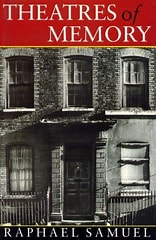
The work of Raphael Samuel and the importance of public history
The inaugural National Humanities Lecture took place at the University of London (School of Advanced Studies) on Tuesday evening.
Over 1,000 people attended in person and on-line to hear David OIusoga speak on the subject. It was streamed on YouTube so hopefully a recording will be made available.
Olusoga appropriately focused on history beyond the academic but also rooted in the best academic practices. He noted that family history was the most popular form of research outside of the academy but that history of particular houses, no doubt promoted by his own House in Time series, is also now popular as well.
He emphasised the importance of going into archives and looking at documents and records, the methods of the research historian, to open up these areas of history for individuals. His work on slavery and slave owners is a case in point but he also highlighted work in which he had played a part in identifying where soldiers of colour who had fought and died for Britain were actually buried. A subject which had more or less been ignored by the War Graves Commission until an historical focus was brought to it.
Olusoga also referenced the work of the late Raphael Samuel (1934-1996) in promoting public histories. His work with History Workshop and at Ruskin emphasised getting students to engage with history by looking at original sources and documents. Books like Theatres of Memory, which Olusoga referenced, take a much wider historical focus on the everyday than was traditionally the case in academic monographs.
As a convenor of the socialist history seminar at the Institute of Historical Research (University of London) I have been endeavouring to do a similar thing since 1995.
The seminar is based with one foot in the academy, and we expect academic rigour at seminars, but one foot in the wider socialist, labour and activist movement. The London Socialist Historians Group which provides the wider framework to the seminar, looks to focus on people who are active in the wider movement (as well as supporting the struggles of the UCU in the academy) because they are both our audience and also potential seminar paper givers.
It’s a different focus to the one David Olusoga brought to the subject on Monday but I’d argue an equally important one

View more by category: Uncategorized (14,123). .

