Articles

As the future of The Observer moves from the Guardian to Tortoise a reminder of a past glory. AJP Taylor on Peterloo (1969)

In Uncategorized on November 24, 2024 by kmflett

The edition of The Observer published on 20th April is the last under the ownership of the Guardian and the Scott Trust. On 22nd April it passes to the ownership of Tortoise. It’s a relatively small media company run by former Times Editor & BBC News Editor James Harding. The political fit looks decent, The Observer in the 60 or so years I’ve read it has always been more classically liberal and a little to the right of the Guardian (imo).

However Guardian and Observer journalists- NUJ members- were hardly engaged in the process and took days of strike action in early December 2024, which I supported and visited the Kings Cross picket lines. Quite how the Observer’s operations can be disentangled from the Guardian remains unclear.

Anyway a reminder of better days. A glorious and still relevant commentary from AJP Taylor from 55 years ago

One event which marked the 150th anniversary of Peterloo in 1969 was the  publication of a book by Robert Walmsley, Peterloo: the case reopened, which sought to play down the massacre and excuse the actions of the Magistrates and Yeomanry.

AJP Taylor reviewed it in The Observer and below are his concluding sentences:

The magistrates and the yeomanry were defending a corrupt system. The demonstrators were demanding their just rights even if they used sticks and stones as well as arguments. Henry Hunt spoke for the people of England and it is irrelevant that he also kept a mistress and ran a blacking business. When the defence of order leads to the killing of innocent people, the guilt always lies with the guardians of order. William Hulton* went home to an agreeable existence at Hulton Hall. John Lees died. I am on the side of John Lees. The sorrows of William Hulton wring no tears from me.

*Hulton was the Chair of the Magistrates who gave the order to send the Yeomanry in

Articles

25th St Catherine’s Day: a reinvented tradition

In Uncategorized on November 24, 2024 by kmflett

In the traditional calendar which features the kind of British history that those who go on about standing up for it have never heard of 25th November is St Catherine’s Day.

Its the counterpart to the more male focused St Clements Day on 23rd November

St Catherine was beheaded in 305AD but 25th November is mainly a secular holiday where observed. It is variously held to mark the beginning of winter (11th November St Martins Day) and/or the start of Advent (1st December) in the modern calendar.

Its associated with lacemakers- St Clements being blacksmiths focused- and with cattern cakes, a kind of spiced fruit bun. These have latterly been reinvented and become popular while fireworks to mark the day- the Catherine Wheel- are also a feature.

The drinking of alcohol is not specifically mentioned but no traditional feast day was complete without beer and wine

https://en.wikipedia.org/wiki/Saint_Catherine%27s_Day

Articles

On Petitions & their impact

In Uncategorized on November 24, 2024 by kmflett

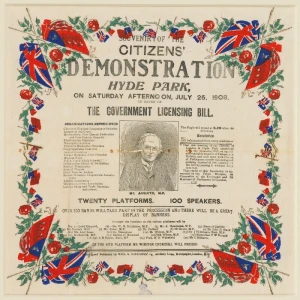
Demonstration in support of the 1908 Bill

On Petitions and their impact

A hard right TV channel and a social media outlet are promoting a petition demanding a new General Election. Apparently hundreds of thousands have signed. Many of course are bots or not UK based. Mr Melon Usk of Washington US and similar does not have a say in UK politics, officially anyway.

Why the petition has gathered publicity beyond bot promotion should concern not just Labour but also the Tories but I’ll post elsewhere on that.

How effective petitions are is debatable. Cynical political campaigners (not me obviously) will tell you that many people will sign a petition simply to get the person wielding it to go away, and would equally happily sign an opposing petition for the same reason. Letters and these days e-mails to MPs from named constituents have more impact. In fact papers in the National Archives indicate that Blair nearly wavered on introducing a hunting ban and that was one reason.

These days of course people can sign on-line but they do have to verify they have signed

The journal Past and Present published on-line an article covering new research into Parliamentary petitions in the Nineteenth Century.

The researchers analysed and where appropriate re-categorised all petitions to Parliament after the 1832 Reform Act through to changes in 1918 which allowed some women the vote for the first time.

They found that 30% of all petitions and all signatures on them in this period were from temperance or pro-drink campaigners.

The temperance campaigners were mainly religious, while pro-drink petitioners came from the licensed trade.

In 1908 when the pro-temperance Liberal Government brought forward a Bill to allow local vetoes on licensing laws 1.2 million signed petitions in favour. However 1.6 million people signed petitions calling on the State to remain neutral on such matters.

The Bill was passed in the Commons but defeated in (the unreformed) House of Lords.

*Petitions, Parliament, and Political Culture. Petitioning the House of Commons 1780-1918. Richard Huzzey & Henry Miller

Articles

The Ambridge Socialist: The earth is a common treasury for all

In Uncategorized on November 24, 2024 by kmflett

The Ambridge Socialist

24th November

The earth is a common treasury for all

The words of Gerrard Winstanley in 1649 but not featured in the Archers this week. However David Archer did opine that there is a ‘lot of anger about inheritance tax’, Leonard pointed out that the tax was needed to pay for the NHS. Archer shut up.

The Ambridge Socialist continues to believe the Grundys should inherit Ambridge

Hilda the Heroine of Ambridge

Hilda is still catching mice, not usually fully intact. There was a scare that Jakob had run her down and killed her this week. It wasn’t Hilda who continues to pursue the war of the wild

Farage in Ambridge

Farage appeared dressed as a farmer at the farming protest in London this week. It may be a preparation for an appearance in Ambridge where he could do some grifting over the EV charging station. He is of course an opponent of rewilding because that land could be owned by a millionaire like him

In other news

Henry’s new goat is a bit smelly

Mick’s charabang has been evicted from Grey Gables and is currently situated in the car park at the Bull. Despite Jolene and Kenton’s best efforts to get him to move in with Joy he’s staying put.

Justin has plans for Brad that involve Justin making money

Articles

Guardiola’s follicle crisis is having an impact on the pitch

In Uncategorized on November 24, 2024 by kmflett

Beard Liberation Front

24th November

Guardiola’s follicle crisis is having an impact on the pitch

The Beard Liberation Front, the informal network of beard wearers, has said that its inquiry into the follicle crisis of Manchester City manager Pep Guardiola is continuing

The team lost 4-0 to Spurs on Saturday, Guardiola’s fifth defeat in a row and the only occasion this has happened in his managerial career.

BLF experts are focusing on pictures and footage of Guardiola’s beard to try and analyse what the cause of his follicle crisis is.

Possibilities include:

lack of proper nourishment at the roots

Uneven hair growth meaning diminished Managerial Beard Power

Waning follicles which can distract a manager from the game

BLF Organiser Keith Flett said, while Guardiola’s follicle crisis appears to have developed over just a few weeks it may be that hairs have been splitting for a while undetected.

Articles

The cost of tradition: King wears satin breeches & a garter

In Uncategorized on November 23, 2024 by kmflett

On Tuesday19th November King Charles held a reception for those who have been appointed to the Order of the Garter. 1500 people from 130 countries showed up at Buckingham Palace and the bill was picked up out of public funds (the Taxpayers Alliance said nothing).

The Order of the Garter dates back to 1348 and in the modern era serves no obvious or useful purpose beyond that of the ceremonial. Tony Blair is a recent member though it was not reported if he attended on Tuesday.

Meanwhile King Charles wore the traditional black breeches and silk stockings he had eschewed at last year’s Coronation. He also wore around his left leg a garter inscribed with the words honit suit qui mal y pense which translates as ‘shame on he who thinks ill of it’ or in plain English, what you looking at mate.

The King also sported a pair of £3,500 opera pumps showing his commitment to sustainability as he had also worn them at the Coronation.

It was indeed a sort of Monty Pythonesque occasion updated to 2024 or possibly stuck in 1348

Articles

23rd November: St Clements Day another forgotten part of the traditional calendar

In Uncategorized on November 23, 2024 by kmflett

23rd November is St Clements Day in the traditional calendar. As usual you will not find GB News and the Telegraph those great upholders of British traditions celebrating.

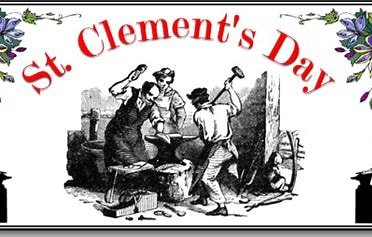
St Clement was the saint of blacksmiths and the focus of the day historically (primarily nineteenth century) are with that trade. However it was one of a (small number) of such events that fell between Halloween and Christmas. The next is the more significant St Catherine’s Day on 25th November.

As often St Clements Day was really about drinking and feasting and young workers (apprentices) collecting money for the better off for this purpose.

One traditional song on Old Clem’s night went “Cattern and Clemen, be here be here! Some of your apples and some of your beer!” Sometimes wine was substituted for beer..

Of course the relentless work routines of market capitalism has seen such traditions marginalised. That doesnt meant they arent worth remembering.

https://en.wikipedia.org/wiki/Saint_Clement%27s_Day

Articles

E P Thompson on the rule of law & class power

In Uncategorized on November 23, 2024 by kmflett

E P Thompson on the rule of law & class power

The late socialist historian E P Thompson wrote a book, Whigs and Hunters, about the State’s war with poachers in the eighteenth century. It was perhaps as much about common land, and the rights of the less well-off and the poor to use it, and how the law viewed this.

Thompson drew some general lessons about the law which he pursued in the 1980s. He argued that the law could not just be dismissed as a tool of the rich (although it was) but had to be engaged and argued with.

A key passage from Whigs and Hunters explains his view of the contradictions involved in this process.

We reach then, not a simple conclusion (law=class power) but a complex and contradictory one. On the one hand.. the law did mediate existent class relations to the advantage of the rulers; not only is this so, but as the century advanced the law became a superb instrument by which these rulers were able to impose new definitions of property to their even greater advantage.. On the other hand the law mediated these class relations through legal forms, which imposed again and again, inhibitions upon the actions of these rulers

Something to keep in mind when it comes to the decisions of the International Criminal Court and the US and UK Governments perhaps

Articles

CVs, manufactured outrage & the peculiarities of Starmerism

In Uncategorized on November 23, 2024 by kmflett

The largely manufactured outrage about Rachel Reeves tweaked CV seems to be continuing with a sanctimonious Editorial in the Times (23rd November).

I’m not sure there are many people who don’t tweak their CVs to fit a particular context but I’m no expert as I am definitely not looking for a job and haven’t had an up to date CV for a long time. I did produce a brief synopsis for Blue Sky (below) but anyone reading that would have no idea that I was an Assistant Executive Engineer (Telecoms). I haven’t done that job for a while (although I remain employed at the same grade…).

When it comes to Rachel Reeves the manufactured outrage is transparent because it never refers to actual examples where the Chancellor has been known to depart from fact based reality. Her 2023 book on women in economics contained passages which appeared to have been lifted from Wikipedia. She blamed researchers but a more basic point is that there is nothing wrong with quoting from Wiki provided it is footnoted (and understood that it shouldn’t be the only source used).

Of more long standing is Reeves inability to correct untruths she tells from time to time about Jeremy Corbyn. She is a long standing opponent of the former Labour leader but that doesn’t require untruths.

There is a certain logic of Starmerism here, where nothing too serious is happening, but there is a careless or disinterested lack of ability to understand that its better either to tell the truth or say nothing.

It might be argued that this is just modern politics and since Reeves critics come from a Tory Party whose most well known recent leader Boris Johnson was excluded from the Commons for knowingly lying it will probably fizzle out once the manufactured outrage mob find other issues

A partial Flett CV

Welcome to new followers. I’m UK based, Tottenham & Cardiff. I convene the socialist history seminar at the Institute of Historical Research & organise the Beard Liberation Front (unrelated). A member of the Campaign for Real Ale since 1975 & a union officer in tech. Cricket, Cheese, Cats, The Archers

Articles

Socialist History Seminar Mon Dec 2nd 5.30pm. Aidan Beatty. Gerry Healy & the WRP

In Uncategorized on November 23, 2024 by kmflett

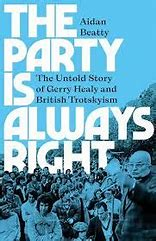
Monday 2nd December 5.30pm, Aidan Beatty. Gerry Healy & the WRP. Violence, Gender & the Perils of Trotskyism. On Zoom. Booking essential https://www.history.ac.uk/events/gerry-healy-and-wrp-violence-gender-and-perils-trotskyism

In October 1985, the Workers Revolutionary Party (WRP), a longstanding if notorious fixture on the British far-left, fractured in a very public split.  While disillusionment after the miners’ strike as well as fears over the party’s finances were the roots of this split, the immediate cause was a set of shocking revelations regarding the party’s leader, Gerry Healy, and his sexual abuse of female members.  Healy’s abusiveness has since come to dominate the memory of the WRP across the Left.  Drawing on archival research as well as extensive interviews with former members of the WRP, this paper seeks to tell both the general history of the WRP as well as recounting the long-standing patterns of sexual abuse and violence that existed within the organisation.  A standard refrain about the WRP, voiced both by many former members as well as hostile critics, is that it was a “cult”, with that term becoming a kind of shorthand for so many of the party’s excesses. While this certainly carries weight, “cult” is also too politically easy an assessment.  I instead argue that the WRP provides a cautionary tale about Leninism and the history of the party raises serious questions for the Left about party organisation, gender politics, and the need to put the “democratic” back into democratic socialism.

All seminars are free to attend. Registration required, details to follow. Organised by the Socialist HIstory Seminar at the Institute of Historical Research & the London Socialist Historians Group