The Beard Liberation Front, the informal network of beard wearers, has barred Robin Simcox, a Government advisor on extremism for bringing the hirsute into disrepute.
Mr Simcox has appeared in the media on regular occasions focused on his dislike of Palestinian demonstrations in London. His background is with the US Heritage Foundation which supports Donald Trump.
The campaigners say that the Beard Liberation Front is a broad based network comprising beard wearers and allies with a wide variety of attitudes and beliefs. However Mr Simcox appears to be intolerant of anyone whose political views he dislikes
BLF Organiser Keith Flett said, we bar very few people. For example while Tory MP Jonathan Gullis is sometimes barred from specific beard awards after incidents, he is not barred from supporting the BLF. Mr Simcox has gone too far and is giving beard wearers a bad name
In the first week of March both the London Evening Standard and the Telegraph ran front page headlines alleging that London is a ‘no go area for Jews’. Both were inspired by hard to far right sources determined to sow division and hate
While cases of anti-Semitic abuse are on the rise in London, as are cases of Islamophobic attacks, the headlines will have come as a surprise to the large and varied Jewish populations of Stamford Hill and Tottenham. I live in the latter area and wandering around as one does earlier the week people were going about their usual business quite unhindered.
The City of Cable St in 1936 that saw off a fascist march aimed at Jews and the Battle of Wood Green in 1977 that did the same 40 years on has a proud record of opposing hatred. That may explain why it has a London Mayor who is a Muslim, who of course is hated by the far right.
The London is anti-Jewish BS is of course aimed at Palestinian protests which invariably feature large Jewish contingents. It’s an inconvenient reality that most media just can’t handle.
It is however all a bit odd given that the same political hard right that is now peddling the London anti-Jewish line has spent the last few years going on about the North London Metropolitan Elite. Code for left-wing Jews and definitely anti-Semitic
David Olusoga wrote (Standard 3rd October 2023) that ‘the centrality of the capital has made it the postal child for resentment at England’s demographic and political power’. While that is undeniably true it’s not the whole picture.
London is also a working class city. It’s here we find of course the HQs of most trade unions and the Labour Party mirroring the power structure of capital. But it’s a city with an organised working class and a labour movement.
As Eric Hobsbawm wrote in his essay on Labour and the Great Cities (New Left Review 1/166) London became and remained a Labour stronghold after 1923 when it elected 20 per cent of the national total of Labour MPs’.
As a labour movement activist and socialist in London for almost 50 years now I’d also note that the London labour movement has echoed that of capital containing people from all over the UK who have come to work in London and indeed people from all over the world who have done likewise and are one of its great strengths.
In London the power of capital is faced by that of organised labour but tempered by the reality that just as the City has areas of great wealth it also has areas of very significant poverty. It’s important to capture all the dimensions here
Dr Keith Flett is a Convenor of the London Socialist Historians Group, born in North London and resident in Tottenham
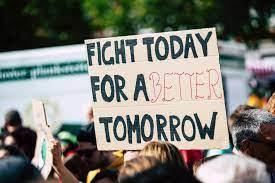
Chris Packham is right that protest outside MPs houses is a legitimate protest tactic, albeit in 2024 one would expect them to be peaceful in intent, if noisy in practice, and not very late at night.
The traditional practice known as rough music was often more robust and far from always progressive. It involved uproarious protests outside the houses of people who were thought to have trangressed a moral code or figures of authority believed to be corrupt.
Packham is right too in backing other forms of protest. He made it clear that while he understood the importance of direct action protests personally he kept to legal means, albeit as protest is increasinly criminalised this becomes more difficult.
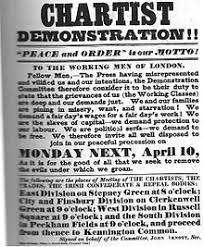
The historical sociologist Charles Tilly identified a repertoire of contention. It went from petitions and meetings to demonstrations, riots and armed revolt. The Chartists in the 1830s and 1840s tried all of them.
All might be legitimate depending on context and indeed what works, keeping in mind in that respect that there is no hierarchy that says you have to start with a petition and end with a revolution
Historians say time for files on State involvement in 1984/5 miner’s strike to be revealed
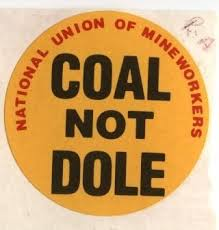
The London Socialist Historians Group who organise the socialist history seminar at the Institute of Historical Research in central London have said that with the 40th anniversary of the 1984/5 miner’s strike now upon us- strikes started in some pits from 5 and 6 March 1984- it is time for files on State involvement in the strike to be made public.
The historians say that the Public Record Office has released a considerable number of official files relating to the strike.
However there is certainly more detail to be discovered. An article in the Daily Mirror on 7th March by Conrad Landin and Ewan Gibbs reveals that Coal Board plans to shut pits leading to up to 70,000 job losses were deliberately delayed until after the 1983 General Election which the Tories won. These revelations come from Coal Board papers.
The Government decision to order an inquiry into some activities of undercover police spies [not related to the strike] suggests that much information remains outside of the public domain. However the very long running SpyCops Inquiry is some way from 1984/5, if it ever gets there.
At the time it was widely believed that soldiers appeared in police uniforms at some strike flash points. In addition there is little doubt that the State interfered in the internal activities of the National Union of Mineworkers.
It is already known that the previous NUM General Secretary Joe Gormley co-operated with the security services to highlight militant activity in the Union. Arthur Scargill was clearly from a very different mould but the focus of Government agents appears to have remained.
LSHG Convenor Dr Keith Flett, said The miner’s strike was a key event in modern British history. It is more than time that we had a full account of what the Government did around it, particularly with continuing concerns around the activities of State agents. We’d like to see all Government papers relating to the strike made available to historians with at least a summary fully in the public domain.
Wednesday 6th March was Budget Day. CAMRA and others had pushed for action to address the crisis in hospitality and in particular in this case pubs.
Chancellor Jeremy Hunt said he was backing pubs by freezing alcohol duty until February 2025 when it was due to rise by 3%.
Pubs are struggling with VAT (as Mr Spoon regularly reminds us supermarkets get a better deal) and business rates. Hunt did nothing.
The duty freeze benefits brewers, in particular Global Big Beer, and the large UK ‘regionals’ traditionally known as the Tory supporting Beerage. It will help their profits. It won’t mean cheaper beer in pubs.
Meanwhile a global brewer Asahi announced it was closing Meantime brewery in Greenwich and moving operations to Fullers in Chiswick. It had previously closed Dark Star in Sussex and moved brewing to Greenwich. Its what Big Beer does. Its focused on brands not the provenance of beer.
Asahi’s media statement was classic management speak (I’m an expert its part of my day job) but it may have hidden concerning news. It seems (not confirmed) that brewing staff at Meantime have been made redundant. Hmmm. Chiswick is not that far from Greenwich and jobs there would be considered suitable alternative employment under redundancy legislation. That is people should not be redundant if there is a suitable alternative in respect of location and skills.
In the UK World Book Day is on 6th March this year. Its focused on encouraging children and young people to read.
It seems odd in that context to suggest E P Thompson’s Making of the English Working Class. A history book of almost 1,000 pages.
Certainly for new readers its a book to dip into it. Thompson’s researches recount numerous instances and stories of working class life in the first half of the nineteenth century, often vignettes of events and incidents.
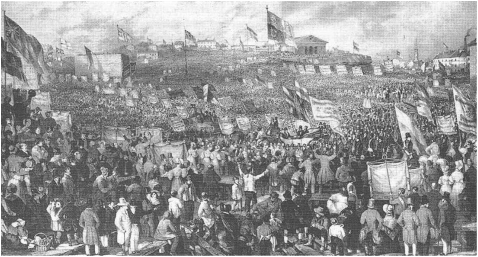
In the 1968 Postscript for the paperback edition he dealt with right-wing critics who claimed that he had exaggerated the numbers at protests. One particular instance he deals with is the 180,000 who may have attended a mass protest in 1833 in Birmingham protesting at the actions of the first Government elected after the 1832 Reform Act.
Thompson notes it was not just a demonstration but an event, accounting perhaps for the large numbers:
It was organised with a hustings set up with stands and scaffolding with contingents marching in behind horsemen. Thompson basing his account on local press reports (and the hostile Times) describes it as a cross between a festival and a fair ‘an excellent excuse for making holyday.. around the skirts of the meeting were refreshment booths, ginger-beer, table ale, oranges and biscuits’. Every account noted the vast number of women and children’
Surely an account that could engage a younger reader and perhaps set them thinking
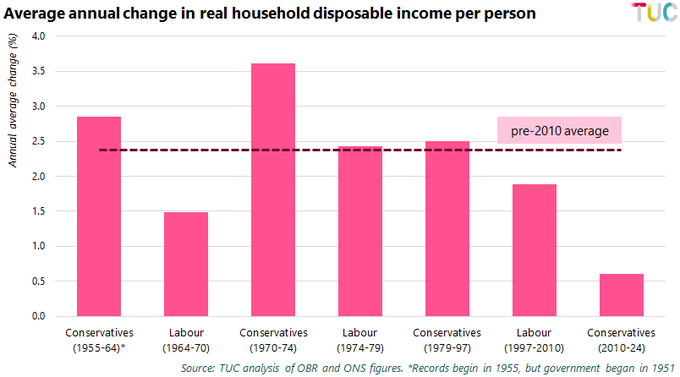
The chart above was posted on X by TUC Research Officer @Alex_Collinson. Beyond the bluster and Tory propaganda of the Budget it provides what nineteenth century radicals called really useful knowledge on the economy.
It underlines the huge impact that Tory austerity since 2010 has had on household disposable incomes. Rishi Sunak is the richest MP in Parliament but many millions are much worse off as a result of the Tory years.
It also perhaps suggests (but also perhaps too early to say) that while Brexits come and go the UK economy is in a period of significant decline. Again though it is those at the bottom of society who have felt the impact of this a lot more than those at the top.
You can find in the media details of a spat between Peter Mandelson and Wes Streeting about whether Keir Starmer is overweight or not. Given mass starvation in Gaza there are surely other matters.
Mandelson argues that image in politics matters while Streeting seems to be saying it doesnt matter if Starmer is a little overweight. If he is, and I have no specific insight, its probably due not to what he is eating but rather his love of real ale. It is one of the more endearing aspects of Starmer,mentioned in Tom Baldwin’s biography, but something he chooses not to make as much of as perhaps he might do.
Baldwin’s book also reveals Starmer’s Saturday night cooking for the family, where he uses lots of pots, takes a long time and infuriates his hungry kids. Its not Starmer’s cooking that is of interest here but his method. A lengthy time taken and in the end the kids have to eat what he produces
The Starmer paunch story has revealed something else broadly in this area. He has long been a vegetarian but now seems to be a pescatarian- fish eater. Why not? It is then revealed that out campaigning he was given a box while waiting for a train which contained chicken. He ate that too and reportedly enjoyed it. On that basis he now appears to be avoiding red meat,although perhaps we shouldnt be surprised if he is pictured leaving a North London McDonalds (something I have been falsely accused of in the past).
What Starmer eats is entirely up to him but having made a thing of being vegetarian and now retreating somewhat from it suggests either a man of pragmatism or a man who lacks principle. People will have differing views..
I have been engaged on (and more often distracted from) writing a review of Rob Sewell’s important new book on the history of Chartism- Chartist Revolution. The text below is not part of that review but some notes on the wider project of what a Chartist historiography might look like in 2024. Suffice to say the good news is that there are currently decent numbers working in this field
Defending the real legacy of Chartism
An Exceptionalism when it comes to the influence of Marxism here and in Europe
Practical involvement of Marx and Engels in movement
Bronterre O’Brien in 1848
John Saville on what kind of society Chartism would have built
Left & Chartist histories: Reg Groves, Andrew Rothstein
Ernest Jones, Harney & Marx & Engels
From around 1960 with the formation of the Society for the Study of Labour History, Chartism has been the subject of a considerable amount of historical research and publications.
While the movement lasted only from 1837 to around 1860 its scale and extent meant still means that there is a vast amount to research and a large amount of archival material to facilitate this. In recent times the weekly Chartist newspaper The Northern Star has been digitised and can be viewed and searched free on-line. Its closely packed pages in small print means that there is still a good deal to find out about Chartism. New research questions and issues can be posed and perhaps answered!
Academic studies have ranged across histories of the movement, that by the late Malcolm Chase reflecting the current state of the art, to specific subjects such as women and Chartism where the late Dorothy Thompson looked at the issues of sex and class in the movement.
The scope of studies of Chartism has increased and broadened since the 1960s and rightly questions of gender and ethnicity are central to this. Rob Sewell’s book is particularly good at placing the struggles of Irish democrats and socialists at the centre of the Chartist challenge in 1848. It doesn’t grapple quite so well with, for example, the role of black Chartists. To be fair this is an area which remains far too little researched.
However the trial of black Chartist William Cuffay is not discussed. The fact that Cuffay was the leader of London Chartism in 1848 and on the left of the movement warrants further thought.
The book does focus, and does well to do so, on some of the key moments of the Chartist challenge. The 1839 Newport Rising, the 1842 General Strike and events in the year of revolutions, 1848. In doing so it provides a very different picture of the British working class to the gradualist Labourist model that has appeared to dominate matters since the beginning of the twentieth century. It suggests that other possibilities and other roads could have been taken. A key issue there is why these were eventually not taken.
The problems of being first
Before 1889, the Chartist May Day in 1850
The Socialist Second International proclaimed the first May Day in 1889 and ever since then marches proclaiming socialism and internationalism have taken place around the world on May 1st.
The origins of May Day in Britain go back much further as a traditional festival marking the coming of Spring.
The first workers movement anywhere in the world, the Chartists while marking the traditional coming of Spring also on occasion prefigured the May Days of 1889 and after.
The Chartist Land Company had set up a series of land settlements- in effect small holdings in England- with people allocated to them by ballot. The idea was to opt out of industrial capitalism and return to the land. The Government refused to make the scheme legal and it had to be wound up.
One of the key Chartist Land Settlements was at O’Connorville on the outskirts of Rickmansworth. The Chartist dwellings still stand although these days they are luxury housing.
On 11th May 1850 the Chartist Northern Star paper published an account of the May Day celebrations that had taken place at O’Connorville on May 1st 1850
The O’Connorville band, improved in instrumentation and numbers made the day ‘echo with the sounds of joy’. In the afternoon the school room was filled with allottees, their wives and children ‘all beaming with ruddy health’. ‘Substantial justice’ was done to a tea of ‘old English fare’ after which there were speakers.
The first resolution praised the People’s Charter ‘may its speedy enactment emancipate the wealth producers’. Another resolution sent solidarity to ‘Louis Blanc, Kossuth, Mazzini and the democrats of all nations’
There followed merry dancing, songs and recitations that went on to the early hours.
There was a pub adjacent to the settlement, the Land of Liberty, Peace and Plenty, but alcohol was frowned upon
The Beard Liberation Front, the informal network of beard wearers, has expressed concern that clean -shaven Tory Chancellor Jeremy Hunt failed to take the chance to be innovative in the Spring statement and announce a luxury tax on shaving.
The campaigners say that while there has been a significant growth in beards, in reality they still represent a minority in the country compared to the clean shaven.
The BLF says that shaving is environmentally unfriendly and a Shaving Tax would do a good deal to address carbon reduction targets by reducing use of electric shavers and power used to make shaving products.
Those currently employed in the shaving industry can easily be re-deployed into the beard care area of the economy, a growing sector.
A Shaving Tax could be levied on all beard related products and would hit all those who did not have a beard. It would hit popular targets such as clean-shaven bankers in the City who would have to grow a beard or pay up.
BLF Organiser Keith Flett said, Jeremy Hunt remains resolutely clean shaven but he could boost his popularity and the Exchequer’s finances considerably by implementing an innovative Shaving Tax. We regret that yet again he has bearded the reasonable demand.